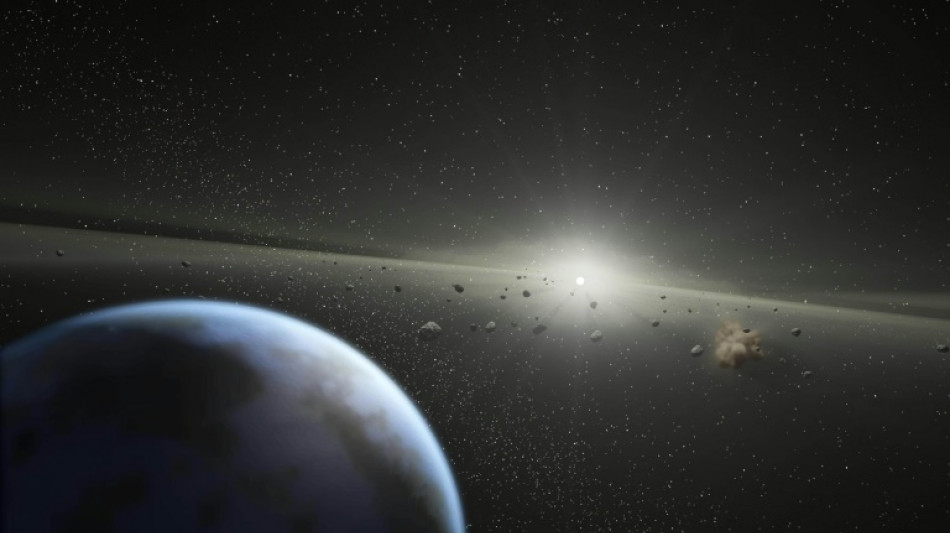
Where are all the aliens?: Fermi's Paradox explained / Photo: © NASA/AFP/File

 Hurricane Polo strengthens to top category 5 off Mexico

 11 hurt as teen opens fire outside school in western Turkey

 UN chief says 'Big Oil' treats atmosphere as open sewer

 Tunisia says 2026 summer hottest on record

 England's Rashid out of Sri Lanka ODIs with hand injury

 Houthis accuse Saudi Arabia of deadly strikes as thousands flee

 Stocks climb as oil slides, AI buzz returns

 India cricketers win in style as Afghan savours 'special' Games silver

 La Liga president hits out at Real Madrid refereeing 'conspiracy' claims

 MEXC Launches “Real Stocks, Real Friends” with Rewards for Bringing Friends to Wall Street

 Mbappe continues media push for Ballon d'Or recognition

 Stocks rise on AI buzz, oil prices cool

 India narrowly survive huge scare against minnows Japan

 Missing F-35 fighter parts 'not sensitive', says Australia minister

 Cambodia showcases scams crackdown with global conference

 Afghan cyclist who disguised herself as man wins Asian Games silver

 Typhoon Dujuan leaves four dead in Japan, 45,000 houses without power

 G7 leaders condemn Houthi strikes on Saudi Arabia

 Google data centre sparks protests in Austria

 Shin Ohashi: Junk food-loving teen and Japan's next big swimming hope

 Stocks rise on AI buzz, drop in oil prices

 China's robot dancers limber up for America's Got Talent final

 Despite military might, Saudi struggles to crush the Houthis

 Trump to tout deals, defend Iran war in UN speech

 Sri Lanka to issue verdict in landmark Easter attack trial

Astronomers raised hopes that humanity might not be alone in the universe by announcing on Thursday they have detected the most promising hints yet of life on a distant planet.
But given the age and vastness of the universe, a different question has long puzzled some scientists: why haven't we already come in contact with aliens?
"Where is everybody?" Enrico Fermi asked fellow famous physicists including Edward Teller over lunch in 1950.
This quandary was named Fermi's Paradox.
"It's a numbers game," Jason Wright, the director of the extraterrestrial intelligence centre at Pennsylvania State University, told AFP.
The Milky Way is around 10 billion years old and is home to more than 100 billion stars.
This suggests there is likely a mind-boggling number of potentially habitable planets in our home galaxy alone.
That could include K2-18b, where astronomers said Thursday they have detected signs of a chemical that is only produced by microbial life on Earth.
Wright said Fermi's Paradox essentially suggests that -- given enough time -- "every alien species will eventually have their own Elon Musk who will go out and settle the next star over".
That we have not yet heard from aliens is known as "the mystery of the great silence".
- So what are the theories? -
At least 75 speculative solutions to Fermi's Paradox have been proposed so far, according to a 2015 book, though Wright guessed more have been added since.
First, it is possible that humanity has not yet detected alien life because there isn't any -- we are truly alone.
Many scientists feel this is unlikely.
Some 87 percent of over 1,000 scientists in relevant fields surveyed in Nature Astronomy earlier this year agreed there is at least a basic form of extraterrestrial life.
More than 67 percent agreed that intelligent aliens are out there.
Of course, it is also possible that aliens are already here and we have not noticed -- or that it has been covered up.
Or interstellar space could just be too difficult to traverse, the distances too vast, the resources needed too great.
- What if there is a 'great filter'? -
Another theory is that there is some kind of "great filter" that prevents life -- or intelligent life -- from occurring in the first place.
Or perhaps there is some kind of barrier that stops civilisations from advancing beyond a certain point.
For example, once civilisations develop the technology to travel through space, they might tend to destroy themselves with something like nuclear weapons.
Or maybe they burn through their planet's natural resources, or make their climate unliveable.
Some of these theories seem to be influenced by fears for human civilisation -- the one example we have of intelligent life.
But Wright felt this was unlikely because any such barrier would have to be the same across the whole universe.
It would also have to make the species go totally extinct every time, otherwise they would eventually bounce back and try again at space travel.
- Are we in a zoo or planetarium? -
There are even more galaxy-brained ideas.
Under the "zoo" hypothesis, technologically advanced aliens would be leaving humans alone to observe us from afar, like animals in a zoo.
The "planetarium" hypothesis posits that aliens could be creating an illusion that makes space seem empty to us, keeping us in the dark.
- ...or a 'dark forest'? -
This theory got its name from the second book in Chinese author Cixin Liu's science-fiction series "The Three-Body Problem".
It posits that the universe is a "dark forest" in which no one wants to reveal their presence lest they be destroyed by others.
There are other hypotheses that aliens prefer to "transcend" to another plane of existence -- which some have compared to virtual reality -- so don't bother with interstellar travel.
- Why would they all be the same? -
But there is a big problem with many of these "so-called solutions," Wright said.
They tend to assume that all the hypothetical kinds of aliens across the universe would all behave in the same way -- forever.
This has been dubbed the "monocultural fallacy".
Wright, who has used SETI telescopes to search for radio signals or lasers from the stars, also pushed back against the idea that humanity would necessarily have already picked up on any alien signal.
Aliens could be sending out messages using all sorts of unknown technology, so maybe the galaxy is not as silent as we think, he said.
"Those of us looking for life in the universe generally don't think of the Fermi paradox or the great silence as such a big problem."
B.Shevchenko--BTB