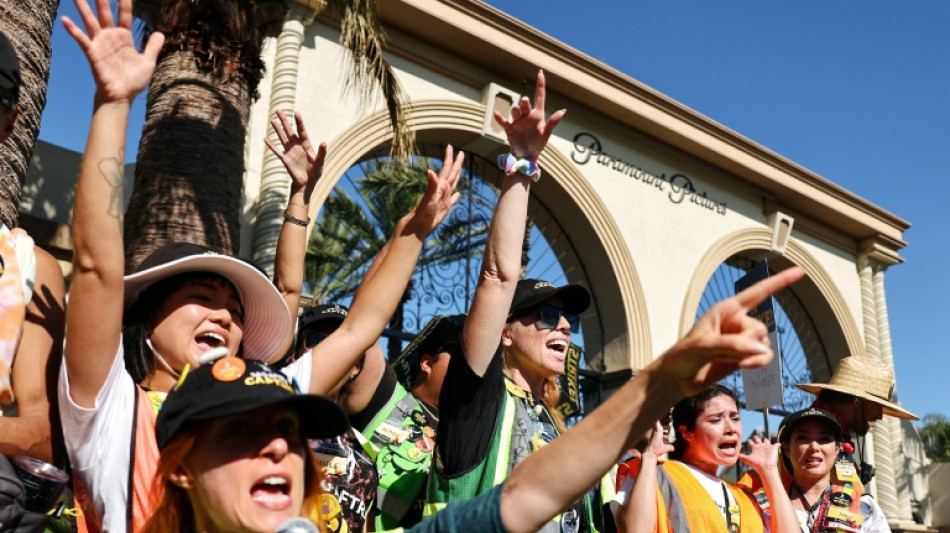
US labor unions fight to contain AI disruption / Photo: © GETTY IMAGES NORTH AMERICA/AFP/File

 Republican senator seeks probe of Trump Jr Russian-funded wedding

 Memoir by Diana's brother goes on sale after rocking UK monarchy

 Newcomers South Korea face holders Italy in Davis Cup finals

 Japan's Kojima sounds Marchand warning with Asian Games gold

 England rugby star Pollock signs new Northampton deal

 STARTRADER Expands Its Chinese Equity CFD Range with CXMT and Unitree Robotics

 MEXC Expands Opportunity Compass with Stock Trading Handbook to Help Crypto Users Build Investment Knowledge

 England paceman Wood retires from international cricket

 Magnificent Mandhana's 79 helps India to Asian Games cricket gold

 Marchand 'stressed' about racing Japanese rivals at LA Olympics

 Mobile boat clinics bring healthcare to India's remote islands
 Former India paceman Zaheer Khan named Chennai coach in IPL

 Six-year-old Chinese girl sets world record with Rubik's Cube

 Swimming prodigy Yu, 13, says 'interviews way harder than racing'

 Star coaches make their bows as Nations League returns
 Rams bounce back as Giants reel from Dart injury

 In Bangladesh, Pakistan's Jinnah photo stirs anger

 Two New Zealand naval ships transit Taiwan Strait

 Zidane gets down to work as France start new era

 Inside the Venezuelan prison meant to 'drive you insane'

 UK king braces as memoir by Diana's brother goes on sale

 Akkodis and Hamburg Public Transport Association Showcase hvv mia at InnoTrans 2026, Demonstrating the Future of AI-Powered Mobility
 No green light to lift EU sanctions on Russian oligarchs, talks to resume

 UK agrees support for Saudi in struggle with Houthis: reports

 EU foreign policy chief calls for continued sanctions on Russia

As artificial intelligence threatens to upend entire sectors of the economy, American labor unions are scrambling to protect workers, demand corporate transparency, and rally political support—an uphill battle in a rapidly changing world.
"As laborers, the ability to withhold our labor is one of our only tools to improve our lives," explained Aaron Novik, a key organizer with Amazon's ALU union.
"What happens when that disappears (to AI)? It's a real existential issue," he added.
Automation has already transformed most industries since the 1960s, typically reducing workforce numbers in the process.
But the emergence of advanced "physical AI" promises a new generation of intelligent robots that won't be limited to repetitive tasks -- potentially displacing far more blue-collar workers than ever before.
The threat extends beyond manufacturing.
The CEO of Anthropic, which created Claude as a competitor to ChatGPT, warned last week that generative AI could eliminate half of all low-skilled white-collar jobs, potentially driving unemployment rates up to 10-20 percent.
"The potential displacement of workers and elimination of jobs is a significant concern not just for our members, but for the public in general," said Peter Finn of the International Brotherhood of Teamsters, America's largest union.
- Vetoes -
The Teamsters have focused their efforts on passing legislation limiting the spread of automation, but face significant political obstacles.
California's governor has twice vetoed bills that would ban autonomous trucks from public roads, despite intense lobbying from the state's hundreds of thousands of union members.
Colorado's governor followed suit last week, and similar battles are playing out in Indiana, Maryland, and other states.
At the federal level, the landscape shifted dramatically with the change in the White House.
Under former president Joe Biden, the Department of Labor issued guidelines encouraging companies to be transparent about AI use, involve workers in strategic decisions, and support employees whose jobs face elimination.
But US President Donald Trump canceled the protections within hours of taking office in January.
"Now it's clear. They want to fully open up AI without the safeguards that are necessary to ensure workers' rights and protections at work," said HeeWon Brindle-Khym of the Retail, Wholesale and Department Store Union (RWDSU), which represents workers in the retail sector.
- Rush to AI -
Meanwhile, companies are racing to implement AI technologies, often with poor results.
"By fear of missing out on innovations, there's been a real push (to release AI products)," observed Dan Reynolds of the Communications Workers of America (CWA).
The CWA has taken a proactive approach, publishing a comprehensive guide for members that urges negotiators to include AI provisions in all collective bargaining agreements.
The union is also developing educational toolkits to help workers understand and negotiate around AI implementation.
A handful of unions have successfully negotiated AI protections into their contracts.
Notable examples include agreements with media company Ziff Davis (which owns Mashable) and video game publisher ZeniMax Studios, a Microsoft subsidiary.
The most significant victories belong to two powerful unions: the International Longshoremen's Association, representing dock workers, secured a moratorium on full automation of certain port operations, while the Screen Actors Guild (SAG-AFTRA) won guarantees that actors must be consulted and compensated whenever their AI likeness is created.
These successes remain exceptional, however.
The American labor movement, as a whole, lacks the bargaining power enjoyed by those highly strategic or publicly visible sectors, said Brindle-Khym.
"Smaller contract-by-contract improvements are a long, slow process," she added.
Despite frequent accusations by corporate interests, the unions' goal isn't to halt technological progress entirely.
"Workers are usually not seeking to stop the march of technology," noted Virginia Doellgast, a Cornell University professor specializing in labor relations.
"They just want to have some control."
As AI continues its rapid advance, the question remains whether unions can adapt quickly enough to protect workers in an economy increasingly dominated by artificial intelligence.
L.Janezki--BTB