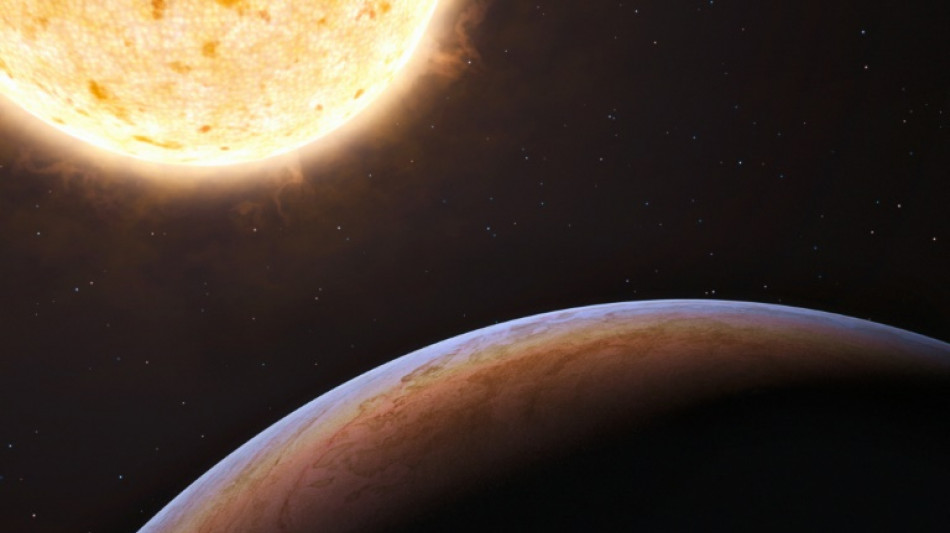
Huge planet discovered orbiting tiny star puzzles scientists / Photo: © ESO/AFP/File

 Republican senator seeks probe of Trump Jr Russian-funded wedding

 Memoir by Diana's brother goes on sale after rocking UK monarchy

 Newcomers South Korea face holders Italy in Davis Cup finals

 Japan's Kojima sounds Marchand warning with Asian Games gold

 England rugby star Pollock signs new Northampton deal

 STARTRADER Expands Its Chinese Equity CFD Range with CXMT and Unitree Robotics

 MEXC Expands Opportunity Compass with Stock Trading Handbook to Help Crypto Users Build Investment Knowledge

 England paceman Wood retires from international cricket

 Magnificent Mandhana's 79 helps India to Asian Games cricket gold

 Marchand 'stressed' about racing Japanese rivals at LA Olympics

 Mobile boat clinics bring healthcare to India's remote islands

 Former India paceman Zaheer Khan named Chennai coach in IPL

 Six-year-old Chinese girl sets world record with Rubik's Cube

 Swimming prodigy Yu, 13, says 'interviews way harder than racing'

 Star coaches make their bows as Nations League returns

 Rams bounce back as Giants reel from Dart injury

 In Bangladesh, Pakistan's Jinnah photo stirs anger

 Two New Zealand naval ships transit Taiwan Strait

 Zidane gets down to work as France start new era

 Inside the Venezuelan prison meant to 'drive you insane'

 UK king braces as memoir by Diana's brother goes on sale

 Akkodis and Hamburg Public Transport Association Showcase hvv mia at InnoTrans 2026, Demonstrating the Future of AI-Powered Mobility

 No green light to lift EU sanctions on Russian oligarchs, talks to resume

 UK agrees support for Saudi in struggle with Houthis: reports

 EU foreign policy chief calls for continued sanctions on Russia

Astronomers announced Wednesday they have discovered a massive planet orbiting a tiny star, a bizarre pairing that has stumped scientists.
Most of the stars across the Milky Way are small red dwarfs like TOI-6894, which has only 20 percent the mass of our Sun.
It had not been thought possible that such puny, weak stars could provide the conditions needed to form and host huge planets.
But an international team of astronomers have detected the unmistakable signature of a gas giant planet orbiting the undersized TOI-6894, according to a study in the journal Nature Astronomy.
This makes the star the smallest star yet known to host a gas giant.
The planet has a slightly larger radius than Saturn, but only half its mass. It orbits its star in a little over three days.
The astronomers discovered the planet when searching through more than 91,000 low-mass red dwarfs observed by NASA's TESS space telescope.
Its existence was then confirmed by ground-based telescopes, including Chile's Very Large Telescope.
"The fact that this star hosts a giant planet has big implications for the total number of giant planets we estimate exist in our galaxy," study co-author Daniel Bayliss of the UK's Warwick University said in a statement.
Another co-author, Vincent Van Eylen, of University College London, said it was an "intriguing discovery".
"We don't really understand how a star with so little mass can form such a massive planet!" he said.
"This is one of the goals of the search for more exoplanets. By finding planetary systems different from our solar system, we can test our models and better understand how our own solar system formed."
- How do you make a planet? -
The most prominent theory for how planets form is called core accretion.
The process begins when a ring of gas and dust -- called a protoplanetary disc -- which surrounds a newly formed star builds up into a planetary core. This core attracts more gas that forms an atmosphere, eventually snowballing into a gas giant.
Under this theory, it is difficult for low-mass stars to host giant planets because there is not enough gas and dust to begin building a core in the first place.
A rival theory proposes that these planets instead form when their protoplanetary disc becomes gravitationally unstable and breaks up, with the collapsing gas and dust forming a planet.
However neither theory seems to explain the existence of the newly discovered planet, TOI-6894b, the researchers said.
The planet also interests scientists because it is strangely cold.
Most of the gas giants discovered outside our Solar System so far have been what are known as "hot Jupiters", where temperatures soar well over 1,000 degrees Celsius.
But the newly discovered planet appears to be under 150C, the researchers said.
"Temperatures are low enough that atmospheric observations could even show us ammonia, which would be the first time it is found in an exoplanet atmosphere," said study co-author Amaury Triaud of Birmingham University.
The James Webb space telescope is scheduled to turn its powerful gaze towards the planet in the next year, which could help uncover some more mysteries of this strange planet.
R.Adler--BTB