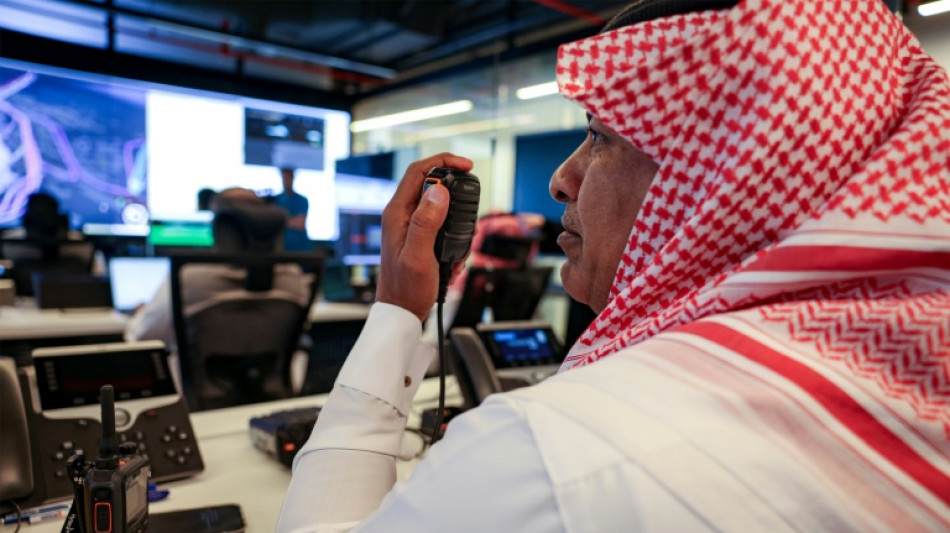
Saudis use AI, drones and thousands of cameras to keep hajj pilgrims safe / Photo: © AFP

 Republican senator seeks probe of Trump Jr Russian-funded wedding
 Memoir by Diana's brother goes on sale after rocking UK monarchy
 Newcomers South Korea face holders Italy in Davis Cup finals

 Japan's Kojima sounds Marchand warning with Asian Games gold
 England rugby star Pollock signs new Northampton deal

 STARTRADER Expands Its Chinese Equity CFD Range with CXMT and Unitree Robotics

 MEXC Expands Opportunity Compass with Stock Trading Handbook to Help Crypto Users Build Investment Knowledge

 England paceman Wood retires from international cricket

 Magnificent Mandhana's 79 helps India to Asian Games cricket gold
 Marchand 'stressed' about racing Japanese rivals at LA Olympics
 Mobile boat clinics bring healthcare to India's remote islands
 Former India paceman Zaheer Khan named Chennai coach in IPL

 Six-year-old Chinese girl sets world record with Rubik's Cube
 Swimming prodigy Yu, 13, says 'interviews way harder than racing'
 Star coaches make their bows as Nations League returns
 Rams bounce back as Giants reel from Dart injury

 In Bangladesh, Pakistan's Jinnah photo stirs anger

 Two New Zealand naval ships transit Taiwan Strait

 Zidane gets down to work as France start new era

 Inside the Venezuelan prison meant to 'drive you insane'

 UK king braces as memoir by Diana's brother goes on sale

 Akkodis and Hamburg Public Transport Association Showcase hvv mia at InnoTrans 2026, Demonstrating the Future of AI-Powered Mobility
 No green light to lift EU sanctions on Russian oligarchs, talks to resume

 UK agrees support for Saudi in struggle with Houthis: reports

 EU foreign policy chief calls for continued sanctions on Russia

Working day and night in front of maps, screens and seemingly endless data, Saudi officials have harnessed artificial intelligence to help manage the million-strong sea of pilgrims during the hajj.
The technology has proven pivotal to track the overwhelming amount of footage from more than 15,000 cameras in and around the holy city of Mecca.
The systems are tuned to spot abnormal crowd movements or predict bottlenecks in foot traffic -- a potential life-saver at a packed event with a history of deadly stampedes.
Software is also used to help guide more than 20,000 buses deployed to transport pilgrims between holy sites during one of the world's biggest annual religious gatherings.
It is all part of the tech arsenal that Saudi Arabia is deploying as 1.4 million faithful from across the globe descend on Mecca and its surrounds.
"In our traffic control room, we use specialised cameras that have AI layers to analyse movements, crowded areas" and predict behaviours, said Mohamed Nazier, chief executive officer for the General Transport Centre at the Royal Commission for Mecca.
The centre has a main control room in Mecca filled with screens and maps, where staff use high-tech tools including AI for round-the-clock monitoring.
About a dozen staff members sit in rows before desktop computers with a large display at the front, zooming in on crowd movements around the holy sites.
On hillsides nearby, cameras that resemble little white robots film buildings, roads and pathways along the hajj route, which winds more than 20 kilometres (12 miles) between Mecca and Mount Arafat.
Nazier said the constant monitoring is aimed at averting traffic collisions with pedestrians on crowded routes while also making sure there are buses available to minimise walking time in the desert heat.
- 'Our eye on the ground' -
It is a decade since the hajj suffered its worst disaster, a stampede that killed up to 2,300 people during the "stoning of the devil" ritual.
Hundreds also died in stampedes in 2006, 1998 and 1994.
In 1990, 1,426 pilgrims were trampled to death or asphyxiated when a tunnel ventilation system failed.
With its cutting-edge technology, "the control room is our eye on the ground," said Mohammed al-Qarni, who oversees the hajj and the year-round umrah pilgrimage at the transport centre.
Artificial intelligence helps to determine "the flow on the (roads to the holy sites), and detects emergency situations even before they occur", he told AFP, adding that the technology can help assess the number of people in a single place.
Cameras and AI can estimate if a site has reached maximum capacity, allowing authorities to divert the flow of pilgrims, Qarni said.
During the holy month of Ramadan this year, the system spotted when the Grand Mosque had reached full capacity.
"The flow to the Haram (Grand Mosque) was stopped and the process controlled," he said.
- Thermal imaging -
The use of advanced technology extends beyond logistics, also tracking unregistered pilgrims, who accounted for most of the 1,301 deaths in sweltering conditions last year.
As temperatures soared to 51.8 degrees Celsius (125.2 Fahrenheit) last year, unauthorised worshippers who lack access to air-conditioned tents and buses bore the brunt. Temperatures are forecast to top 40C this week.
The hajj, one of the five pillars of Islam, must be completed by all Muslims with the means at least once.
Yet not everyone is able to secure or afford one of the official permits, which are allocated to countries by quota and awarded to individuals by lottery.
To try to stop anyone sneaking in this year, a fleet of camera-equipped drones is monitoring entrances into Mecca.
"We use artificial intelligence and other tools like drones and thermal imaging cameras," the director general of public security, Lieutenant General Mohammed bin Abdullah Al-Bassami, told reporters.
Meanwhile, the Saudi Special Forces for Roads Security said it was using "smart thermal imaging" to monitor the perimeter of Mecca and the holy sites.
A.Gasser--BTB