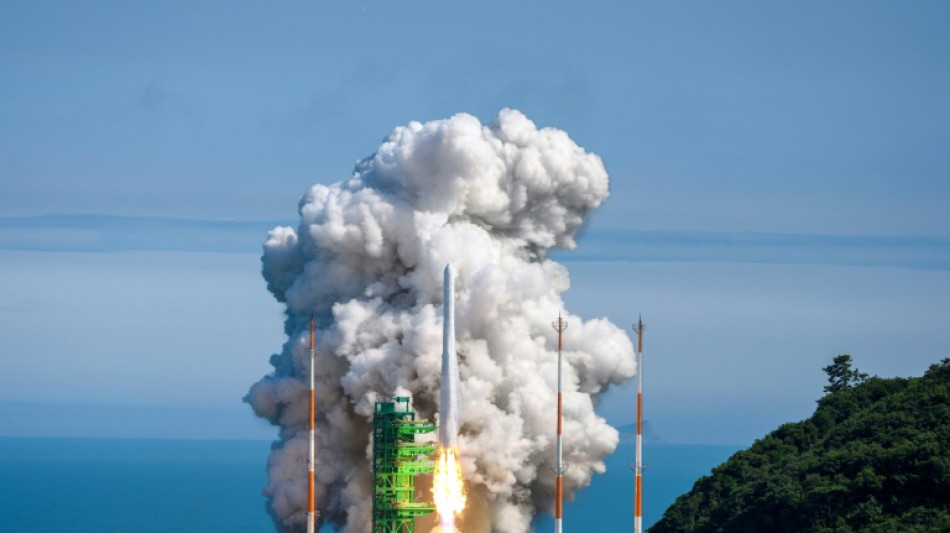
South Korea space rocket launch puts satellites in orbit / Photo: © YONHAP/AFP

 US warns of rapid escalation in Mideast war

 Iran 'put hearts on the court' to win Asian Games basketball bronze

 School girl Yu helps China dominate in Asian Games swimming openers

 Myanmar win first Asian Games teqball gold as Spain great Puyol watches

 China's 13-year-old Yu scorches to first major gold at Asian Games

 Russians vote on last day of parliamentary elections

 Hong Kong pays final respects to former city leader Tung

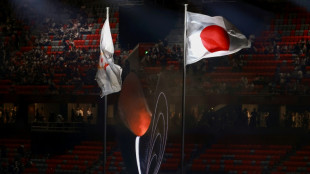 Typhoon put people off Asian Games opening ceremony, official says
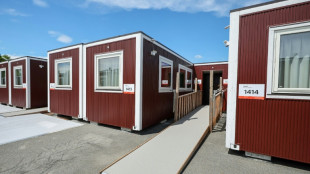
 China's 13-year-old Yu cruises as Asian Games swimming begins

 AI 'warning shots' focus Beijing on national security risks
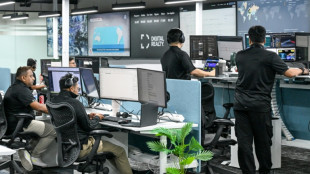
 Philippine tribe in limbo over US-led tech hub

 Leo XIV, first US pope transcends his restrained style

 Singer Ed Sheeran says Gaza situation 'unjustifiable' following controversy

 In 'Tenzing', a Sherpa mountaineer gets his due

 Ed Sheeran set to return to stage after Palestinian controversy

 Toulouse edge Vannes, Lyon beat Pau to take Top 14 summit

 Germans arrested for Louvre stunt in Mona Lisa hall

 Saudi-led coalition says Houthis fired ballistic missile at Riyadh

 France's debt climbs to highest since 1978: ministry

 McIlroy two shots off the lead at Wentworth after eagle on 18

 Martinez brace saves Inter in Serie A top-two clash with Roma

 Rosenior abused but guides Paris FC past old club Strasbourg

 Seven-try Lyon beat Pau, climb to Top 14 summit

 Brighton defeat a 'big lesson' against complacency for Arsenal, says Arteta

 Thousands protest inaction over climate crisis in Switzerland

South Korea said Tuesday it had successfully launched its homegrown space rocket and placed a payload into orbit in a "giant leap" for the country's quest to become an advanced space-faring nation.
The Korea Satellite Launch Vehicle II, nicknamed Nuri and emblazoned with the South Korean flag, lifted off at 4:00pm (0700 GMT) from the launch site in Goheung on the southern coast, trailing a column of flame.
All three stages of the rocket worked, taking it to its target altitude of 700 kilometres (430 miles), and it successfully separated a performance verification satellite and put it into orbit, Seoul said.
South Korea's space program "has taken a giant leap forward," said Lee Jong-ho, minister of science and technology, adding he declared the mission a success.
"South Korea has now become the seventh nation in the world to launch a space vehicle with homegrown technology," he said, adding the government would continue its quest to become "an advanced space-faring nation".
South Korea will launch a Moon orbiter in August, Lee added.
The Tuesday test, South Korea's second test launch of its homegrown space rocket, comes eight months after the first test failed to put a dummy satellite into orbit.
In the first test last October, all three stages of the rocket worked with the vehicle reaching an altitude of 700 kilometres, and the 1.5-tonne payload separating successfully.
But it failed to put a dummy satellite into orbit after the third-stage engine stopped burning earlier than scheduled.
In Tuesday's test, in addition to a dummy satellite, Nuri carried a rocket performance verification satellite and four cube satellites developed by four local universities for research purposes.
The three-stage Nuri rocket has been a decade in development at a cost of 2 trillion won ($1.5 billion).
It weighs 200 tonnes and is 47.2 metres (155 feet) long, fitted with a total of six liquid-fuelled engines.
In Asia, China, Japan and India all have advanced space programmes, and the South's nuclear-armed neighbour North Korea was the most recent entrant to the club of countries with their own satellite launch capability.
- Lunar ambitions -
Ballistic missiles and space rockets use similar technology and Pyongyang put a 300-kilogram (660-pound) satellite into orbit in 2012 in what Washington condemned as a disguised missile test.
South Korea becomes the seventh nation -- not including North Korea -- to have successfully launched a one-tonne payload on their own rockets.
The South Korean space programme has a mixed record -- its first two launches in 2009 and 2010, which in part used Russian technology, both ended in failure.
The second one exploded two minutes into the flight, with Seoul and Moscow blaming each other.
Eventually a 2013 launch succeeded, but still relied on a Russian-developed engine for its first stage.
"The fact that we now have our own space rocket means we will be able to test and verify technologies needed for space exploration projects down the road," Bang Hyo-choong, professor of aerospace engineering at KAIST, told the Yonhap News Agency.
The satellite launch business is increasingly the preserve of private companies, notably Elon Musk's SpaceX, whose clients include the US space agency NASA and the South Korean military.
The Tuesday test looks set to bring South Korea closer to achieving its space ambitions, including a plan to land a probe on the Moon by 2030.
South Korea plans to conduct four more such test launches by 2027.
J.Fankhauser--BTB