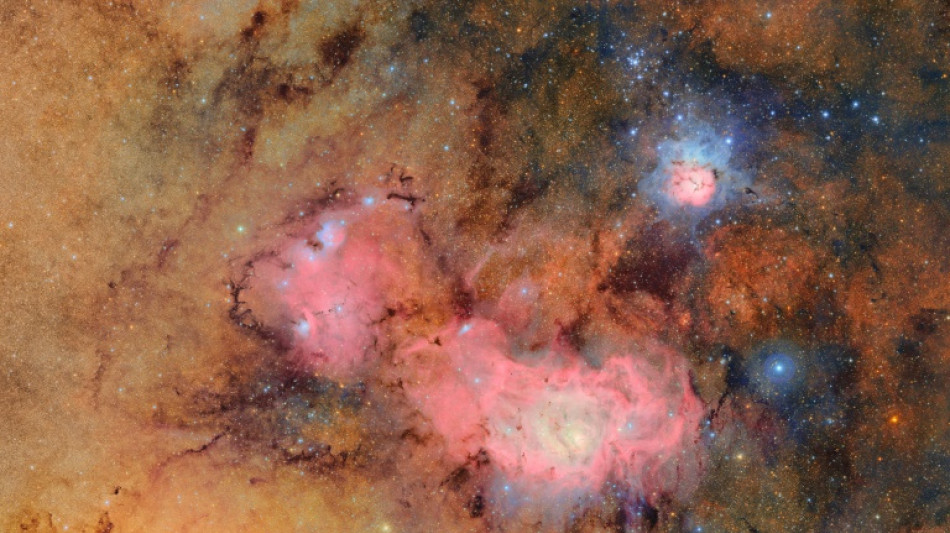
Groundbreaking Vera Rubin Observatory reveals first images / Photo: © NSF-DOE Vera C. Rubin Observatory/AFP

 Newcomers South Korea face holders Italy in Davis Cup finals

 Japan's Kojima sounds Marchand warning with Asian Games gold

 England rugby star Pollock signs new Northampton deal

 STARTRADER Expands Its Chinese Equity CFD Range with CXMT and Unitree Robotics

 MEXC Expands Opportunity Compass with Stock Trading Handbook to Help Crypto Users Build Investment Knowledge

 England paceman Wood retires from international cricket

 Magnificent Mandhana's 79 helps India to Asian Games cricket gold

 Marchand 'stressed' about racing Japanese rivals at LA Olympics

 Mobile boat clinics bring healthcare to India's remote islands

 Former India paceman Zaheer Khan named Chennai coach in IPL

 Six-year-old Chinese girl sets world record with Rubik's Cube

 Swimming prodigy Yu, 13, says 'interviews way harder than racing'

 Star coaches make their bows as Nations League returns

 Rams bounce back as Giants reel from Dart injury

 In Bangladesh, Pakistan's Jinnah photo stirs anger

 Two New Zealand naval ships transit Taiwan Strait

 Zidane gets down to work as France start new era

 Inside the Venezuelan prison meant to 'drive you insane'

 UK king braces as memoir by Diana's brother goes on sale

 Akkodis and Hamburg Public Transport Association Showcase hvv mia at InnoTrans 2026, Demonstrating the Future of AI-Powered Mobility

 Macron says talks with Trump on Red Sea, Ukraine 'constructive'

 Green policies just good politics, says UK minister

 Bardot auction in Paris fetches nearly one million euros

 No timeline on Daniels injury return, says Commanders coach

 British Columbia sues OpenAI in US court over Canada school shooting

The team behind the long-awaited Vera Rubin Observatory in Chile published their first images on Monday, revealing breathtaking views of star-forming regions as well as distant galaxies.
More than two decades in the making, the giant US-funded telescope sits perched at the summit of Cerro Pachon in central Chile, where dark skies and dry air provide ideal conditions for observing the cosmos.
One of the debut images is a composite of 678 exposures taken over just seven hours, capturing the Trifid Nebula and the Lagoon Nebula -- both several thousand light-years from Earth -- glowing in vivid pinks against orange-red backdrops.
The image reveals these stellar nurseries within our Milky Way in unprecedented detail, with previously faint or invisible features now clearly visible.
Another image offers a sweeping view of the Virgo Cluster of galaxies.
The team also released a video dubbed the "cosmic treasure chest," which begins with a close-up of two galaxies before zooming out to reveal approximately 10 million more.
"The Rubin Observatory is an investment in our future, which will lay down a cornerstone of knowledge today on which our children will proudly build tomorrow," said Michael Kratsios, director of the White House Office of Science and Technology Policy.
Equipped with an advanced 8.4-meter telescope and the largest digital camera ever built, the Rubin Observatory is supported by a powerful data-processing system.
Later this year, it will begin its flagship project, the Legacy Survey of Space and Time (LSST). Over the next decade, it will scan the night sky nightly, capturing even the subtlest visible changes with unmatched precision.
The observatory is named after pioneering American astronomer Vera C. Rubin, whose research provided the first conclusive evidence for the existence of dark matter -- a mysterious substance that does not emit light but exerts gravitational influence on galaxies.
Dark energy refers to the equally mysterious and immensely powerful force believed to be driving the accelerating expansion of the universe. Together, dark matter and dark energy are thought to make up 95 percent of the cosmos, yet their true nature remains unknown.
The observatory, a joint initiative of the US National Science Foundation and Department of Energy, has also been hailed as one of the most powerful tools ever built for tracking asteroids.
In just 10 hours of observations, the Rubin Observatory discovered 2,104 previously undetected asteroids in our solar system, including seven near-Earth objects -- all of which pose no threat.
For comparison, all other ground- and space-based observatories combined discover about 20,000 new asteroids per year.
Rubin is also set to be the most effective observatory at spotting interstellar objects passing through the solar system.
More images from the observatory are expected to be released later Monday morning.
C.Meier--BTB