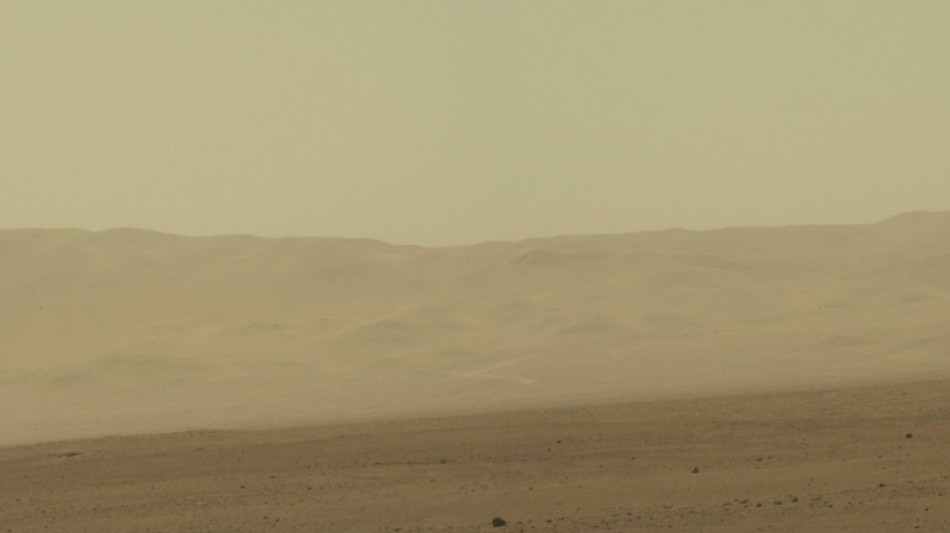
Why is there no life on Mars? Rover finds a clue / Photo: © GETTY IMAGES NORTH AMERICA/AFP/File

 Newcomers South Korea face holders Italy in Davis Cup finals

 Japan's Kojima sounds Marchand warning with Asian Games gold

 England rugby star Pollock signs new Northampton deal

 STARTRADER Expands Its Chinese Equity CFD Range with CXMT and Unitree Robotics

 MEXC Expands Opportunity Compass with Stock Trading Handbook to Help Crypto Users Build Investment Knowledge

 England paceman Wood retires from international cricket

 Magnificent Mandhana's 79 helps India to Asian Games cricket gold

 Marchand 'stressed' about racing Japanese rivals at LA Olympics

 Mobile boat clinics bring healthcare to India's remote islands

 Former India paceman Zaheer Khan named Chennai coach in IPL

 Six-year-old Chinese girl sets world record with Rubik's Cube

 Swimming prodigy Yu, 13, says 'interviews way harder than racing'

 Star coaches make their bows as Nations League returns

 Rams bounce back as Giants reel from Dart injury

 In Bangladesh, Pakistan's Jinnah photo stirs anger

 Two New Zealand naval ships transit Taiwan Strait

 Zidane gets down to work as France start new era

 Inside the Venezuelan prison meant to 'drive you insane'

 UK king braces as memoir by Diana's brother goes on sale

 Akkodis and Hamburg Public Transport Association Showcase hvv mia at InnoTrans 2026, Demonstrating the Future of AI-Powered Mobility

 Macron says talks with Trump on Red Sea, Ukraine 'constructive'

 Green policies just good politics, says UK minister

 Bardot auction in Paris fetches nearly one million euros

 No timeline on Daniels injury return, says Commanders coach

 British Columbia sues OpenAI in US court over Canada school shooting

Why is Mars barren and uninhabitable, while life has always thrived here on our relatively similar planet Earth?
A discovery made by a NASA rover has offered a clue for this mystery, new research said Wednesday, suggesting that while rivers once sporadically flowed on Mars, it was doomed to mostly be a desert planet.
Mars is thought to currently have all the necessary ingredients for life except for perhaps the most important one: liquid water.
However the red surface is carved out by ancient rivers and lakes, showing that water once flowed on our nearest neighbour.
There are currently several rovers searching Mars for signs of life that could have existed back in those more habitable times, millions of years ago.
Earlier this year, NASA's Curiosity rover discovered a missing piece in this puzzle: rocks that are rich in carbonate minerals.
These "carbonates" -- such as limestone on Earth -- act as a sponge for carbon dioxide, pulling it in from the atmosphere and trapping it in rock.
A new study, published in the journal Nature, modelled exactly how the existence of these rocks could change our understanding of Mars's past.
- Brief 'oases' -
Lead study author Edwin Kite, a planetary scientist at the University of Chicago and a member of the Curiosity team, told AFP it appeared there were "blips of habitability in some times and places" on Mars.
But these "oases" were the exception rather than the rule.
On Earth, carbon dioxide in the atmosphere warms the planet. Over long timescales, the carbon becomes trapped in rocks such as carbonates.
Then volcanic eruptions spew the gas back into the atmosphere, creating a well-balanced climate cycle supportive of consistently running water.
However Mars has a "feeble" rate of volcanic outgassing compared to Earth, Kite said. This throws off the balance, leaving Mars much colder and less hospitable.
According to the modelling research, the brief periods of liquid water on Mars were followed by 100 million years of barren desert -- a long time for anything to survive.
It is still possible that there are pockets of liquid water deep underground on Mars we have not yet found, Kite said.
NASA's Perseverance Rover, which landed on an ancient Martian delta in 2021, has also found signs of carbonates at the edge of dried-up lake, he added.
Next, the scientists hope to discover more evidence of carbonates.
Kite said the best proof would be returning rock samples from the Martian surface back to Earth -- both the United States and China are racing to do this in the next decade.
- Are we alone? -
Ultimately, scientists are searching for an answer to one of the great questions: how common are planets like Earth that can harbour life?
Astronomers have discovered nearly 6,000 planets beyond our Solar System since the early 1990s.
But only for Mars and Earth can scientists study rocks which allow them to understand the planet's past, Kite said.
If we do determine that Mars never hosted even tiny micro-organisms during its watery times, that would indicate it is difficult to kick-start life across the universe.
But if we discover proof of ancient life, that would "basically be telling us the origin of life is easy on a planetary scale," Kite said.
C.Meier--BTB