
Ailing oceans in the spotlight at major UN meet / Photo: © AFP/File

 US warns of rapid escalation in Mideast war

 Iran 'put hearts on the court' to win Asian Games basketball bronze

 School girl Yu helps China dominate in Asian Games swimming openers

 Myanmar win first Asian Games teqball gold as Spain great Puyol watches

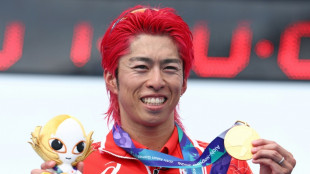
 China's 13-year-old Yu scorches to first major gold at Asian Games

 Russians vote on last day of parliamentary elections

 Hong Kong pays final respects to former city leader Tung
 Typhoon put people off Asian Games opening ceremony, official says

 China's 13-year-old Yu cruises as Asian Games swimming begins

 AI 'warning shots' focus Beijing on national security risks

 Philippine tribe in limbo over US-led tech hub

 Leo XIV, first US pope transcends his restrained style

 Singer Ed Sheeran says Gaza situation 'unjustifiable' following controversy

 In 'Tenzing', a Sherpa mountaineer gets his due

 Ed Sheeran set to return to stage after Palestinian controversy

 Toulouse edge Vannes, Lyon beat Pau to take Top 14 summit

 Germans arrested for Louvre stunt in Mona Lisa hall

 Saudi-led coalition says Houthis fired ballistic missile at Riyadh

 France's debt climbs to highest since 1978: ministry

 McIlroy two shots off the lead at Wentworth after eagle on 18

 Martinez brace saves Inter in Serie A top-two clash with Roma

 Rosenior abused but guides Paris FC past old club Strasbourg

 Seven-try Lyon beat Pau, climb to Top 14 summit

 Brighton defeat a 'big lesson' against complacency for Arsenal, says Arteta

 Thousands protest inaction over climate crisis in Switzerland

A long-delayed UN conference on how to restore the faltering health of global oceans kicks off in Lisbon Monday, with thousands of policymakers, experts and advocates on the case.
Humanity needs healthy oceans. They generate 50 percent of the oxygen we breathe and provide essential protein and nutrients to billions of people every day.
Covering more than two-thirds of Earth's surface, the seven seas have also softened the impact of climate change for life on land.
But at a terrible cost.
Absorbing around a quarter of CO2 pollution -- even as emissions increased by half over the last 60 years -- has turned sea water acidic, threatening aquatic food chains and the ocean's capacity to pull down carbon.
And soaking up more than 90 percent of the excess heat from global warming has spawned massive marine heatwaves that are killing off precious coral reefs and expanding dead zones bereft of oxygen.
"We have only begun to understand the extent to which climate change is going to wreak havoc on ocean health," said Charlotte de Fontaubert, the World Bank's global lead for the blue economy.
Making things worse is an unending torrent of pollution, including a garbage truck's worth of plastic every minute, according the UN Environment Programme (UNEP).
On current trends, yearly plastic waste will nearly triple to one billion tonnes by 2060, according to a recent OECD report.
- Wild fish stocks -
Microplastics -- found inside Arctic ice and fish in the ocean's deepest trenches -- are estimated to kill more than a million seabirds and over 100,000 marine mammals each year.
Solutions on the table range from recycling to global caps on plastic production.
Global fisheries will also be under the spotlight during the five-day UN Ocean Conference, originally slated for April 2020 and jointly hosted by Portugal and Kenya.
"At least one-third of wild fish stocks are overfished and less than 10 percent of the ocean is protected," Kathryn Matthews, chief scientist for US-based NGO Oceana, told AFP.
"Destructive and illegal fishing vessels operate with impunity in many coastal waters and on the high seas."
One culprit is nearly $35 billion in subsidies. Baby steps taken last week by the World Trade Organization (WTO) to reduce handouts to industry will hardly make a dent, experts said.
The conference will also see a push for a moratorium on deep-sea mining of rare metals needed for a boom electric vehicle battery construction.
Scientists say poorly understood seabed ecosystems are fragile and could take decades or longer to heal once disrupted.
Another major focus will be "blue food", the new watchword for ensuring that marine harvests from all sources are sustainable and socially responsible.
- Protected areas -
Rising aquaculture yields -- from salmon and tuna to shellfish and algae -- are on track to overtake wild marine harvests in decline since the 1990s, with each producing roughly 100 million tonnes per year.
If properly managed, "wild ocean fish can provide a climate-friendly, micro-nutrient protein source that can feed one billion people a healthy seafood meal every day -- forever," said Matthews.
The Lisbon meet will see ministers and even a few heads of state, including French President Emmanuel Macron, but is not a formal negotiating session.
But participants will push for a strong oceans agenda at two critical summits later this year: the COP27 UN climate talks in November, hosted by Egypt, followed by the long-delayed COP15 biodiversity negotiations, recently moved from China to Montreal.
Oceans are already at the heart of a draft biodiversity treaty tasked with halting what many scientists fear is the first "mass extinction" event in 65 million years.
Nearly 100 nations support a cornerstone provision that would designate 30 percent of the planet's land and ocean as protected areas.
For climate change, the focus will be on carbon sequestration: boosting the ocean's capacity to soak up CO2, whether by enhancing natural sinks such as mangroves or through geoengineering schemes.
At the same time, scientists warn, a drastic reduction of greenhouse gases is needed to restore ocean health.
J.Horn--BTB