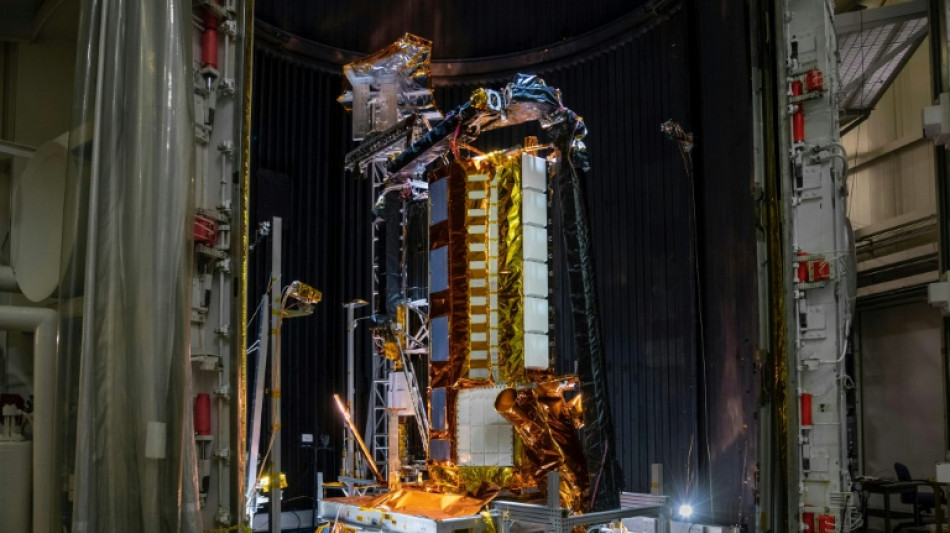
US, India launch powerful Earth-monitoring satellite / Photo: © NASA/AFP

 Stocks rise on AI buzz, oil prices cool

 India narrowly survive huge scare against minnows Japan

 Missing F-35 fighter parts 'not sensitive', says Australia minister

 Cambodia showcases scams crackdown with global conference

 Afghan cyclist who disguised herself as man wins Asian Games silver

 Typhoon Dujuan leaves four dead in Japan, 45,000 houses without power

 G7 leaders condemn Houthi strikes on Saudi Arabia

 Google data centre sparks protests in Austria

 Shin Ohashi: Junk food-loving teen and Japan's next big swimming hope

 Stocks rise on AI buzz, drop in oil prices

 China's robot dancers limber up for America's Got Talent final

 Despite military might, Saudi struggles to crush the Houthis

 Trump to tout deals, defend Iran war in UN speech

 Sri Lanka to issue verdict in landmark Easter attack trial

 No green light to lift EU sanctions on Russian oligarchs, talks to resume

 UK agrees support for Saudi in struggle with Houthis: reports

 EU foreign policy chief calls for continued sanctions on Russia

 Flights scrapped, evacuations urged as Typhoon Dujuan wallops Japan

 Fonseca to take break from tennis

 A Cuban zoo, and its animals, in epic battle for survival

 Infantino proposes consulting federations to reform FIFA

 El Nino weather pattern enters record territory: scientist

 OpenAI calls for US to lead global effort on AI standards

 South African ostriches plucked alive for luxury fashion: report

 US networks halt Trump coverage in revolt over White House ban

A formidable new radar satellite jointly developed by the United States and India launched Wednesday, designed to track subtle changes in Earth's land and ice surfaces and help predict both natural and human-caused hazards.
Dubbed NISAR (NASA-ISRO Synthetic Aperture Radar), the pickup truck-sized spacecraft blasted off around 5:40 pm (1210 GMT) from the Satish Dhawan Space Centre on India's southeastern coast, riding an ISRO Geosynchronous Satellite Launch Vehicle rocket.
Livestream of the event showed excited schoolchildren brought to watch the launch and mission teams erupting in cheers and hugging.
Highly anticipated by scientists, the mission has also been hailed as a milestone in growing US-India cooperation between President Donald Trump and Prime Minister Narendra Modi.
"Our planet surface undergoes constant and meaningful change," Karen St Germain, director of NASA's Earth Science division, told reporters ahead of launch.
"Some change happens slowly. Some happens abruptly. Some changes are large, while some are subtle."
By picking up on tiny changes in the vertical movement of the Earth's surface -- as little as one centimeter (0.4 inches) -- scientists will be able to detect the precursors for natural and human-caused disasters, from earthquakes, landsides and volcanoes to aging infrastructure like dams and bridges.
"We'll see land substance and swelling, movement, deformation and melting of mountain glaciers and ice sheets covering both Greenland and Antarctica, and of course, we'll see wildfires," added St Germain, calling NISAR "the most sophisticated radar we've ever built."
India in particular is interested in studying its coastal and nearby ocean areas by tracking yearly changes in the shape of the sea floor near river deltas and how shorelines are growing or shrinking.
Data will also be used to help guide agricultural policy by mapping crop growth, tracking plant health, and monitoring soil moisture.
Equipped with a 12-meter dish that will unfold in space, NISAR will record nearly all of Earth's land and ice twice every 12 days from an altitude of 464 miles (747 kilometers).
- Microwave frequencies -
As it orbits, the satellite will continuously transmit microwaves and receive echoes from the surface.
Because the spacecraft is moving, the returning signals are distorted, but computer processing will reassemble them to produce detailed, high-resolution images.
Achieving similar results with traditional radar would require an impractically large 12-mile-wide dish.
NISAR will operate on two radar frequencies: L-band and S-band. The L-band is ideal for sensing taller vegetation like trees, while the S-band enables more accurate readings of shorter plants such as bushes and shrubs.
NASA's Jet Propulsion Laboratory and India's ISRO shared the workload, each building components on opposite sides of the planet before integrating and testing the spacecraft at ISRO's Satellite Integration & Testing Establishment in the southern Indian city of Bengaluru.
NASA's contribution came to just under $1.2 billion, while ISRO's costs were around $90 million.
India's space program has made major strides in recent years, including placing a probe in Mars orbit in 2014 and landing a robot and rover on the Moon in 2023.
Shubhanshu Shukla, a test pilot with the Indian Air Force, recently became the second Indian to travel to space and the first to reach the International Space Station -- a key step toward India's own indigenous crewed mission planned for 2027 under the Gaganyaan ("sky craft") program.
F.Müller--BTB