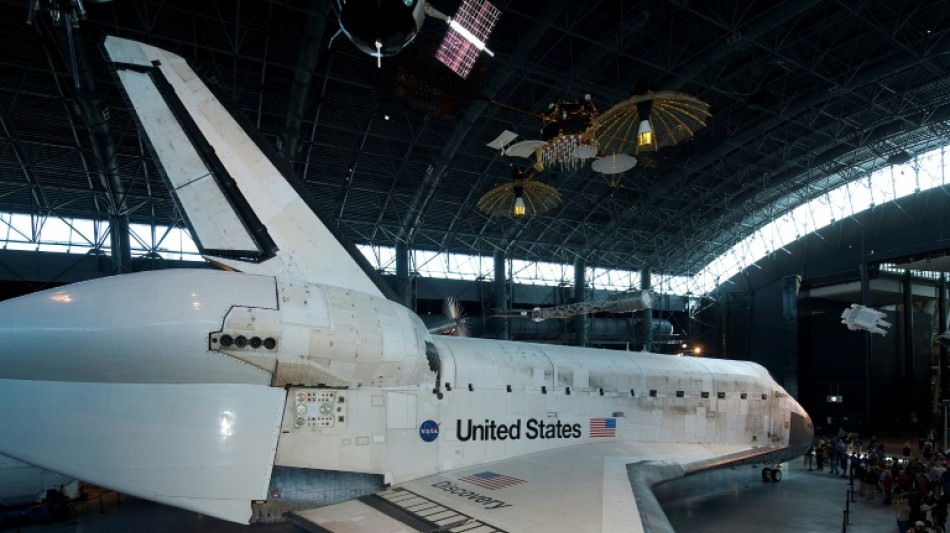
Bid to relocate US Space Shuttle Discovery faces museum pushback / Photo: © Smithsonian National Air and Space Museum/AFP

 Stocks rise on AI buzz, oil prices cool

 India narrowly survive huge scare against minnows Japan

 Missing F-35 fighter parts 'not sensitive', says Australia minister

 Cambodia showcases scams crackdown with global conference

 Afghan cyclist who disguised herself as man wins Asian Games silver

 Typhoon Dujuan leaves four dead in Japan, 45,000 houses without power

 G7 leaders condemn Houthi strikes on Saudi Arabia

 Google data centre sparks protests in Austria

 Shin Ohashi: Junk food-loving teen and Japan's next big swimming hope

 Stocks rise on AI buzz, drop in oil prices

 China's robot dancers limber up for America's Got Talent final

 Despite military might, Saudi struggles to crush the Houthis

 Trump to tout deals, defend Iran war in UN speech

 Sri Lanka to issue verdict in landmark Easter attack trial

 No green light to lift EU sanctions on Russian oligarchs, talks to resume

 UK agrees support for Saudi in struggle with Houthis: reports

 EU foreign policy chief calls for continued sanctions on Russia

 Flights scrapped, evacuations urged as Typhoon Dujuan wallops Japan

 Fonseca to take break from tennis

 A Cuban zoo, and its animals, in epic battle for survival

 Infantino proposes consulting federations to reform FIFA

 El Nino weather pattern enters record territory: scientist

 OpenAI calls for US to lead global effort on AI standards

 South African ostriches plucked alive for luxury fashion: report

 US networks halt Trump coverage in revolt over White House ban

Tucked inside President Donald Trump's flagship tax and spending bill last month was a little-noticed provision to relocate the iconic Space Shuttle Discovery from a museum outside Washington to Houston.
The plan now faces legal uncertainty, with the Smithsonian Institution arguing Congress had no authority to give away what it considers private property -- even before accounting for the steep logistical and financial challenges.
"The Smithsonian Institution owns the Discovery and holds it in trust for the American public," the museum network, which receives substantial federal funding yet remains an independent entity, said in a statement to AFP on Friday.
"In 2012, NASA transferred 'all rights, title, interest and ownership' of the shuttle to the Smithsonian," the statement continued, calling Discovery one of the museum's "centerpieces" that welcomes millions of visitors a year.
The push to move Discovery from the Air and Space Museum's site in northern Virginia began in April, when Texas Senator John Cornyn, a Republican who faces a tough primary challenge next year by state attorney general Ken Paxton, introduced the "Bring the Space Shuttle Home Act," naming Discovery.
The legislation stalled until it was folded into the mammoth "Big Beautiful Bill," signed into law on July 4.
Its passage allocated $85 million for the move, though the nonpartisan Congressional Research Service has projected a far higher cost of $325 million, adding that the NASA administrator's power over non-NASA entities is "unclear."
To comply with Senate rules, the bill's language was modified such that Discovery is no longer named directly. Instead, the bill refers to a "space vehicle," though there is little doubt as to the target.
NASA's administrator -- currently Transportation Secretary Sean Duffy, serving in an acting capacity -- was given 30 days to identify which spacecraft is to be relocated, a deadline coming up on Sunday.
- End of an era -
NASA's Space Shuttle program ended in 2011, after a 30-year run that carried America's post-Apollo space ambitions.
The four surviving orbiters -- Atlantis, Endeavour, prototype Enterprise, and Discovery -- were awarded to Florida, California, New York, and Virginia through a ranked selection process.
Discovery, the most flown, was chosen as a vehicle-of-record in a near-complete state, intended for study by future generations.
"There was not a lot of support within Houston to want a shuttle," space historian Robert Pearlman told AFP, adding that a proposal to house it at Space Center Houston was relatively weak.
But after the announcement, Texas -- home to the Johnson Space Center, which oversees NASA's human spaceflight -- felt snubbed, and allegations of political interference by then-president Barack Obama swirled.
A NASA inspector general probe found no evidence of foul play.
- Enormous challenges -
Relocating Discovery now would pose major technical hurdles. NASA had modified two Boeing 747s to ferry retired shuttles -- one is now a museum piece, and the other is out of service.
That leaves land and water transport. "The nearest water entrance to the Potomac River is about 30 miles away," Pearlman said -- but it may be too shallow for the orbiter and required barge, requiring a 100-mile journey instead.
A water transport would require a massive enclosed barge, he added.
The US government owns only one such vessel, controlled by the military. Loaning it to a civilian agency would require another act of Congress, and the alternative would involve building one from scratch.
Dennis Jenkins, a former shuttle engineer who oversaw the delivery of retired orbiters to their new homes, told the Collect Space outlet he could see costs reach a billion dollars.
Nicholas O'Donnell, an attorney at Sullivan & Worcester with expertise in art and museum law, told AFP that assuming Smithsonian has valid paperwork, "I don't think Secretary Duffy or anyone in the federal government has any more authority to order the move of Discovery than you or I do."
The government could invoke eminent domain -- seizing private property for public use -- but it would have to pay fair market value or try to sue.
The Smithsonian is unlikely to want a court battle, and while it's legally independent, its financial reliance on federal funds leaves it politically vulnerable, said O'Donnell.
A.Gasser--BTB