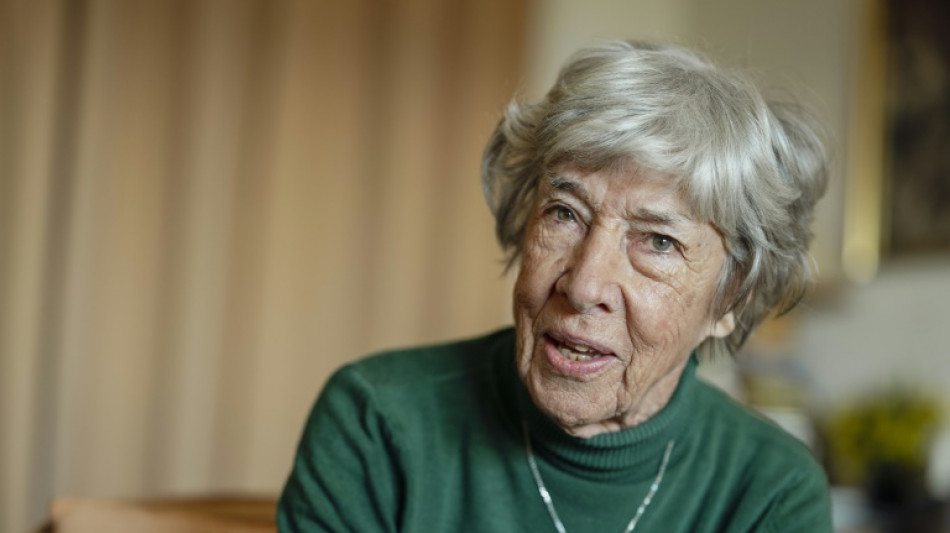
Dutch child survivor of Japan's WWII camps breaks silence / Photo: © AFP

 Marchand 'stressed' about racing Japanese rivals at LA Olympics
 Mobile boat clinics bring healthcare to India's remote islands
 Former India paceman Zaheer Khan named Chennai coach in IPL

 Six-year-old Chinese girl sets world record with Rubik's Cube

 Swimming prodigy Yu, 13, says 'interviews way harder than racing'

 Star coaches make their bows as Nations League returns

 Rams bounce back as Giants reel from Dart injury

 In Bangladesh, Pakistan's Jinnah photo stirs anger

 Two New Zealand naval ships transit Taiwan Strait

 Zidane gets down to work as France start new era

 Inside the Venezuelan prison meant to 'drive you insane'

 UK king braces as memoir by Diana's brother goes on sale

 Akkodis and Hamburg Public Transport Association Showcase hvv mia at InnoTrans 2026, Demonstrating the Future of AI-Powered Mobility

 Macron says talks with Trump on Red Sea, Ukraine 'constructive'

 Green policies just good politics, says UK minister

 Bardot auction in Paris fetches nearly one million euros

 No timeline on Daniels injury return, says Commanders coach

 British Columbia sues OpenAI in US court over Canada school shooting

 French star Batum retires after 18-year NBA career

 Zidane leads first France training session

 Man shot by ICE agent in Texas detained with bullet inside him: lawyer

 California declares state of emergency ahead of El Nino

 South Africa arrests three more suspects, after nine women murdered

 Carse needs time away from England, says captain Brook

 NOWPayments Releases Cross-Chain Payout Data Revealing Key Performance Benchmarks Across TRON, BNB Chain, and Solana

It has taken Tineke Einthoven 80 years to be able to speak about what she lived through as a child in brutal Japanese internment camps during World War II without breaking down.
"Now I can talk about it without crying," said the Dutch woman who was four when she and her family were captured and held in "horrible" conditions in a camp on the Indonesian island of Java.
Her three-year nightmare began early in 1942, a few months after the Japanese attacked the US naval base at Pearl Harbor in Hawaii.
"There was a lot of bombing and the Japanese arrived. We had dug a big hole in the garden to shelter my parents, my brother and my two sisters, as well as the family of our servants," the 87-year-old psychologist recalled, speaking publicly for the first time about the ordeal.
Indonesia was a Dutch colony at the time, and Imperial Japan was keen to get its hands on its oil fields and rubber plantations.
The Japanese separated her father, Willem Frederik Einthoven, from the rest of the family, and they did not hear from him for a year.
The son of Nobel Prize winner Willem Einthoven, the inventor of the electrocardiogram, he was an engineer who headed Radio Malabar, the communications link with the Netherlands, but he refused to collaborate with his captors.
- One in 10 perished -
His wife and children were sent to a camp in Tjibunut, near Bandung, where they were held with thousands of other Dutch, British and Australian civilians.
The vast majority of the 130,000 Allied civilians held by the Japanese during the war were Dutch, with more than one in 10 dying in the camps.
The fact that there were more than twice as many Dutch civilians as military prisoners of war has meant that their ordeal is more "vivid in Dutch collective memory", said historian Daniel Milne of the University of Kyoto.
"We often had nothing more than a bit of rice to eat," said Einthoven.
"Since I was the smallest, I would slip under the fence to find food outside the camp, but I could only get weeds," Einthoven added. Parents were punished if a child was caught. "We risked the death penalty."
"We suffered from hunger, lack of water, the heat, a total lack of hygiene and hours spent under the sun being counted and recounted."
One of Einthoven's friends named Marianne, to whom she had given a doll, died of diphtheria.
"I wondered if that doll would also cross to the other side; it was my first questioning of death," she said.
- Convoys bombed -
Then, in January 1944, the family was reunited and deported to Japan, where the Japanese military wanted her father and his team to invent a radar system.
During the journey, their convoy was bombed by the Americans, but their ship was spared. Many were not so lucky, with thousands of Dutch POWs perishing on the voyage, their ships sunk or torpedoed.
The 60 or so camps that held "some 1,200 civilians in Japan" are little known, said Mayumi Komiya of the POW Research Network Japan.
Some of the prisoners did not survive, including Tineke's father, who died of pneumonia at 51, weakened by the lack of food and the long march to the laboratory that had been set up for him.
The family was then sent to a temple 300 kilometres (185 miles) west of Tokyo, where they survived in isolation.
They heard about Emperor Hirohito announcing Japan's surrender on August 15, 1945 from "some Italians, who were also prisoners not far away. One of them threw himself into my mother's arms, and she was very embarrassed," Einthoven recalled.
She still remembers licking soup off rocks with other children from cans that had shattered during a failed American parachute drop to them.
Repatriated via Australia to the Netherlands, Tineke worked after the war as a psychologist in Geneva, Nice in France, and neighbouring Monaco, and had two children.
But she never shared her experiences of those years with anyone beyond her family.
"I am speaking out today to show that even if one has lived through something horrible, one doesn't have to suffer your entire life. You can move on if you choose to free yourself from the victim status," she said with a smile.
O.Lorenz--BTB