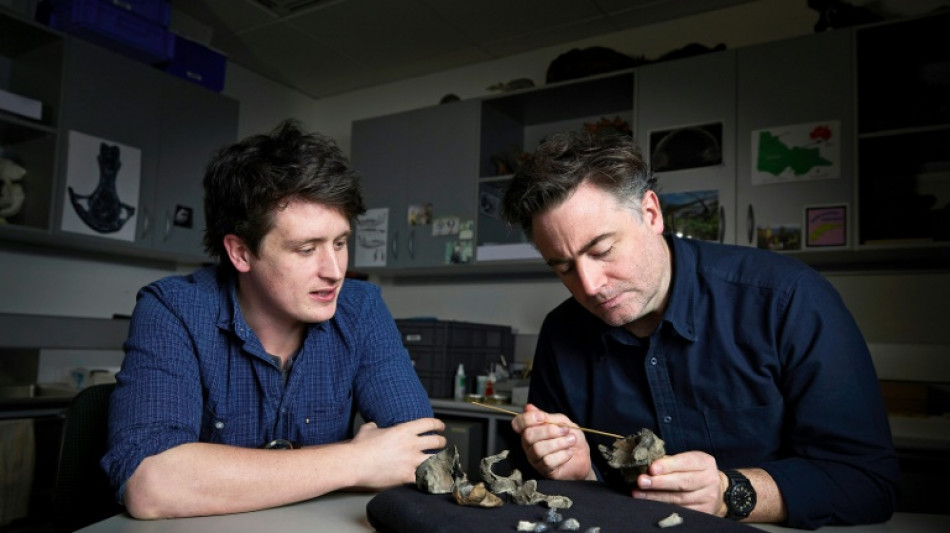
Scientists unearth 'cute' but fearsome ancient whale / Photo: © MUSEUMS VICTORIA/AFP

 Marchand 'stressed' about racing Japanese rivals at LA Olympics

 Mobile boat clinics bring healthcare to India's remote islands

 Former India paceman Zaheer Khan named Chennai coach in IPL

 Six-year-old Chinese girl sets world record with Rubik's Cube

 Swimming prodigy Yu, 13, says 'interviews way harder than racing'

 Star coaches make their bows as Nations League returns

 Rams bounce back as Giants reel from Dart injury

 In Bangladesh, Pakistan's Jinnah photo stirs anger

 Two New Zealand naval ships transit Taiwan Strait

 Zidane gets down to work as France start new era

 Inside the Venezuelan prison meant to 'drive you insane'

 UK king braces as memoir by Diana's brother goes on sale

 Akkodis and Hamburg Public Transport Association Showcase hvv mia at InnoTrans 2026, Demonstrating the Future of AI-Powered Mobility

 Macron says talks with Trump on Red Sea, Ukraine 'constructive'

 Green policies just good politics, says UK minister

 Bardot auction in Paris fetches nearly one million euros

 No timeline on Daniels injury return, says Commanders coach

 British Columbia sues OpenAI in US court over Canada school shooting

 French star Batum retires after 18-year NBA career

 Zidane leads first France training session

 Man shot by ICE agent in Texas detained with bullet inside him: lawyer

 California declares state of emergency ahead of El Nino

 South Africa arrests three more suspects, after nine women murdered

 Carse needs time away from England, says captain Brook

 NOWPayments Releases Cross-Chain Payout Data Revealing Key Performance Benchmarks Across TRON, BNB Chain, and Solana

Australian scientists have discovered a razor-toothed whale that prowled the seas 26 million years ago, saying Wednesday the species was "deceptively cute" but a fearsome predator.
Museums Victoria pieced together the species from an unusually well-preserved skull fossil found on Victoria's Surf Coast in 2019.
Scientists discovered a "fast, sharp-toothed predator" that would have been about the size of a dolphin.
"It's essentially a little whale with big eyes and a mouth full of sharp, slicing teeth," said researcher Ruairidh Duncan.
"Imagine the shark-like version of a baleen whale -- small and deceptively cute, but definitely not harmless."
The skull belonged to a group of prehistoric whales known as the mammalodontids, distant smaller relatives of today's filter-feeding whales.
It is the fourth mammalodontid species ever discovered, Museums Victoria said.
"This fossil opens a window into how ancient whales grew and changed, and how evolution shaped their bodies as they adapted to life in the sea," said palaeontologist Erich Fitzgerald, who co-authored the study.
Victoria's Surf Coast lies on the Jan Juc Formation -- a geological feature dating to the Oligocene epoch between 23 and 30 million years ago.
A string of rare fossils have been unearthed along the scenic stretch of beach, a renowned site for the study of early whale evolution.
"This region was once a cradle for some of the most unusual whales in history, and we're only just beginning to uncover their stories," said Fitzgerald.
"We're entering a new phase of discovery.
"This region is rewriting the story of how whales came to rule the oceans, with some surprising plot twists."
The species was named Janjucetus dullardi, a nod to local Ross Dullard who stumbled across the skull while strolling the beach in 2019.
It was described in the peer-reviewed Zoological Journal of the Linnean Society.
F.Pavlenko--BTB