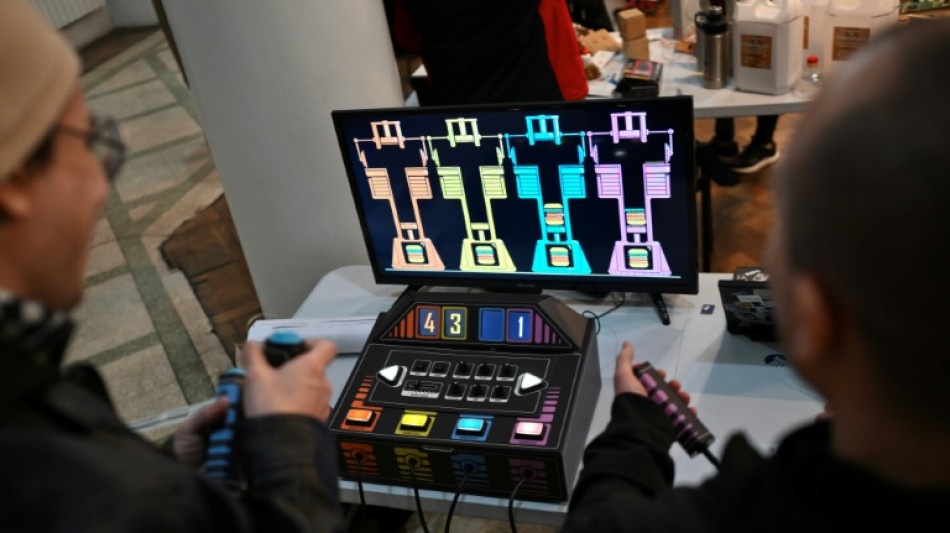
'Old things work': Argentines giving new life to e-waste / Photo: © AFP

 Marchand 'stressed' about racing Japanese rivals at LA Olympics

 Mobile boat clinics bring healthcare to India's remote islands

 Former India paceman Zaheer Khan named Chennai coach in IPL

 Six-year-old Chinese girl sets world record with Rubik's Cube
 Swimming prodigy Yu, 13, says 'interviews way harder than racing'

 Star coaches make their bows as Nations League returns

 Rams bounce back as Giants reel from Dart injury

 In Bangladesh, Pakistan's Jinnah photo stirs anger

 Two New Zealand naval ships transit Taiwan Strait

 Zidane gets down to work as France start new era

 Inside the Venezuelan prison meant to 'drive you insane'

 UK king braces as memoir by Diana's brother goes on sale

 Akkodis and Hamburg Public Transport Association Showcase hvv mia at InnoTrans 2026, Demonstrating the Future of AI-Powered Mobility

 Macron says talks with Trump on Red Sea, Ukraine 'constructive'

 Green policies just good politics, says UK minister

 Bardot auction in Paris fetches nearly one million euros

 No timeline on Daniels injury return, says Commanders coach

 British Columbia sues OpenAI in US court over Canada school shooting

 French star Batum retires after 18-year NBA career

 Zidane leads first France training session
 Man shot by ICE agent in Texas detained with bullet inside him: lawyer

 California declares state of emergency ahead of El Nino

 South Africa arrests three more suspects, after nine women murdered
 Carse needs time away from England, says captain Brook

 NOWPayments Releases Cross-Chain Payout Data Revealing Key Performance Benchmarks Across TRON, BNB Chain, and Solana

Need a new gaming console? Just make one yourself with an old ventilator. Got an old payment terminal? Turn it into a camera.
These are just some of the creations of Argentina's Cyber Dumpster Divers, a collective of ingenious tech aficionados who turn e-waste into new products.
"We experiment with technology by trying to recycle it and repurpose items that other people would simply throw away," said Esteban Palladino, a musician who goes by the pseudonym Uctumi on social media.
"It's a movement that has a charitable side, a techno-political side, and also a playful side," he added.
Argentina produces an estimated 520,000 tons of electronic waste per year, making it fifth in the Americas after the United States, Brazil, Mexico and Canada, according to a 2024 report by the UN Research Institute.
In 2022, the world generated a record 62 million tons, the report said.
The manifesto of the Cyber Dumpster Divers, who have dozens of members across Argentina, says that faced with "the immorality of equipment thrown in the trash, the... diver rebels against the authority of the market."
The waste pickers see themselves as revolutionaries at war with the tech "oligarchy."
They call their provincial chapters cells, their manifesto is modelled on that of Karl Marx, and their posters feature a cyborg Che Guevara, who was born in Argentina.
The movement began in 2019 with hardware soup kitchens where people exchanged electronics parts.
During the Covid pandemic, it gained impetus because many people suddenly needed computers to study or work at home.
In stepped the recyclers.
They resurrected old machines from the rubbish heap, fitted them with free operating systems and donated them to people and organizations in need.
- 'Old things work' -
The collective's third annual meeting in Buenos Aires included a workshop on reviving defunct smartphones.
Visitors also lined up to play the "Ventilastation," a gaming console made from an industrial fan, and to learn how to run AI applications locally on old computers.
"Old things work," read a slogan on the screen.
Electronics engineer Juan Carrique traveled 470 kilometers (290 miles) from the central province of Santa Fe to present "roboticlaje" or robotic recycling.
Carrique goes into schools to teach children how to use e-waste to build temperature sensors or motor controls.
"It's not the same to buy something ready-made as having to make it yourself, using pieces of trash," he said.
The 47-year-old diabetic is a fierce critic of planned obsolescence -- companies programming products to become out of date after a certain period.
He used a free app to make his blood sugar monitor compatible with his phone, extending the device's manufacturer-specified lifespan.
It's about "reclaiming the right to recognize when things work or don't work, not being told they work or don't work," he said.
While giving a second life to old electronic devices may seem the height of geekiness, the Cyber Dumpster Divers are wary of the impact of smartphones, particularly on Argentina's youth.
"It's this ecosystem that is destroying the social fabric, destroying the psyche of young people," one of the recyclers, Cristian Rojo, said.
L.Dubois--BTB