'Correcting The Map': reshaping perceptions of Africa / Photo: © AFP

 Marchand 'stressed' about racing Japanese rivals at LA Olympics
 Mobile boat clinics bring healthcare to India's remote islands
 Former India paceman Zaheer Khan named Chennai coach in IPL
 Six-year-old Chinese girl sets world record with Rubik's Cube
 Swimming prodigy Yu, 13, says 'interviews way harder than racing'
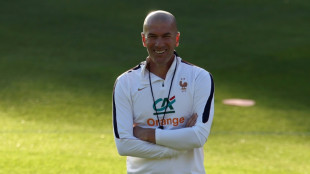 Star coaches make their bows as Nations League returns
 Rams bounce back as Giants reel from Dart injury

 In Bangladesh, Pakistan's Jinnah photo stirs anger

 Two New Zealand naval ships transit Taiwan Strait

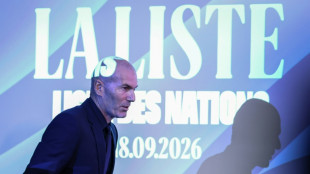 Zidane gets down to work as France start new era
 Inside the Venezuelan prison meant to 'drive you insane'

 UK king braces as memoir by Diana's brother goes on sale

 Akkodis and Hamburg Public Transport Association Showcase hvv mia at InnoTrans 2026, Demonstrating the Future of AI-Powered Mobility

 Macron says talks with Trump on Red Sea, Ukraine 'constructive'

 Green policies just good politics, says UK minister

 Bardot auction in Paris fetches nearly one million euros

 No timeline on Daniels injury return, says Commanders coach

 British Columbia sues OpenAI in US court over Canada school shooting

 French star Batum retires after 18-year NBA career

 Zidane leads first France training session

 Man shot by ICE agent in Texas detained with bullet inside him: lawyer

 California declares state of emergency ahead of El Nino

 South Africa arrests three more suspects, after nine women murdered

 Carse needs time away from England, says captain Brook

 NOWPayments Releases Cross-Chain Payout Data Revealing Key Performance Benchmarks Across TRON, BNB Chain, and Solana

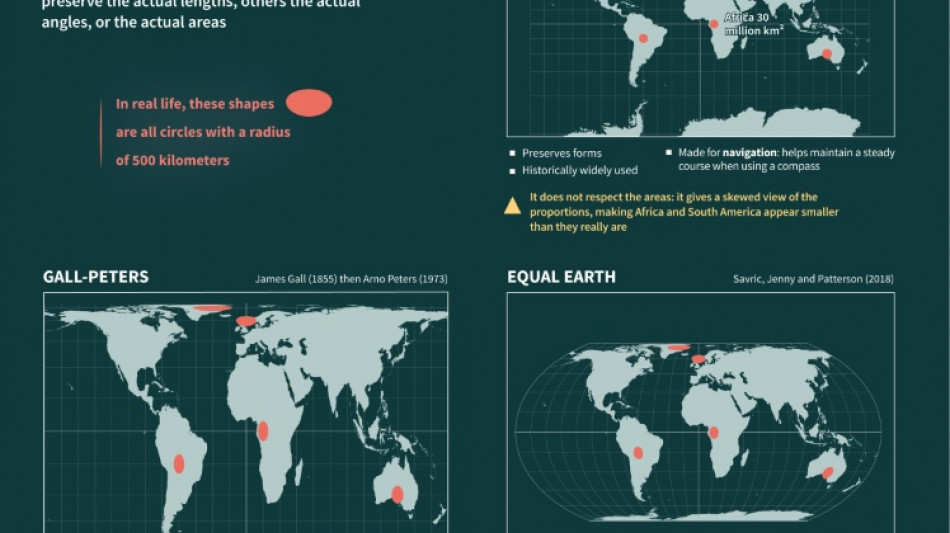
The Mercator world map, long a fixture in classrooms globally, makes the European Union appear almost as large as Africa. In reality, Africa is more than seven times bigger.
It is a distortion that has prompted a new African initiative, "Correct the Map", calling for depictions that show Africa's true scale.
"For centuries, this map has minimised Africa, feeding into a narrative that the continent is smaller, peripheral and less important," said Fara Ndiaye, co-founder of Speak Up Africa, which is leading the campaign alongside another advocacy group, Africa No Filter.
Accurately translating the Earth's sphere into a flat map always calls for compromises, requiring parts to be stretched, cut or left out, experts told AFP.
Historically, maps have reflected the worldview of their makers.
Babylonian clay tablets from the sixth century BC placed their empire at the centre of the world, while medieval European charts often focused on religious sites.
Choices must be made: a world map will look very different depending on whether Australia, Siberia or Europe is placed at its centre.
Today's most-used map was designed for maritime navigation by Flemish cartographer Gerardus Mercator in 1569.
It focused on accurate depictions of the shapes and angles of land masses, but their relative sizes were often inaccurate.
Mercator's projection inflated northern regions and compressed equatorial ones, making Europe and North America appear much larger, while shrinking Africa and South America.
The distortions are stark: a 100-square-kilometre patch around Oslo, Norway, looks four times larger than the same area around Nairobi, Kenya.
Greenland appears as large as Africa, even though it is 14 times smaller.
- Striking a balance -
Alternatives to the Mercator emerged in the 20th century, including one from 1921 by Oswald Winkel and another in 1963 by Arthur Robinson that reduced distortions but sacrificed precision. The 1970s Gall-Peters projection restored proportional sizes but stretched shapes.
To strike a balance between accuracy and aesthetics, cartographers Tom Patterson, Bojan Savric and Bernhard Jenny launched the Equal Earth projection in 2018.
It makes Africa, Latin America, South Asia and Oceania appear vastly larger.
"Equal Earth preserves the relative surface areas of continents and, as much as possible, shows their shapes as they appear on a globe," Savric told AFP.
This is the projection now endorsed by the African Union.
Speak Up Africa says the next steps of their campaign are to push for adoption by African schools, media and publishers.
"We are also engaging the UN and UNESCO (its cultural body), because sustainable change requires global institutions," Ndiaye said.
- 'Naive' controversy –
Some critics reject claims of bias.
"Any claim that Mercator is flagrantly misleading people seems naive," Mark Monmonier, a Syracuse University geography professor and author of "How to Lie with Maps", told AFP.
"If you want to compare country sizes, use a bar graph or table, not a map."
Despite its distortions, Mercator remains useful for digital platforms because its focus on accurate land shapes and angles makes "direction easy to calculate", Ed Parsons, a former geospatial technologist at Google, told AFP.
"While a Mercator map may distort the size of features over large areas, it accurately represents small features which is by far the most common use for digital platforms," he said.
Having accurate relative sizes, as with the Equal Earth map, can complicate navigation calculations, but technology is adapting.
"Most mapping software has supported Equal Earth since 2018," Savric said. "The challenge is usage. People are creatures of habit."
Some dismiss the whole thrust of the African campaign.
Ghanaian policy analyst Bright Simons says the continent needs more than a larger size on maps to "earn global respect".
"South Korea, no matter how Mercator renders it, has almost the same GDP as all 50 African countries combined," he said.
But advocates remain convinced of their cause.
"Success will be when children everywhere open their textbooks and see Africa as it truly is: vast, central and indispensable," Ndiaye said.
Y.Bouchard--BTB