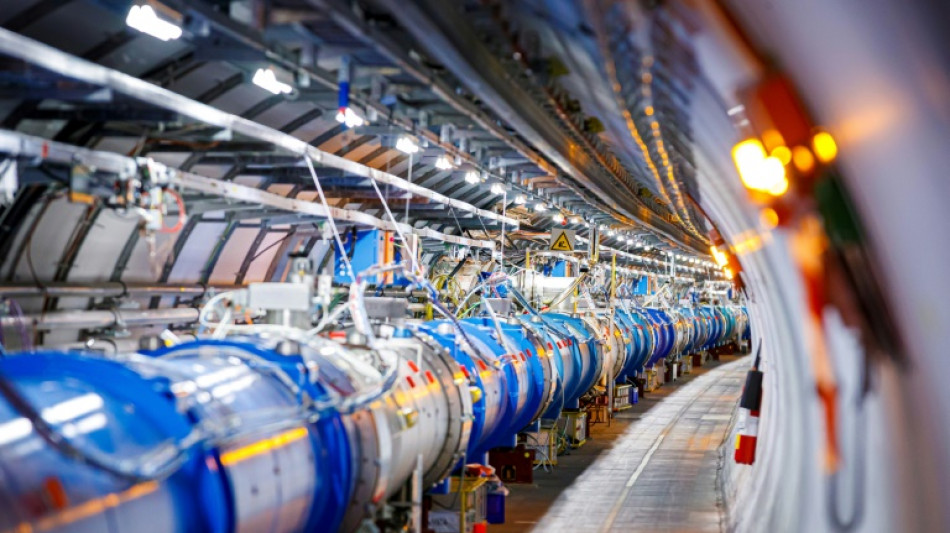
Large Hadron Collider revs up to unprecedented energy level / Photo: © AFP/File

 US warns of rapid escalation in Mideast war

 Iran 'put hearts on the court' to win Asian Games basketball bronze

 School girl Yu helps China dominate in Asian Games swimming openers

 Myanmar win first Asian Games teqball gold as Spain great Puyol watches

 China's 13-year-old Yu scorches to first major gold at Asian Games

 Russians vote on last day of parliamentary elections

 Hong Kong pays final respects to former city leader Tung

 Typhoon put people off Asian Games opening ceremony, official says

 China's 13-year-old Yu cruises as Asian Games swimming begins

 AI 'warning shots' focus Beijing on national security risks
 Philippine tribe in limbo over US-led tech hub

 Leo XIV, first US pope transcends his restrained style

 Singer Ed Sheeran says Gaza situation 'unjustifiable' following controversy

 In 'Tenzing', a Sherpa mountaineer gets his due

 Ed Sheeran set to return to stage after Palestinian controversy

 Toulouse edge Vannes, Lyon beat Pau to take Top 14 summit

 Germans arrested for Louvre stunt in Mona Lisa hall

 Saudi-led coalition says Houthis fired ballistic missile at Riyadh

 France's debt climbs to highest since 1978: ministry

 McIlroy two shots off the lead at Wentworth after eagle on 18

 Martinez brace saves Inter in Serie A top-two clash with Roma

 Rosenior abused but guides Paris FC past old club Strasbourg

 Seven-try Lyon beat Pau, climb to Top 14 summit

 Brighton defeat a 'big lesson' against complacency for Arsenal, says Arteta

 Thousands protest inaction over climate crisis in Switzerland

Ten years after it discovered the Higgs boson, the Large Hadron Collider is about to start smashing protons together at unprecedented energy levels in its quest to reveal more secrets about how the universe works.
The world's largest and most powerful particle collider started back up in April after a three-year break for upgrades in preparation for its third run.
From Tuesday it will run around the clock for nearly four years at a record energy of 13.6 trillion electronvolts, the European Organisation for Nuclear Research (CERN) announced at a press briefing last week.
It will send two beams of protons -- particles in the nucleus of an atom -- in opposite directions at nearly the speed of light around a 27-kilometre (17-mile) ring buried 100 metres under the Swiss-French border.
The resulting collisions will be recorded and analysed by thousands of scientists as part of a raft of experiments, including ATLAS, CMS, ALICE and LHCb, which will use the enhanced power to probe dark matter, dark energy and other fundamental mysteries.
- 1.6 billion collisions a second -
"We aim to be delivering 1.6 billion proton-proton collisions per second" for the ATLAS and CMS experiments, CERN's head of accelerators and technology Mike Lamont said.
This time around the proton beams will be narrowed to less than 10 microns -- a human hair is around 70 microns thick -- to increase the collision rate, he added.
The new energy rate will allow them to further investigate the Higgs boson, which the Large Hadron Collider first observed on July 4, 2012.
The discovery revolutionised physics in part because the boson fit within the Standard Model -- the mainstream theory of all the fundamental particles that make up matter and the forces that govern them.
However several recent findings have raised questions about the Standard Model, and the newly upgraded collider will look at the Higgs boson in more depth.
"The Higgs boson is related to some of the most profound open questions in fundamental physics today," said CERN director-general Fabiola Gianotti, who first announced the boson's discovery a decade ago.
Compared to the collider's first run that discovered the boson, this time around there will be 20 times more collisions.
"This is a significant increase, paving the way for new discoveries," Lamont said.
Joachim Mnich, CERN's head of research and computing, said there was still much more to learn about the boson.
"Is the Higgs boson really a fundamental particle or is it a composite?" he asked.
"Is it the only Higgs-like particle that exists -- or are there others?"
- 'New physics season' -
Past experiments have determined the mass of the Higgs boson, as well as more than 60 composite particles predicted by the Standard Model, such as the tetraquark.
But Gian Giudice, head of CERN's theoretical physics department, said observing particles is only part of the job.
"Particle physics does not simply want to understand the how -- our goal is to understand the why," he said.
Among the Large Hadron Collider's nine experiments is ALICE, which probes the matter that existed in the first 10 microseconds after the Big Bang, and LHCf, which uses the collisions to simulate cosmic rays.
After this run, the collider will come back in 2029 as the High-Luminosity LHC, increasing the number of detectable events by a factor of 10.
Beyond that, the scientists are planning a Future Circular Collider -- a 100-kilometre ring that aims to reach energies of a whopping 100 trillion electronvolts.
But for now, physicists are keenly awaiting results from the Large Hadron Collider's third run.
"A new physics season is starting," CERN said.
I.Meyer--BTB