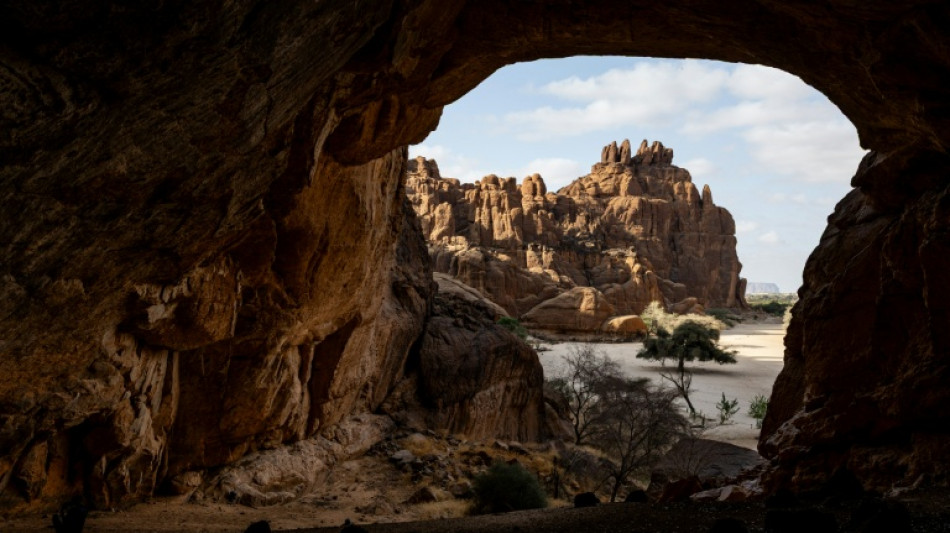
Tracing the 'Green Sahara' in Chad's northern desert / Photo: © AFP

 Typhoon Dujuan leaves four dead in Japan, 45,000 houses without power

 G7 leaders condemn Houthi strikes on Saudi Arabia

 Google data centre sparks protests in Austria

 Shin Ohashi: Junk food-loving teen and Japan's next big swimming hope

 Stocks rise on AI buzz, drop in oil prices

 China's robot dancers limber up for America's Got Talent final

 Despite military might, Saudi struggles to crush the Houthis

 Trump to tout deals, defend Iran war in UN speech

 Sri Lanka to issue verdict in landmark Easter attack trial

 No green light to lift EU sanctions on Russian oligarchs, talks to resume

 UK agrees support for Saudi in struggle with Houthis: reports

 EU foreign policy chief calls for continued sanctions on Russia

 Flights scrapped, evacuations urged as Typhoon Dujuan wallops Japan

 Fonseca to take break from tennis

 A Cuban zoo, and its animals, in epic battle for survival

 Infantino proposes consulting federations to reform FIFA

 El Nino weather pattern enters record territory: scientist

 OpenAI calls for US to lead global effort on AI standards
 South African ostriches plucked alive for luxury fashion: report

 US networks halt Trump coverage in revolt over White House ban

 Paramount settles with US states to clear Warner Bros. mega-merger

 Climate crisis a job for world leaders, not just activists: UK FM
 US networks halt Trump coverage over White House ban

 French singer accuses Miley Cyrus of plagiarism

 EU fines Google 403 mn euros for location data breach

A cloud of dust escapes from an excavation site in the sand of Chad's arid north, where scientists are looking for signs of human habitation in an area once humid and called the "Green Sahara".
Kneeling, armed with a brush and trowel inside the largest rock shelter at the Gaora Hallagana site in the Ennedi West province, Djimet Guemona, 35, meticulously removed every layer of sand.
"It's as if we are turning the pages of a historic book to travel back in time," said Guemona, an archaeologist at the National Centre for Research and Development.
His face lit up at the discovery of each fragment of pottery or scrap of charcoal.
The scientific mission, conducted over five days in late July some 30 kilometres (nearly 19 miles) from Fada, the main town in Ennedi West, brought together Chadian archaeologists and geologists from universities in N'Djamena and Abeche.
It aimed to lay "the first cornerstone" of the chronological framework for ancient settlements in Ennedi, Guemona said.
The Natural and Cultural Reserve of Ennedi (RNCE) was created in 2018 in the Chadian province, which stands at the crossroads with Libya and Sudan and is home to a rich archaeological heritage.
Tens of thousands of engravings and paintings can be found on the rocky walls across the vast reserve's more than 50,000 square kilometres (19,305 square miles).
Since the RNCE was included on the UNESCO World Heritage list in 2016, the Chadian government brought in the South African organisation, African Parks, to help run it for 15 years.
The head of the scientific mission funded by the group, Mahamat Ahmat Oumar, said 1,686 sites had been catalogued so far.
"But this likely represents less than a quarter of the total," he said.
"There is enormous archaeological potential but it remains poorly documented," Oumar added. "Research has been dominated by foreign scientists.
"Chadian researchers have not sufficiently invested in this part of the country."
- Tourism -
Some sandstone rock formations, tinted pink, purple or orange depending on the time of day, are hard to access.
Even venturing onto the imposing blocks, which look like they have been placed on top of the sand, is a physical and logistical challenge in a province scorched by the sun.
Certain areas have also long been inaccessible due to the border region's tumultuous history.
"There was a break in scientific exploration in the 1960s with the civil war until the 1990s," said Oumar.
Remnants of shells and tank debris from the Chad-Libya war of 1978 to 1987 are still present and travel to the area remains "strongly discouraged" by the foreign ministry of the former colonial power France.
"It's Lascaux times 100,000," joked Frederique Duquesnoy, 61, an archaeologist and associate member of the Mediterranean Laboratory of Prehistoric Europe and Africa (LAMPEA), referring to the network of caves in southwest France famous for its ancient wall art.
Using a phone and a tablet, she employs an image enhancement tool to reveal paintings invisible to the naked eye.
"This herd of domestic cattle reflects a period when there were pastures, gallery forests and waterways here," she said, pointing to a sandy stretch in front of the cave.
"It corresponds to the so-called 'Green Sahara' period" between 10,000 and 3,000 years BC, she added.
Further evidence of the humid era are the depictions of hippopotamuses, giraffes and elephants found in other rock shelters.
Fragments of pottery collected by Celestin Gabi, a 35-year-old Chadian doctoral student in archaeology at France's University of Toulouse Jean Jaures, seem to support the hypothesis.
Some, adorned with wavy patterns, "could date back to 7,000 BC", he said.
- Understanding -
After surveys and potential carbon-dating of the collected materials, the next step will be to organise large-scale digs to deepen understanding of the people who lived in Ennedi during the Early Holocene period and how they adapted to increasingly dry conditions.
"Better understanding this heritage will allow us equally to showcase it to the public and to attract a large number of visitors each year," said Oumar.
"At the moment, only a handful of travel agencies share a market catering to wealthy tourists."
The Chadian authorities are currently drafting a tourist development plan and African Parks hopes it will be finalised by the first half of next year.
"The only way of self-funding the preservation of this heritage is tourism," said Hamid Kodi, 28, the deputy director of RNCE.
African Parks is the second biggest employer in the province after the state, with 149 staff.
The NGO, which oversees around 20 parks across Africa, has previously faced accusations of "neo-colonialist practices" and rights violations.
In Ennedi, African Parks promotes a more responsible management and its "support" for local people, in particular by assigning "management to young people in the region", Kodi, who himself comes from Ennedi, said.
G.Schulte--BTB