Trump jeopardising US role as scientific leader: Nobel officials / Photo: © AFP

 Typhoon Dujuan leaves four dead in Japan, 45,000 houses without power

 G7 leaders condemn Houthi strikes on Saudi Arabia
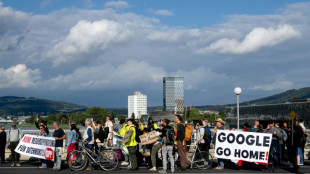 Google data centre sparks protests in Austria

 Shin Ohashi: Junk food-loving teen and Japan's next big swimming hope

 Stocks rise on AI buzz, drop in oil prices

 China's robot dancers limber up for America's Got Talent final

 Despite military might, Saudi struggles to crush the Houthis

 Trump to tout deals, defend Iran war in UN speech

 Sri Lanka to issue verdict in landmark Easter attack trial
 No green light to lift EU sanctions on Russian oligarchs, talks to resume

 UK agrees support for Saudi in struggle with Houthis: reports

 EU foreign policy chief calls for continued sanctions on Russia

 Flights scrapped, evacuations urged as Typhoon Dujuan wallops Japan

 Fonseca to take break from tennis

 A Cuban zoo, and its animals, in epic battle for survival

 Infantino proposes consulting federations to reform FIFA

 El Nino weather pattern enters record territory: scientist

 OpenAI calls for US to lead global effort on AI standards

 South African ostriches plucked alive for luxury fashion: report

 US networks halt Trump coverage in revolt over White House ban

 Paramount settles with US states to clear Warner Bros. mega-merger

 Climate crisis a job for world leaders, not just activists: UK FM

 US networks halt Trump coverage over White House ban
 French singer accuses Miley Cyrus of plagiarism
 EU fines Google 403 mn euros for location data breach

Donald Trump's assault on science could threaten the United States' position as the world's leading research nation and have knock-on effects worldwide, Nobel Prize officials in Sweden told AFP.
Since taking office in January, the US president has cut billions of dollars in funding, attacked universities' academic freedoms and overseen mass layoffs of scientists across federal agencies.
Next week, the Nobel Prizes will be announced in Stockholm and Oslo, and chances are high that researchers working in the United States will take home some of the prestigious awards.
The United States is home to more Nobel science laureates than any other country, due largely to its longstanding investment in basic science and academic freedoms.
But that could change, said Hans Ellegren, secretary general of the Royal Swedish Academy of Sciences, which awards the Nobel prizes in physics, chemistry, and economics.
"In the post-war period, the US has taken over Germany's role as the world's leading scientific nation. When they now start cutting research funding, it threatens the country's position," he told AFP.
Since January, the National Institutes of Health (NIH) have terminated 2,100 research grants totalling around $9.5 billion and $2.6 billion in contracts, according to an independent database called Grant Watch.
Affected projects include studies on gender, the health effects of global warming, Alzheimer's disease and cancer.
Efforts are under way to restore some of the funding but uncertainty looms.
Other fields in Trump's line of fire include vaccines, climate change and diversity, equity and inclusion.
Thomas Perlmann, secretary general of the committee that awards the Nobel Prize for Medicine, said it was "no coincidence that the US has by far the most Nobel laureates".
"But there is now a creeping sense of uncertainty about the US' willingness to maintain their leading position in research," he said.
Perlmann called the United States "the very engine" of scientific research worldwide.
"There would be very serious consequences for research globally if it starts to falter," he added.
"It doesn't take very many years of large cutbacks to cause irreversible harm."
- 'China on the rise' -
Trump's cuts could lead to a brain drain and ripple effects on research in other countries, Ellegren and Perlmann said.
Scientists and researchers who have already lost their jobs or funding may not return to their fields even if budgets are restored, and younger would-be scientists may decide not to pursue a career in research, they said.
"There is a risk that a whole generation of young researchers will be lost," Ellegren warned.
While Trump's policies primarily affect US research, international cooperation is already suffering as a result, he said.
The NIH finance collaborations in other countries, "and that has become more difficult under the new administration".
"Any nationalist or chauvinistically inclined regulation of academic activity hampers the global exchange of ideas and data," Ellegren stressed.
"Research is by nature global. Researchers have always exchanged knowledge and experiences."
Some countries have tried to attract US scientists, while non-American researchers may be tempted to leave the United States to pursue their work elsewhere.
A US retreat could therefore open the door for other nations to take big strides.
"Research is an important basis for innovation and entrepreneurship. That means it could become easier for other countries to compete with the US," Ellegren suggested.
"The big global trend right now is that research in China is on the rise," he said, adding: "They are investing unbelievable resources."
Perlmann said Trump ought to protect the US legacy.
"You would hope that Trump doesn't want to give a walkover to China and other countries keen to take over the leader's jersey."
If given a chance to talk directly to Trump, Ellegren said he would impress upon him that it was in America's own interest to maintain academic freedoms and scientific funding.
"I would say that... one of the reasons your country has been so successful is that researchers have been able to seek new knowledge and have good resources."
"The United States has invested a lot in research in the post-war period, both privately and federally. And that is what has helped your country build its prosperity," he said.
T.Bondarenko--BTB