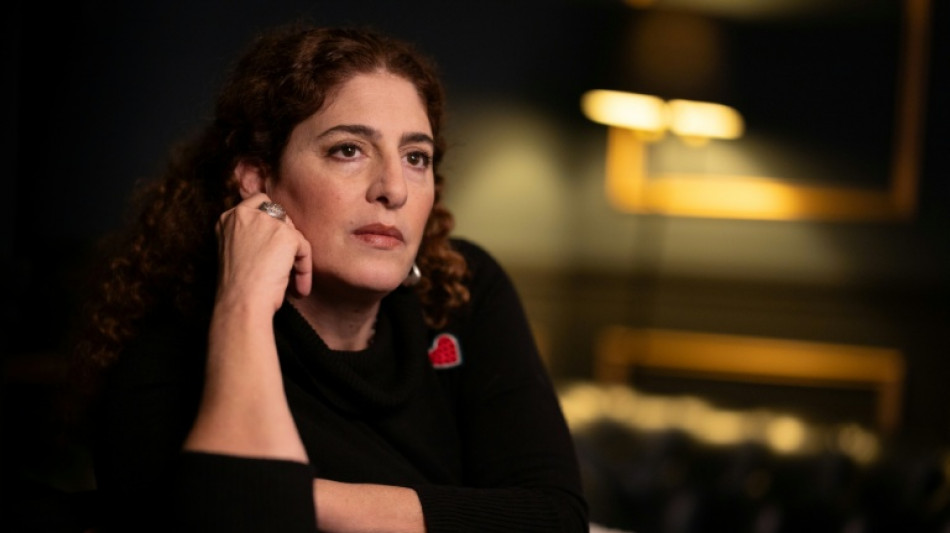
'Palestine 36' director says film is about 'refusal to disappear' / Photo: © AFP

 Inside the Venezuelan prison meant to 'drive you insane'

 UK king braces as memoir by Diana's brother goes on sale
 No green light to lift EU sanctions on Russian oligarchs, talks to resume

 UK agrees support for Saudi in struggle with Houthis: reports

 EU foreign policy chief calls for continued sanctions on Russia

 Flights scrapped, evacuations urged as Typhoon Dujuan wallops Japan

 Fonseca to take break from tennis

 A Cuban zoo, and its animals, in epic battle for survival

 Infantino proposes consulting federations to reform FIFA

 El Nino weather pattern enters record territory: scientist
 OpenAI calls for US to lead global effort on AI standards
 South African ostriches plucked alive for luxury fashion: report
 US networks halt Trump coverage in revolt over White House ban

 Paramount settles with US states to clear Warner Bros. mega-merger

 Climate crisis a job for world leaders, not just activists: UK FM
 US networks halt Trump coverage over White House ban
 French singer accuses Miley Cyrus of plagiarism

 EU fines Google 403 mn euros for location data breach

 'Best is yet to come,' says De la Fuente after Spain extension

 Why diesel prices are rising more than crude oil

 COP31 host says AI's climate footprint to be a summit priority

 Renewables hit record in 2025, but world must move faster: report

 US media outlets to sue Trump administration after White House ban

 Global stocks rally on lower oil prices, US-China hopes

 EU proposes energy rating for data centres

The director of Oscar-shortlisted film "Palestine 36" said her big-budget production about a crucial but little-known Arab rebellion is a statement about Palestinians "refusal to disappear".
Veteran filmmaker Annemarie Jacir started production on the sweeping historical epic just before Israel's devastating invasion of Gaza in October 2023.
Making the movie was a "financial disaster", she admitted in an interview with AFP, but encouraging critical reaction since its debut last September and its shortlisting for an Oscar have offered solace.
Nominated by Palestine for Best International Feature, it is the most cinematically ambitious of four productions that deal with the Israeli-Palestinian conflict that are in the running for an Academy Award in March.
"The cinema is not going to save us," said Jacir, a Palestinian born in Bethlehem in 1974 but now living in the Israeli port Haifa. "But it's about the refusal to disappear and this film for us was our refusal."
The Gaza war, sparked by an unprecedented attack by the Hamas militant group on Israel, saw US President Donald Trump and far-right Israeli government ministers openly discuss displacing Palestinians or annexing their remaining ancestral land.
Jacir explained that most accounts of modern Palestinian history begin with the creation of the state of Israel after World War II which led to the "Nakba" in 1948, the uprooting of nearly half the Palestinian population.
"We always start Palestinian history with the Nakba," she said.
As the title of her film suggests, she focuses on 1936 when colonial-era Britain was struggling to administer the holy land for which it assumed responsibility at the end of World War I.
Palestine was a hotbed of resentment and the scene of clashes between the Muslim-majority Palestinian population and newly arrived Jewish immigrants, most of whom were fleeing persecution in Europe.
"1936 is so critical and there's really been nothing done about it. And it sets the stage for everything," Jacir explained.
- 'Disaster' -
She follows a large cast of characters, from villagers losing their land to Zionist settlers, members of the corrupt Palestinian economic elite, as well as the brutally repressive British army and administrators.
Its mostly Arabic-speaking cast includes Oscar-winning British actor Jeremy Irons as a cynical British High Commissioner and Franco-Palestinian actress Hiam Abbass from "Succession" as a defiant village elder.
The project almost never made it to screens with the war in Gaza starting just as filming was about to start in the West Bank in late 2023.
Jacir had built a typical village from the 1930s over 12 months, but then had to abandon the site and move the cast to Jordan.
"We planted crops, and we built the bus, all the vehicles, the tanks, we made guns, the costumes" she told AFP. "Then we lost it all after October 7th... It was a nightmare, a financial disaster.
"Thank God for our financiers, including the BBC, the British Film Institute. Nobody abandoned us," she added.
The film is a sweeping fictionalised story set in the context of real events, with the dramatic climax being the Peel Commission which proposed the partition of Palestine and the creation of a Jewish state.
Ninety years later, with Palestinians limited to the destroyed Gaza enclave and the Israeli-controlled West Bank, and under constant pressure from settlers, Jacir says she no longer believes in a two-state solution.
Her vision? "You live as one people, one place without borders, without control. There is no other way."
She will find out later this month film her film gets the nod for an Oscar nomination as Best International Feature.
Another film about Palestinians, the gut-wrenching "The Voice of Hind Rajab" about a girl killed during the Gaza war, also made the 15-strong shortlist which is set to be reduced to five.
F.Müller--BTB