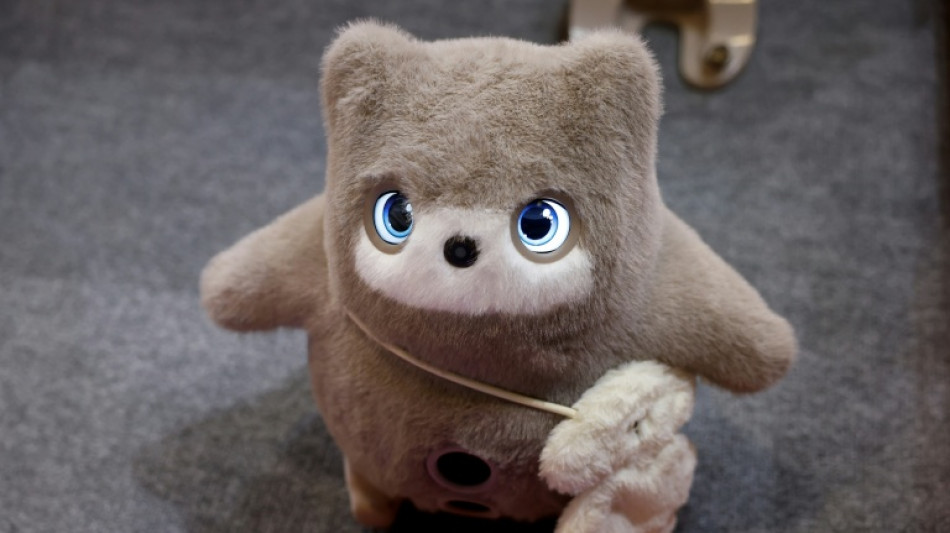
AI toys look for bright side after troubled start / Photo: © AFP

 Inside the Venezuelan prison meant to 'drive you insane'

 UK king braces as memoir by Diana's brother goes on sale

 No green light to lift EU sanctions on Russian oligarchs, talks to resume

 UK agrees support for Saudi in struggle with Houthis: reports

 EU foreign policy chief calls for continued sanctions on Russia

 Flights scrapped, evacuations urged as Typhoon Dujuan wallops Japan

 Fonseca to take break from tennis

 A Cuban zoo, and its animals, in epic battle for survival

 Infantino proposes consulting federations to reform FIFA

 El Nino weather pattern enters record territory: scientist

 OpenAI calls for US to lead global effort on AI standards

 South African ostriches plucked alive for luxury fashion: report

 US networks halt Trump coverage in revolt over White House ban

 Paramount settles with US states to clear Warner Bros. mega-merger

 Climate crisis a job for world leaders, not just activists: UK FM

 US networks halt Trump coverage over White House ban

 French singer accuses Miley Cyrus of plagiarism

 EU fines Google 403 mn euros for location data breach

 'Best is yet to come,' says De la Fuente after Spain extension

 Why diesel prices are rising more than crude oil

 COP31 host says AI's climate footprint to be a summit priority

 Renewables hit record in 2025, but world must move faster: report

 US media outlets to sue Trump administration after White House ban

 Global stocks rally on lower oil prices, US-China hopes

 EU proposes energy rating for data centres

Toy makers at the Consumer Electronics Show were adamant about being careful to ensure that their fun creations infused with generative artificial intelligence don't turn naughty.
That need was made clear by a recent Public Interest Research Groups report with alarming findings, including an AI-powered teddy bear giving advice about sex and how to find a knife.
After being prompted, a Kumma bear suggested that a sex partner could add a "fun twist" to a relationship by pretending to be an animal, according to the "Trouble in Toyland" report published in November.
The outcry prompted Singaporean startup FoloToy to temporarily suspend sales of the bears.
FoloToy chief executive Wang Le told AFP that the company switched to a more advanced version of the OpenAI model used.
When PIRG tested the toy for the report, "they used some words children would not use," Wang Le said.
He expressed confidence that the updated bear would either evade or not answer inappropriate questions.
Toy giant Mattel, meanwhile, made no mention of the report in mid-December when it postponed the release of its first toy developed in partnership with ChatGPT-maker OpenAI.
- Caution advised -
The rapid advancement of generative AI since ChatGPT's arrival has paved the way for a new generation of smart toys.
Among the four devices tested by PIRG was Curio's Grok -- not to be confused with xAI's voice assistant -- a four-legged stuffed toy inspired by a rocket that has been on the market since 2024.
The top performer in its class, Grok refused to answer questions unsuitable for a five-year-old.
It also allowed parents to override the algorithm's recommendations with their own and to review the content of interactions with young users.
Curio has received the independent KidSAFE label, which certifies that child protection standards are being applied.
However, the plush rocket is also designed to continuously listen for questions, raising privacy concerns about what it does with what is said around it.
Curio told AFP it was working to address concerns raised in the PIRG report about user data being shared with partners such as OpenAI and Perplexity.
"At the very least, parents should be cautious," Rory Erlich of PIRG said about having chatbot-enabled toys in the house.
"Toys that retain information about a child over time and try to form an ongoing relationship should especially be of concern."
Chatbots in toys do create opportunities for them to serve as tutors of sorts.
Turkish company Elaves says its round, yellow toy Sunny will be equipped with a chatbot to help children learn languages.
"Conversations are time-limited, naturally guided to end, and reset regularly to prevent drifting, confusion, or overuse," said Elaves managing partner Gokhan Celebi.
This was to answer the tendency that AI chatbots get into trouble -- spouting errors or going off the rails -- when conversations drag on.
Olli, which specializes in integrating AI into toys, has programmed its software to alert parents when inappropriate words or phrases are spoken during exchanges with built-in bots.
For critics, letting toy makers police themselves on the AI front is insufficient.
"Why aren't we regulating these toys?" asks Temple University psychology professor Kathy Hirsh-Pasek.
"I'm not anti-tech, but they rushed ahead without guardrails, and that's unfair to kids and unfair to parents."
L.Dubois--BTB