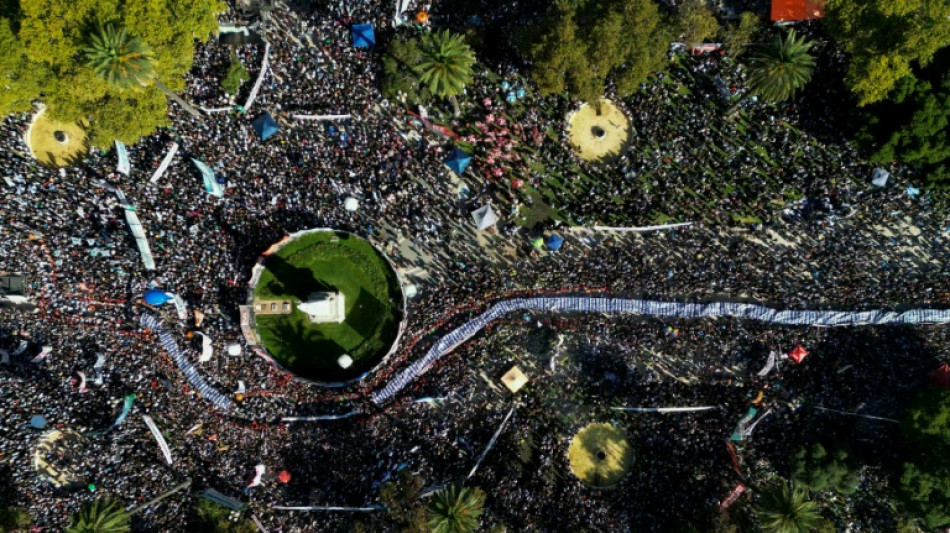
Huge crowd in Buenos Aires marks 50 years since Argentina's coup / Photo: © AFP

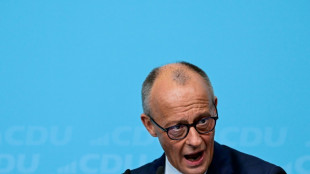
 Germany's Merz vows to stay course despite new vote losses

 Man City outgun Sunderland despite Brobbey hat-trick, Man Utd rescue Fulham draw

 Mourinho blames ref committee for Real Madrid derby defeat

 Maresca craves a 1-0 win after eight-goal Man City thriller
 Atletico Madrid beat Real Madrid in tense derby clash
 Reusser retains world time-trial title

 Man City outgun Sunderland despite Brobbey hat-trick, Liverpool win at Bournemouth

 Top US, Chinese economic officials meet ahead of Trump-Xi summit
 Erdogan's LGBTQ crackdown 'first step of election campaign': activist
 Mass drone barrage on Moscow kills two

 82-year-old dies after beach fight in Greece over sun lounger

 US warns of rapid escalation in Mideast war

 Iran 'put hearts on the court' to win Asian Games basketball bronze

 School girl Yu helps China dominate in Asian Games swimming openers
 Myanmar win first Asian Games teqball gold as Spain great Puyol watches

 China's 13-year-old Yu scorches to first major gold at Asian Games
 Russians vote on last day of parliamentary elections
 Hong Kong pays final respects to former city leader Tung

 Typhoon put people off Asian Games opening ceremony, official says

 China's 13-year-old Yu cruises as Asian Games swimming begins

 AI 'warning shots' focus Beijing on national security risks

 Philippine tribe in limbo over US-led tech hub
 Leo XIV, first US pope transcends his restrained style

 Singer Ed Sheeran says Gaza situation 'unjustifiable' following controversy
 In 'Tenzing', a Sherpa mountaineer gets his due
A crowd into the tens of thousands gathered in Buenos Aires on Tuesday to mark 50 years since Argentina's military ushered in years of dictatorship with a coup on March 24, 1976.
AFP journalists saw one of the biggest rallies in the capital in years converge on Plaza de Mayo, the city's traditional focal point and home to the Casa Rosada presidential complex.
Other cities also drew crowds after social and political groups called for countrywide demonstrations under the slogans "Memory, Truth and Justice" and "Never again" in memory of the victims.
Valeria Coronel, a 43-year-old teacher, was holding her eight-year-old daughter's hand as they joined the rally.
"Memory gets passed down from generation to generation so that the struggle continues," she told AFP. "That's the legacy I want to leave her."
Some people released white balloons into the sky while others bore banners with slogans including "They didn't defeat us."
Others carried photographs of relatives who never emerged from detention, with some carrying placards saying "We are still looking for you."
The Mothers and Grandmothers of Plaza de Mayo headed up the march as they continued a tradition that began during the dictatorship, when they started gathering in the square to demand information on the whereabouts of their abducted children.
The group has recovered the identities of 140 grandchildren taken from their families as infants or born in captivity. It is estimated that more than 300 remain to be found.
"What do you think -- 140 resolved cases?" said 95-year-old Estela De Carlotto, president of the association.
"Every return of a grandchild is evidence of the atrocities committed by sinister state terrorism: disappearances, murders, theft, abduction of minors and forgery of official documents," added Carlotto, whose own grandson was the 114th to be found.
The 1976 coup overthrew president Isabel Peron, who had replaced her husband Juan Peron after he died in office.
- Memory and political dispute -
Current far-right President Javier Milei's government disputes claims by rights groups that around 30,000 people died or disappeared under the dictatorship, one of Latin America's bloodiest, which ended in 1983.
The government estimates the number of disappeared at officially fewer than 9,000, maintaining that there were excesses committed on both sides in the dictatorship years, and playing down the role of military violence.
On Tuesday, the presidential office released a video denouncing a "biased and revanchist perspective" as a prism through which history of that time has been studied, claiming that the left has used it as an "instrument of manipulation."
The military regime brutally clamped down on resistance from dissidents including a left-wing guerrilla movement, students and labor activists, detaining thousands in camps such as Buenos Aires' infamous ESMA naval school.
Argentine officials last week published almost 500 pages of intelligence documents dating from 1973-1983, including the seven-year period of the military dictatorship.
The long-classified documents range from shopping lists to surveillance records of universities, unions, businesses and political organizations.
"The publication of historical archives strengthens institutional credibility, helps debunk conspiracy theories and demonstrates a commitment to the truth," according to a guide published with the documents.
I.Meyer--BTB