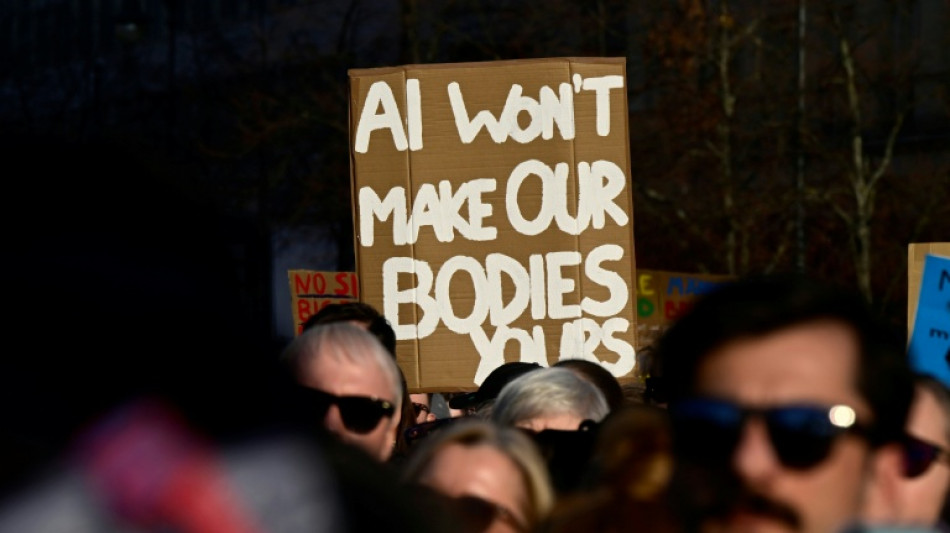
AI making cyber attacks costlier and more effective: Munich Re / Photo: © AFP/File

 Germany's Merz vows to stay course despite new vote losses

 Man City outgun Sunderland despite Brobbey hat-trick, Man Utd rescue Fulham draw

 Mourinho blames ref committee for Real Madrid derby defeat

 Maresca craves a 1-0 win after eight-goal Man City thriller
 Atletico Madrid beat Real Madrid in tense derby clash

 Reusser retains world time-trial title

 Man City outgun Sunderland despite Brobbey hat-trick, Liverpool win at Bournemouth

 Top US, Chinese economic officials meet ahead of Trump-Xi summit
 Erdogan's LGBTQ crackdown 'first step of election campaign': activist
 Mass drone barrage on Moscow kills two

 82-year-old dies after beach fight in Greece over sun lounger

 US warns of rapid escalation in Mideast war

 Iran 'put hearts on the court' to win Asian Games basketball bronze

 School girl Yu helps China dominate in Asian Games swimming openers

 Myanmar win first Asian Games teqball gold as Spain great Puyol watches

 China's 13-year-old Yu scorches to first major gold at Asian Games
 Russians vote on last day of parliamentary elections

 Hong Kong pays final respects to former city leader Tung

 Typhoon put people off Asian Games opening ceremony, official says

 China's 13-year-old Yu cruises as Asian Games swimming begins

 AI 'warning shots' focus Beijing on national security risks

 Philippine tribe in limbo over US-led tech hub

 Leo XIV, first US pope transcends his restrained style

 Singer Ed Sheeran says Gaza situation 'unjustifiable' following controversy

 In 'Tenzing', a Sherpa mountaineer gets his due
Artificial intelligence is making cyberattacks increasingly sophisticated and costlier for businesses, reinsurer Munich Re said Wednesday, warning of methods ranging from highly personalised phishing emails to computer-generated, convincing fake identities.
"If cybercrime were a country, it would be the third-largest economy in the world", behind only the United States and China, the reinsurer said in a report.
Citing figures from market analysis firm Statista, Munich Re projected cybercrime will generate global losses of some $14 billion (12.07 bn euros) in 2028.
Martin Kreuzer, head of cyber risks at Munich Re, told AFP that "automation now plays a central role", enabling attackers to operate "efficiently and in a more targeted way".
"They rely on highly personalised phishing emails, automatically generated malware, and synthetic identities that appear deceptively real," he said.
The trend of "agentic AI" means the advent of systems that can "act autonomously, make decisions, and even circumvent defensive mechanisms," according to Kreuzer.
The most widespread cyberattacks are still ransomware, in which hackers lock systems and demand money to release them.
Munich Re's study says that the number of publicly reported attacks of this kind "increased by nearly 50 percent in 2025 and... continue unabated in 2026".
Coordinated attacks via networks of hijacked devices, used to overwhelm systems, also more than doubled in 2025 and are becoming more common thanks to services available for hire.
At a more advanced level, criminals are collaborate with states, concealing the origin of attacks and accelerating their global operations.
"Nation-state actors are among the most professional players in the cyber threat landscape," said Kreuzer.
"Here we are seeing both an evolution of tools and methods, and the emergence of hybrid warfare driven by geopolitical motives," he said, adding that "disinformation is increasingly being used as a weapon".
The study notes that while attacks on large businesses attract most public attention, "the majority of cyber incidents and claims affect micro-companies and SMEs".
Compared with risks from natural catastrophes, for which almost half of all losses were insured in 2025, Kreuzer said that "cyber risk coverage is still far too low, with only a fraction insured".
L.Janezki--BTB