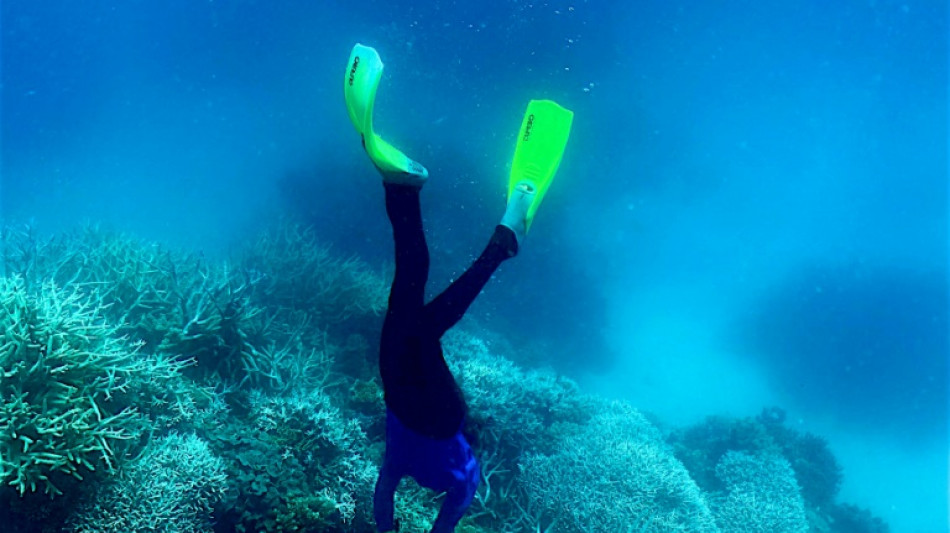
Great Barrier Reef sees fragile coral comeback / Photo: © AFP

 Multi-Asset Trading Venue Monochrome Exchange Announces IEO of Its Native Token, $MCR

 South Korea break Japan hearts to win Asian Games basketball gold
 Acosta takes first victory at Austrian MotoGP

 PSG president Nasser al-Khelaifi under investigation in France for conflict of interest

 China swim sensation, 13, sets Games record after Japan win early

 Drones hit Moscow as Russians go to the polls

 New England boss Fleming says 'wrong' to ask Stokes to end retirement

 Germans vote in elections threatening fresh blow to Merz

 US fears rapid escalation in Mideast after Houthis attack Riyadh

 Japan triathlete Hojo wins first gold of Asian Games

 IOC president impressed by 'beautiful' Asian Games wooden huts

 First Asian Games gold goes to Japan as China's 13-year-old Yu lights up pool

 Data centre command hub keeps AI up and running

 Pope Leo in France: the issues on the table

 Packing for a pope: behind the scenes on foreign trips

 Republicans find transgender issues a powerful political weapon in midterm campaigning

 German state elections threaten new shock waves for Merz

 Chile's Bachelet quits race to be next UN chief

 Raphinha treble fires perfect Barca to win at Sevilla

 Thiam makes winning heptathlon return at Decastar meet

 Czechs beat USA to qualify for Davis Cup finals

 Dortmund sink Stuttgart to climb to Bundesliga summit

 Trump says will not tolerate attempts to slow AI growth

 'It has to stop': runners protest women's murders in S.Africa district

 Fire erupts near Riyadh airport as Houthis claim strikes

Parts of Australia's beleaguered Great Barrier Reef now have the highest levels of coral cover seen in decades, a government report said Thursday, suggesting the aquatic wonder could survive given the chance.
Portions of the vast UNESCO heritage site showed a marked increase in coral cover in the last year, reaching levels not seen in 36 years of monitoring, the Australian Institute of Marine Science said.
Scientists surveying 87 sites said northern and central parts of the reef had bounced back from damage more quickly than some had expected, thanks mainly to fast-growing Acropora -- a branching coral that supports thousands of marine species.
"These latest results demonstrate the reef can still recover in periods free of intense disturbances," said the Australian Institute of Marine Science's CEO Paul Hardisty.
But far from declaring victory, Hardisty warned the gains could easily be reversed by cyclones, new bleaching events or crown-of-thorns outbreaks.
He pointed to a reversal in fortunes for the southern portion of the reef, which a year ago had appeared to be on the mend, but was now in decline again.
"This shows how vulnerable the reef is to the continued acute and severe disturbances that are occurring more often, and are longer-lasting," he said.
Coral coverage has increased by 36 percent across sites monitored in the northern part of the reef, up from 27 percent in 2021.
But the picture was less encouraging as the scientists moved south, with a smaller increase in cover in the reef's central belt and a marked decrease in coral cover in the south.
The spread of coral-killing crown-of-thorns starfish has also taken a toll.
Only fierce lobbying by the Australian government stopped the reef from being labelled "in danger" by UNESCO -- a potentially devastating blow to the country's multi-billion-dollar tourism industry.
Many fear that the speeding rate of damage could cause the reef to be destroyed entirely.
Marine scientist Terry Hughes said it was "good news" that coral was regrowing, but warned the species driving the recovery were very vulnerable to ocean heating.
He added that replacing large, old, slow-growing corals that had defined the reef was likely "no longer possible. Instead we're seeing partial reassembly of fast-growing, weedy corals before the next disturbance."
Zoe Richards a researcher at the Coral Conservation and Research Group at Curtin University also cautioned against over-optimism.
"This recovery trend is driven by a handful of Acropora species which often grow in a boom-and-bust pattern," she said. "This means that the next thermal stress event could easily decimate these coral communities once again."
"We are already finding evidence that each mass bleaching event leads to local extinctions of rarer species, so the short-term success of a handful of fast-growing coral species masks the full story about the largely hidden losses of biodiversity."
J.Horn--BTB