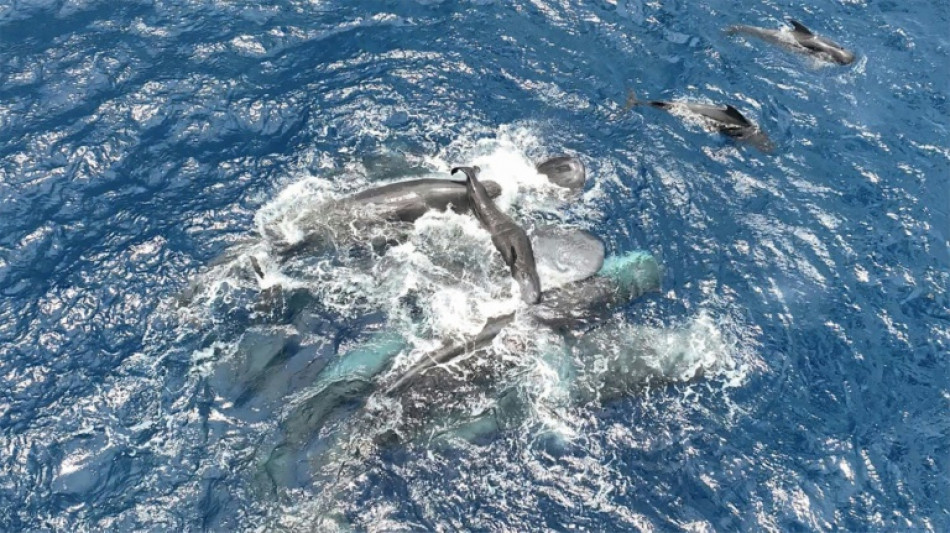
Whale filmed giving birth, with a little help from her friends / Photo: © Project CETI/AFP

 Macron welcomes Canada's Carney to French Atlantic territory

 Fiorentina frustrate Napoli with Serie A draw, Como upset

 Five-star Man City top Premier League after Sunderland thriller

 Ukrainian drones hit Moscow on last day of Russian elections

 Multi-Asset Trading Venue Monochrome Exchange Announces IEO of Its Native Token, $MCR

 South Korea break Japan hearts to win Asian Games basketball gold

 Acosta takes first victory at Austrian MotoGP

 PSG president Nasser al-Khelaifi under investigation in France for conflict of interest

 China swim sensation, 13, sets Games record after Japan win early

 Drones hit Moscow as Russians go to the polls

 New England boss Fleming says 'wrong' to ask Stokes to end retirement

 Germans vote in elections threatening fresh blow to Merz

 US fears rapid escalation in Mideast after Houthis attack Riyadh

 Japan triathlete Hojo wins first gold of Asian Games

 IOC president impressed by 'beautiful' Asian Games wooden huts

 First Asian Games gold goes to Japan as China's 13-year-old Yu lights up pool

 Data centre command hub keeps AI up and running

 Pope Leo in France: the issues on the table

 Packing for a pope: behind the scenes on foreign trips

 Republicans find transgender issues a powerful political weapon in midterm campaigning

 German state elections threaten new shock waves for Merz

 Chile's Bachelet quits race to be next UN chief

 Raphinha treble fires perfect Barca to win at Sevilla

 Thiam makes winning heptathlon return at Decastar meet

 Czechs beat USA to qualify for Davis Cup finals

Scientists have managed to film a spectacular event rarely witnessed by humans: a sperm whale giving birth while other females worked together to support the mother and her newborn.
A team from Project CETI, an international effort seeking to understand how whales communicate, were in a boat near a pod of 11 whales off the coast of the Caribbean island of Dominica on July 8, 2023.
A 19-year-old female named Rounder was surrounded by family members and others as she was about to give birth to her second calf.
Over nearly five and a half hours, the scientists documented the group's behaviour, watching them from the boat, filming them with drones and recording the sounds underneath the waves.
The data they collected, which was published in the journals Scientific Reports and Science on Thursday, represent an exceptional rarity in the history of science.
Out of 93 species of cetaceans -- a group that includes whales, dolphins and porpoises -- only nine have ever been observed giving birth in the wild.
Rarer still was that whales not related to the mother were helping out.
"This is the first evidence of birth assistance in non-primates," Project CETI team member Shane Gero told the New Scientist.
"It is fascinating to see the intergenerational support from the grandmother to her labouring daughter, and the support from the other, unrelated females."
- Lifting up the newborn -
The birth lasted 34 minutes, from their tails emerging from the water to the calf being born.
During labour, other adult females dove under Rounder's dorsal fin, often on their backs with the heads facing her genital slit.
Immediately after the birth, the pod's behaviour "rapidly changed" as every member became active, according to the study in Scientific Reports.
All the adults were "squeezing the newborn's body between theirs, touching it with their heads", the researchers wrote.
The whales pointed their noses towards the newborn, "pushing it around, under the water, and onto and across their bodies above the surface".
The remarkable behaviour dates back more than 36 million years and is believed to be due to the unique history of cetaceans.
After their distant ancestors left the water and adapted to life on land, cetaceans are the only mammals that returned to the ocean.
This dive back into the water required some evolutionary tricks to prevent newborns from drowning.
For example, whale calves are born tail-first, rather than head-first like other mammals.
However, while newborn sperm whales become talented swimmers within a few hours, they still sink right after birth.
So other whales have to lift the calf up "to prevent the newborn from sinking while also facilitating its first breaths", the researchers suggested.
Primates -- including humans -- are the only other mammals known to help assist each other out during birth.
- Excited vocal sounds -
The scientists also recorded the whales making many sounds, including significant changes in "vocal style" during key events, the study said.
This included when a group of pilot whales approached the pod after the birth.
The changes in vocalisation suggest that the group was coordinating to support the birth -- or protect the newborn, the researchers said.
Sperm whales have one of the longest pregnancies in the animal kingdom, with a gestation period that lasts up to 16 months.
When calves are born they are already four metres (13 feet) long. They will rely on their mother's milk for at least two years.
As they grow, the young become the centre of their pod's social unit, with others helping out with babysitting while the mother searches for food.
After the birth was filmed in 2023, the pod was not spotted again for over a year. Then the newborn was spotted with Accra and Aurora -- the other young members of the pod -- on July 25 last year.
Surviving its first year is a good sign that the sperm whale will reach adulthood, the Project CETI team said.
L.Janezki--BTB