-
 Macron welcomes Canada's Carney to French Atlantic territory
-
Reusser retains world time-trial title

-
 Fiorentina frustrate Napoli with Serie A draw, Como upset
-
Man City outgun Sunderland despite Brobbey hat-trick, Liverpool win at Bournemouth

-
 Five-star Man City top Premier League after Sunderland thriller
-
Top US, Chinese economic officials meet ahead of Trump-Xi summit

-
 Ukrainian drones hit Moscow on last day of Russian elections
-
Erdogan's LGBTQ crackdown 'first step of election campaign': activist

-
 Multi-Asset Trading Venue Monochrome Exchange Announces IEO of Its Native Token, $MCR
-
Mass drone barrage on Moscow kills two
-
 South Korea break Japan hearts to win Asian Games basketball gold
-
82-year-old dies after beach fight in Greece over sun lounger

-
 Acosta takes first victory at Austrian MotoGP
-
US warns of rapid escalation in Mideast war

-
 PSG president Nasser al-Khelaifi under investigation in France for conflict of interest
-
Iran 'put hearts on the court' to win Asian Games basketball bronze

-
 China swim sensation, 13, sets Games record after Japan win early
-
School girl Yu helps China dominate in Asian Games swimming openers

-
 Drones hit Moscow as Russians go to the polls
-
Myanmar win first Asian Games teqball gold as Spain great Puyol watches

-
 New England boss Fleming says 'wrong' to ask Stokes to end retirement
-
China's 13-year-old Yu scorches to first major gold at Asian Games
-
 Germans vote in elections threatening fresh blow to Merz
-
Russians vote on last day of parliamentary elections

-
 US fears rapid escalation in Mideast after Houthis attack Riyadh
-
Hong Kong pays final respects to former city leader Tung

-
 Japan triathlete Hojo wins first gold of Asian Games
-
Typhoon put people off Asian Games opening ceremony, official says
-
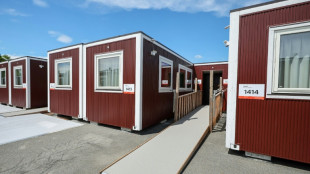 IOC president impressed by 'beautiful' Asian Games wooden huts
-
China's 13-year-old Yu cruises as Asian Games swimming begins

-
 First Asian Games gold goes to Japan as China's 13-year-old Yu lights up pool
-
AI 'warning shots' focus Beijing on national security risks

-
 Data centre command hub keeps AI up and running
-
Philippine tribe in limbo over US-led tech hub

-
 Pope Leo in France: the issues on the table
-
Leo XIV, first US pope transcends his restrained style

-
 Packing for a pope: behind the scenes on foreign trips
-
Singer Ed Sheeran says Gaza situation 'unjustifiable' following controversy

-
 Republicans find transgender issues a powerful political weapon in midterm campaigning
-
In 'Tenzing', a Sherpa mountaineer gets his due

-
 German state elections threaten new shock waves for Merz
-
Ed Sheeran set to return to stage after Palestinian controversy

-
 Chile's Bachelet quits race to be next UN chief
-
Toulouse edge Vannes, Lyon beat Pau to take Top 14 summit

-
 Raphinha treble fires perfect Barca to win at Sevilla
-
Germans arrested for Louvre stunt in Mona Lisa hall
-
 Thiam makes winning heptathlon return at Decastar meet
-
Saudi-led coalition says Houthis fired ballistic missile at Riyadh

-
 Czechs beat USA to qualify for Davis Cup finals
-
France's debt climbs to highest since 1978: ministry
Artemis astronauts survey lunar surface on flyby, solar eclipse up next
The four astronauts carrying out NASA's first lunar flyby in more than half-a-century were sending back detailed observations of the Moon after traveling further from Earth than any human before.
NASA's mission control in Houston regained contact with the crew after they temporarily lost signal for some 40 minutes, as their spacecraft passed behind Earth's natural satellite.
"It is so great to hear from Earth again," said astronaut Christina Koch, as the crewmembers were once again able to speak with humans on their home planet.
"We will always choose Earth, we will always choose each other."
Earlier the Artemis II team broke the distance record set by the 1970 Apollo 13 mission, which they were expected to surpass by 4,105 miles (6,606 kilometers) when they reached the journey's anticipated furthest distance from Earth -- 252,760 miles (406,778 kilometers).
It was one of the voyage's most notable achievements yet.
Astronaut Jeremy Hansen said the moment was "to challenge this generation and the next, to make sure this record is not long-lived."
The lunar flyby observation period will continue until approximately 9:20pm eastern (0120 GMT).
Soon astronauts will witness a solar eclipse, when the Sun will be behind the Moon.
- 'Wow' -
The more than six-hour task of observing and documenting the lunar surface brought human perspective to features of the Moon that we primarily know through photographs taken by robots.
Victor Glover detailed the "terminator" -- the Moon's boundary between night and day.
"Wow -- I wish I had some more time to just sit here and describe what I'm seeing," he said, before creating a vivid portrait for the scientists listening in from Earth.
"But the terminator right now is just fantastic. It is the most rugged that I've seen it from a lighting perspective."
Kelsey Young, the lead scientist for the Artemis II mission, responded with elation. "Oh my gosh, that was an amazing picture you just painted," she said.
"Those types of observations are things that humans are uniquely able to contribute, and you just really brought us along with you."
Fellow astronaut Christina Koch meanwhile offered a colorful rendering of lunar craters.
"What it really looks like is like a lampshade with tiny pinprick holes and the light shining through," she said. "They are so bright compared to the rest of the Moon."
- Moon memorials -
The Orion capsule is zipping around the Moon before U-turning and heading back to Earth in a so-called "free-return trajectory," a return-trip that will take about four days.
Adding to the historic nature of the mission led by Reid Wiseman, the Artemis II crew includes several firsts.
Glover will be the first person of color to fly around the Moon, Koch will be the first woman, and Canadian Hansen the first non-American.
Monday's celestial workday included a poignant moment just after the crew broke the distance record, when they proposed designating two previously unnamed craters.
The first they requested to name in honor of their spacecraft's nickname, "Integrity."
They offered a second name, "Carroll," for another crater, which they asked be named after the late wife of mission commander Reid Wiseman, who died of cancer.
"It's a bright spot on the Moon," said Hansen, his voice breaking with emotion. "And we would like to call it Carroll."
The astronauts embraced, and mission control in Houston held a moment of silence.
"Integrity and Carroll crater, loud and clear. Thank you," said Gibbons.
NASA said they would formally submit the name proposals to the International Astronomical Union, the body charged with naming celestial bodies and surface features.
H.Seidel--BTB