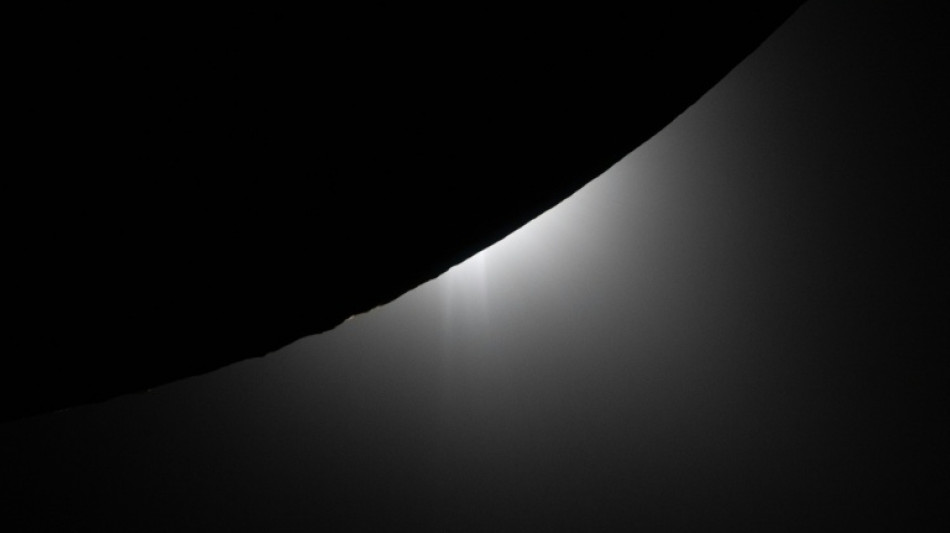
Artemis astronauts to shed light on space health risks / Photo: © NASA/AFP

 Multi-Asset Trading Venue Monochrome Exchange Announces IEO of Its Native Token, $MCR

 South Korea break Japan hearts to win Asian Games basketball gold

 Acosta takes first victory at Austrian MotoGP

 PSG president Nasser al-Khelaifi under investigation in France for conflict of interest

 China swim sensation, 13, sets Games record after Japan win early

 Drones hit Moscow as Russians go to the polls

 New England boss Fleming says 'wrong' to ask Stokes to end retirement

 Germans vote in elections threatening fresh blow to Merz
 US fears rapid escalation in Mideast after Houthis attack Riyadh

 Japan triathlete Hojo wins first gold of Asian Games
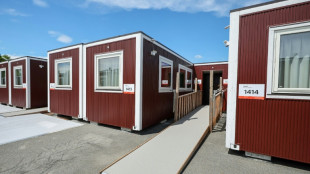 IOC president impressed by 'beautiful' Asian Games wooden huts

 First Asian Games gold goes to Japan as China's 13-year-old Yu lights up pool

 Data centre command hub keeps AI up and running

 Pope Leo in France: the issues on the table

 Packing for a pope: behind the scenes on foreign trips

 Republicans find transgender issues a powerful political weapon in midterm campaigning

 German state elections threaten new shock waves for Merz

 Chile's Bachelet quits race to be next UN chief

 Raphinha treble fires perfect Barca to win at Sevilla

 Thiam makes winning heptathlon return at Decastar meet

 Czechs beat USA to qualify for Davis Cup finals

 Dortmund sink Stuttgart to climb to Bundesliga summit

 Trump says will not tolerate attempts to slow AI growth

 'It has to stop': runners protest women's murders in S.Africa district

 Fire erupts near Riyadh airport as Houthis claim strikes

While the Artemis II astronauts have been protected from the icy vacuum of space on their journey, their bodies have nonetheless been left exposed to possibly high levels of radiation -- a danger of space travel that NASA is anxiously waiting to study.
Their trip around the Moon has taken the four astronauts farther into space than any human before -- more than 1,000 times the distance from Earth to the International Space Station.
Earth's magnetosphere offers some protection against radioactive cosmic rays and solar particles to the orbiting ISS, but no such cover on the Moon.
Studying the impacts of radiation is essential as NASA hopes to eventually build a Moon base and send astronauts on the long trip to Mars.
The US space agency installed radiation sensors on the Orion capsule and took blood samples of the astronauts before takeoff to compare with samples post-trip. The crew's saliva samples are gathered throughout the journey and their health is monitored via smartwatches.
NASA has also placed state-of-the-art computer chips in the capsule that can replicate certain physiological functions, like that of an organ.
Mission planners chose to mimic bone marrow, which produces blood cells and is one of the tissues "most quickly affected by radiation and other stressors," NASA Human Research Program chief scientist Steven Platts told AFP.
With all of the data, Platts said his team hoped to better understand the variation between low earth orbit and deep space.
"It will be good research information for us to see the level of radiation, but also the type of radiation," he said.
"Our prediction is that we'll see a lot more galactic cosmic radiation... which is from supernovas and is everywhere," versus radiation coming from the Sun, he said.
- Mental health -
Platts said while most people associate radiation with cancer risk, it also can impact the central nervous system and blood circulation.
"It can lead to inflammation in the brain, and that's one of the things that can increase the risk of Parkinson's disease," he said.
With the Artemis II astronauts spending just 10 days in space, radiation is not a major concern, but the danger could rise dramatically with longer stays on the Moon.
Extensive health studies were conducted on the Apollo astronauts, but technology has advanced greatly in the 50 years since, said Bruce Betts, chief scientist at the Planetary Society, a space advocacy group.
"There will be a lot of information on the medical side of things," he said.
The other major focus is on psychological risks of spending long periods of time on the Moon or Mars.
With greater disconnection from home and tight living quarters, mental health could pose the greatest danger to astronauts on such missions, Platts said.
He compared the difference between the ISS and the tiny Orion capsule as like going from a "six-bedroom house, like a mansion... to a camper van."
B.Shevchenko--BTB