
Key Atlantic current could weaken more than expected: study / Photo: © AFP/File

 Multi-Asset Trading Venue Monochrome Exchange Announces IEO of Its Native Token, $MCR

 South Korea break Japan hearts to win Asian Games basketball gold

 Acosta takes first victory at Austrian MotoGP

 PSG president Nasser al-Khelaifi under investigation in France for conflict of interest

 China swim sensation, 13, sets Games record after Japan win early

 Drones hit Moscow as Russians go to the polls

 New England boss Fleming says 'wrong' to ask Stokes to end retirement

 Germans vote in elections threatening fresh blow to Merz

 US fears rapid escalation in Mideast after Houthis attack Riyadh

 Japan triathlete Hojo wins first gold of Asian Games

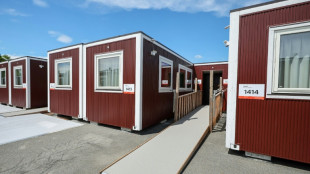 IOC president impressed by 'beautiful' Asian Games wooden huts

 First Asian Games gold goes to Japan as China's 13-year-old Yu lights up pool

 Data centre command hub keeps AI up and running

 Pope Leo in France: the issues on the table

 Packing for a pope: behind the scenes on foreign trips

 Republicans find transgender issues a powerful political weapon in midterm campaigning

 German state elections threaten new shock waves for Merz

 Chile's Bachelet quits race to be next UN chief

 Raphinha treble fires perfect Barca to win at Sevilla

 Thiam makes winning heptathlon return at Decastar meet

 Czechs beat USA to qualify for Davis Cup finals

 Dortmund sink Stuttgart to climb to Bundesliga summit

 Trump says will not tolerate attempts to slow AI growth

 'It has to stop': runners protest women's murders in S.Africa district

 Fire erupts near Riyadh airport as Houthis claim strikes

A key Atlantic Ocean current system that helps regulate the planet's climate could weaken more than expected by 2100, with potentially devastating consequences worldwide, a new study has found.
Known as Atlantic Meridional Overturning Circulation (AMOC), this conveyor belt of currents plays a crucial role in redistributing heat by transporting warmer waters from the tropics northward.
An AMOC collapse could lead to harsher winters in northern Europe, droughts in South Asia and the Sahel region in Africa, and higher sea levels in North America, among other consequences.
Previous climate model projections have estimated an average slowdown of around 32 percent by the end of the century due to climate change.
The latest study, published Wednesday in the journal Science Advances, estimates that the system could slow by 51 percent by 2100 under a mid-range scenario for greenhouse gas emissions, with a margin of error of plus or minus eight percentage points.
"We obtained an estimate of a future AMOC slowdown that is more severe than we expected," climate scientist Valentin Portmann, the paper's lead author, told AFP.
"We are closer to a critical state that is worrying," Portmann said.
Predicting what will happen to AMOC in the future is a topic of debate in the scientific community.
"There is a kind of consensus on the fact that this circulation will slow down. But there is still quite a bit of debate about the intensity of this slowdown," said Florian Sevellec, research director at the French National Centre for Scientific Research (CNRS) in Brest, France.
- Refining predictions -
In its 2021 report, the UN's Intergovernmental Panel on Climate Change said AMOC will "very likely decline" over this century.
But the panel of international experts also expressed "medium confidence" that a collapse of AMOC would not take place before 2100.
The latest study, conducted by researchers from the CNRS and the University of Bordeaux in southwest France, seeks to "refine this estimate of the future slowdown" and "reduce uncertainty", Sevellec said.
While nearly all climate models predict an AMOC slowdown by 2100, the projections range widely: from as little as three percent to as much as 72 percent, depending on varying emissions scenarios.
Portmann said the new study seeks to narrow that uncertainty using "observational constraints" -- a statistical approach that combines real-world observations with results from climate models.
- 'The debate is not over' -
Stefan Rahmstorf, an oceanographer at the Potsdam Institute for Climate Impact Research (PIK), said the paper showed that pessimistic models "are unfortunately the realistic ones, in that they agree better with observational data".
Rahmstorf, who who was not involved in the study, said that this means AMOC would be so weak by 2100 that it would "very likely" be "on the way to full shutdown".
Fabien Roquet, a physical oceanography professor at the University of Gothenburg in Sweden, said the study was interesting but he cautioned that another team using a similar method reached opposite conclusions last year.
"What is certain, however, is that the climate is warming rapidly," Roquet said.
"Whether the AMOC weakens or not, large-scale changes are already underway... and should intensify in the coming decades."
"The debate is not over," said Sevellec, who was also not part of the research team but whose thesis on AMOC was used for the study. "One paper does not settle a scientific debate."
M.Ouellet--BTB