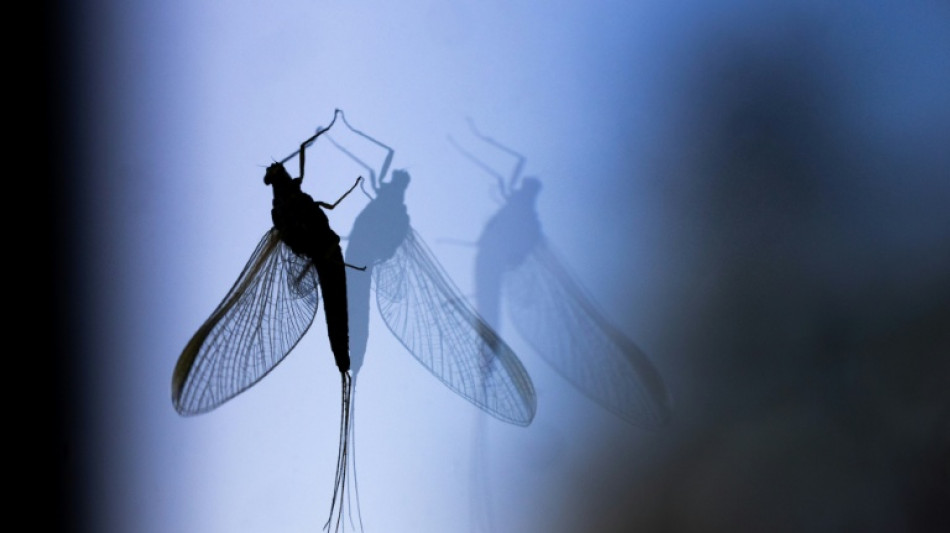
Drivers help study road-trip mystery: what became of bug splats? / Photo: © AFP

 US warns of rapid escalation in Mideast war

 Iran 'put hearts on the court' to win Asian Games basketball bronze

 School girl Yu helps China dominate in Asian Games swimming openers

 Myanmar win first Asian Games teqball gold as Spain great Puyol watches

 China's 13-year-old Yu scorches to first major gold at Asian Games

 Russians vote on last day of parliamentary elections

 Hong Kong pays final respects to former city leader Tung

 Typhoon put people off Asian Games opening ceremony, official says

 China's 13-year-old Yu cruises as Asian Games swimming begins

 AI 'warning shots' focus Beijing on national security risks

 Philippine tribe in limbo over US-led tech hub

 Leo XIV, first US pope transcends his restrained style

 Singer Ed Sheeran says Gaza situation 'unjustifiable' following controversy

 In 'Tenzing', a Sherpa mountaineer gets his due

 Ed Sheeran set to return to stage after Palestinian controversy

 Toulouse edge Vannes, Lyon beat Pau to take Top 14 summit

 Germans arrested for Louvre stunt in Mona Lisa hall

 Saudi-led coalition says Houthis fired ballistic missile at Riyadh

 France's debt climbs to highest since 1978: ministry

 McIlroy two shots off the lead at Wentworth after eagle on 18

 Martinez brace saves Inter in Serie A top-two clash with Roma

 Rosenior abused but guides Paris FC past old club Strasbourg

 Seven-try Lyon beat Pau, climb to Top 14 summit

 Brighton defeat a 'big lesson' against complacency for Arsenal, says Arteta

 Thousands protest inaction over climate crisis in Switzerland

Long an emblem of the summer road trip, squashed bugs on the car have become less numerous over the years, many people say -- causing concern about the health of the world's insect populations.
While drivers may be happy to have less yuckiness to clean from their windscreens, a perceived decline in flying insects hit by vehicles has some experts worried about the creatures, which play a vital role in the environment as pollinators, ecosystem balancers and food sources for other species.
But anecdotal evidence is one thing. Studying the so-called "windshield phenomenon" is another.
So scientists in France have launched an app-based study that enlists drivers as volunteer researchers.
Users download the free app, Bugs Matter, count the number of squished bugs on their number plates at the end of a trip, and send the results to be compiled as part of what the programme's creators hope will be a massive citizen science project.
The study is being run by the National Museum of Natural History (MNHN), the environmental groups OPIE and Noe and the French Biodiversity Office.
One app user, Marjorie, brought AFP on a car trip with her to Enghien-les-Bains, north of Paris, to take the app for a test drive before using it on a long road trip.
Step one: wipe the licence plate clean. Step two: enter geolocation data. Step three: drive.
"I'm 53, and I remember how as a kid, on long car trips when we stopped to fill the tank, there was always the obligatory clean-the-windscreen stage," said Marjorie.
"We hardly do that anymore."
- 'Pretty incredible' -
The study follows others around the world that have found declining insect numbers, including previous car-based studies in Denmark and the United Kingdom that both found sharp reductions in splats.
The two-decade-long Danish study, which ran until 2017, found reductions of 80 and 97 percent on two stretches of road in Denmark, while the UK study -- which also used the Bugs Matter app and is still ongoing -- found a decline of nearly 63 percent from 2021 to 2024.
A German study published in 2017 found a "dramatic decline" of more than 75 percent in the average biomass of flying insects in protected nature reserves.
"It's pretty incredible. Imagine going into the supermarket and finding only two out of every 10 products are in stock," said MNHN's Gregoire Lois.
Scientists say the decline is driven by human activity, including habitat loss, pesticide use, pollution and climate change.
But part of the study's goal is to understand the exact mechanisms behind the decline, and whether the results vary between urban areas, agricultural regions and forest land, Lois said.
Researchers hope to eventually expand the project to collect the insects' DNA and identify which species are being hit, he said.
Why use number plates as a reference?
"It's the only shared, standardised thing on every car, in both size and position: facing the road, perpendicular to the ground and travelling forward," said Lois.
After making her test trip, Marjorie parked her car, went to count her specimens and found a troubling data point.
"We just drove 22 kilometres" (14 miles), she said, "and there are absolutely no insects."
F.Müller--BTB

