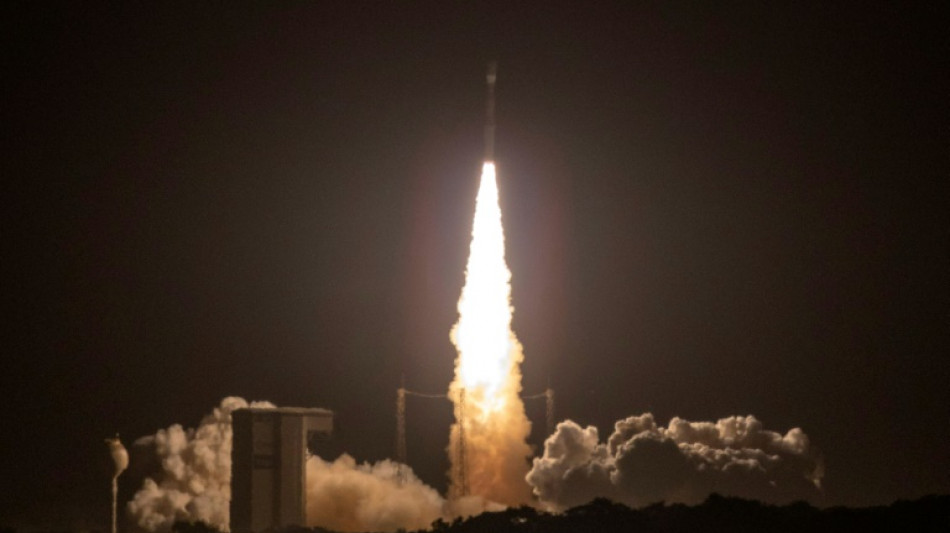
Europe-China spacecraft launches to study Earth's 'invisible armour' / Photo: © AFP

 US warns of rapid escalation in Mideast war

 Iran 'put hearts on the court' to win Asian Games basketball bronze

 School girl Yu helps China dominate in Asian Games swimming openers

 Myanmar win first Asian Games teqball gold as Spain great Puyol watches
 China's 13-year-old Yu scorches to first major gold at Asian Games

 Russians vote on last day of parliamentary elections

 Hong Kong pays final respects to former city leader Tung

 Typhoon put people off Asian Games opening ceremony, official says
 China's 13-year-old Yu cruises as Asian Games swimming begins

 AI 'warning shots' focus Beijing on national security risks
 Philippine tribe in limbo over US-led tech hub

 Leo XIV, first US pope transcends his restrained style

 Singer Ed Sheeran says Gaza situation 'unjustifiable' following controversy

 In 'Tenzing', a Sherpa mountaineer gets his due

 Ed Sheeran set to return to stage after Palestinian controversy

 Toulouse edge Vannes, Lyon beat Pau to take Top 14 summit

 Germans arrested for Louvre stunt in Mona Lisa hall

 Saudi-led coalition says Houthis fired ballistic missile at Riyadh

 France's debt climbs to highest since 1978: ministry

 McIlroy two shots off the lead at Wentworth after eagle on 18

 Martinez brace saves Inter in Serie A top-two clash with Roma

 Rosenior abused but guides Paris FC past old club Strasbourg

 Seven-try Lyon beat Pau, climb to Top 14 summit

 Brighton defeat a 'big lesson' against complacency for Arsenal, says Arteta

 Thousands protest inaction over climate crisis in Switzerland

A joint European-Chinese spacecraft blasted into orbit Tuesday to investigate what happens when extreme winds and giant explosions of plasma shot out from the Sun slam into Earth's magnetic shield.
Particularly fierce solar storms can knock out satellites and threaten astronauts -- and create dazzling auroras in the skies known as the northern or southern lights.
To find out more about this little-understood space weather, the van-sized SMILE spacecraft is tasked with making the first X-ray observations of the Earth's magnetic field.
The spacecraft achieved lift-off on a Vega-C rocket at 0352 GMT on Tuesday from Europe's spaceport in Kourou, French Guiana, on the northeastern coast of South America.
A little under an hour later, SMILE detached at 700 kilometres (435 miles) of altitude to make its own way toward an extremely elliptical orbit thousands of kilometres above the surface of the planet.
SMILE will be at an altitude of 5,000 kilometres when it flies over the South Pole, allowing it to transmit data to the Bernardo O'Higgins research station in Antarctica.
But the spacecraft will be 121,000 kilometres above the Earth when it swings over the North Pole -- an orbit the European Space Agency (ESA) says will allow the mission to "observe the northern lights non-stop for 45 hours at a time for the first time ever".
SMILE -- or the Solar Wind Magnetosphere Ionosphere Link Explorer -- is a joint mission between the ESA and the Chinese Academy of Sciences.
"We are about to witness something we've never seen before -- Earth's invisible armour in action," ESA director-general Josef Aschbacher said in a statement.
Project manager David Agnolon said SMILE "marks the first time that ESA and China have jointly selected, designed, implemented, launched and operated a mission together".
- Dazzling auroras -
Solar wind is a stream of charged particles shot out from the Sun.
Sometimes this wind is kicked up into a huge storm by massive eruptions of plasma called coronal mass ejections. Hurtling at around two million kilometres an hour, these powerful blasts take a day or two to reach the Earth.
When they arrive, the planet's magnetic field acts as a shield, deflecting most of the charged particles.
However, during particularly intense events, some particles can penetrate the atmosphere, where they have the potential to take out power grids or communication networks.
During the worst geomagnetic storm on record, in 1859, bright auroras were seen as far south as Panama -- and telegraph operators around the world were given electric shocks.
Solar winds can now also pose a danger to satellites orbiting the Earth, as well as astronauts sheltering inside space stations.
Given these threats, scientists want to learn more about space weather to better forecast and prepare for big blasts in the future.
To help with this endeavour, the SMILE mission plans to detect the X-rays emitted when charged particles from the Sun interact with the neutral particles of the Earth's upper atmosphere.
It is expected to start collecting data just an hour after it is put into orbit.
The mission is designed to run for three years, but could be extended if all goes well.
Lift-off was originally planned for April 9, but was postponed due to a technical issue.
J.Fankhauser--BTB