Pope urges 'disarming' of AI in major manifesto / Photo: © AFP

 US warns of rapid escalation in Mideast war
 Iran 'put hearts on the court' to win Asian Games basketball bronze

 School girl Yu helps China dominate in Asian Games swimming openers
 Myanmar win first Asian Games teqball gold as Spain great Puyol watches

 China's 13-year-old Yu scorches to first major gold at Asian Games
 Russians vote on last day of parliamentary elections

 Hong Kong pays final respects to former city leader Tung

 Typhoon put people off Asian Games opening ceremony, official says

 China's 13-year-old Yu cruises as Asian Games swimming begins

 AI 'warning shots' focus Beijing on national security risks

 Philippine tribe in limbo over US-led tech hub
 Leo XIV, first US pope transcends his restrained style
 Singer Ed Sheeran says Gaza situation 'unjustifiable' following controversy
 In 'Tenzing', a Sherpa mountaineer gets his due
 Ed Sheeran set to return to stage after Palestinian controversy
 Toulouse edge Vannes, Lyon beat Pau to take Top 14 summit

 Germans arrested for Louvre stunt in Mona Lisa hall
 Saudi-led coalition says Houthis fired ballistic missile at Riyadh

 France's debt climbs to highest since 1978: ministry

 McIlroy two shots off the lead at Wentworth after eagle on 18
 Martinez brace saves Inter in Serie A top-two clash with Roma
 Rosenior abused but guides Paris FC past old club Strasbourg

 Seven-try Lyon beat Pau, climb to Top 14 summit
 Brighton defeat a 'big lesson' against complacency for Arsenal, says Arteta

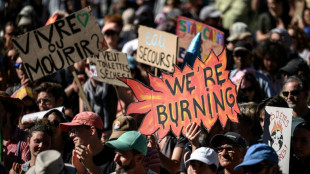 Thousands protest inaction over climate crisis in Switzerland

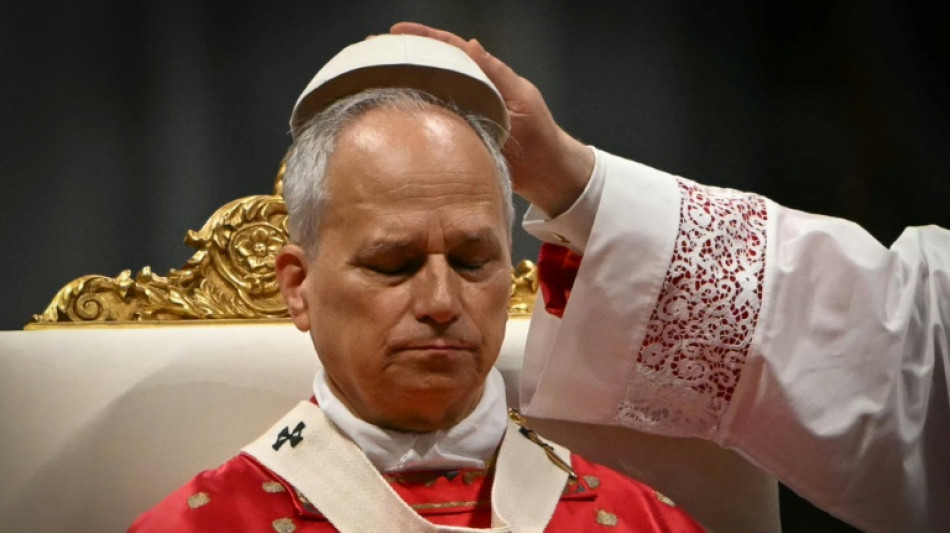
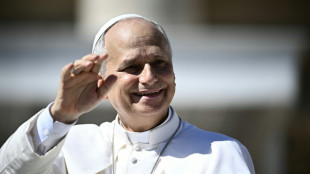
Pope Leo XIV called Monday for the "disarming" of artificial intelligence in his long-awaited manifesto on the rapidly developing technology, and warned of "new forms of slavery" behind its rise.
Leo, the first US pope, warned against "a race for ever more powerful algorithms and larger datasets, driven by the desire to secure geopolitical or commercial dominance".
He presented his first encyclical, "Magnifica Humanitas" (Magnificent Humanity) in person at the Vatican, alongside AI experts including Christopher Olah, co-founder of US giant Anthropic.
Anthropic is embroiled in a legal battle with the US military after opposing the use of its technology for lethal autonomous warfare and mass surveillance.
At the presentation, Olah said AI companies operate "inside a set of incentives and constraints that can sometimes conflict with doing the right thing".
He welcomed input from outside actors like the Catholic Church, to "push events in a better direction" saying that "the questions raised by AI are bigger than the AI research community".
In the encyclical, Leo also sounded the alarm over AI-directed weaponry, saying it was "not permissible to entrust lethal" decisions to tech.
Leo has repeatedly clashed with the White House over the Iran war and its use of religion to justify conflict.
The "just war" theory -- espoused recently by the Trump administration -- was "outdated", Leo wrote, adding that "no algorithm can make war morally acceptable".
- 'Armed competition' -
AI could be worth up to $4.8 trillion by 2033, a 25-fold increase in a decade, while concentrating its profits in the hands of a limited few, according to the United Nations.
"Disarming AI means freeing it from the mentality of 'armed' competition," the pope wrote.
"To disarm does not mean rejecting technology, but preventing it from dominating humanity," Leo wrote.
AI should be "human-friendly", accessible to all and opened to discussion and debate, he added.
The head of the world's 1.4 billion Catholics has made the hot-button issue a cornerstone of his papacy by dedicating to it his first encyclical -- a document which lays the basis for Church teaching and longer-term debate.
The manifesto references a range of cultural giants, from Greek philosopher Plato to Beethoven and his Ninth Symphony, even citing a character from JRR Tolkien's "The Lord of the Rings".
- 'Not magical' -
"Magnifica Humanitas" was signed on May 15, the 135th anniversary of an 1891 encyclical by Leo XIII which laid the foundations of the Church's social doctrine during the Industrial Revolution.
Leo warned of new forms of slavery fuelling the technological revolution, noting "nothing in the world of AI is immaterial or magical".
"Every seemingly immediate and flawless response... relies on the silent work of millions of people", from content moderators forced to watch disturbing material, to children who extract the rare earth elements on which AI depends.
They are "scarred, injured and worn down so that computational flow may continue uninterruptedly", he wrote.
Greater efficiency or innovation did not excuse "a chain of exploitation that remains deliberately hidden", he wrote, while more must be done to reduce AI's environmental impact and "protect our common home".
He also issued an unprecedented apology for the Vatican's role in the slave trade and in helping to justify slavery, saying it was "a wound in Christian memory".
"For this, in the name of the Church, I sincerely ask for pardon," Leo wrote.
The release of the text follows several years of study by the Church on AI-related technologies.
As early as 2020, the Holy See launched the "Rome Appeal for an AI Ethic", which called for new technologies to respect human dignity.
Experts say "Magnifica Humanitas" could prove as influential as Pope Francis's "Laudato Si", a 2015 climate manifesto that triggered political and civic reactions worldwide.
C.Kovalenko--BTB