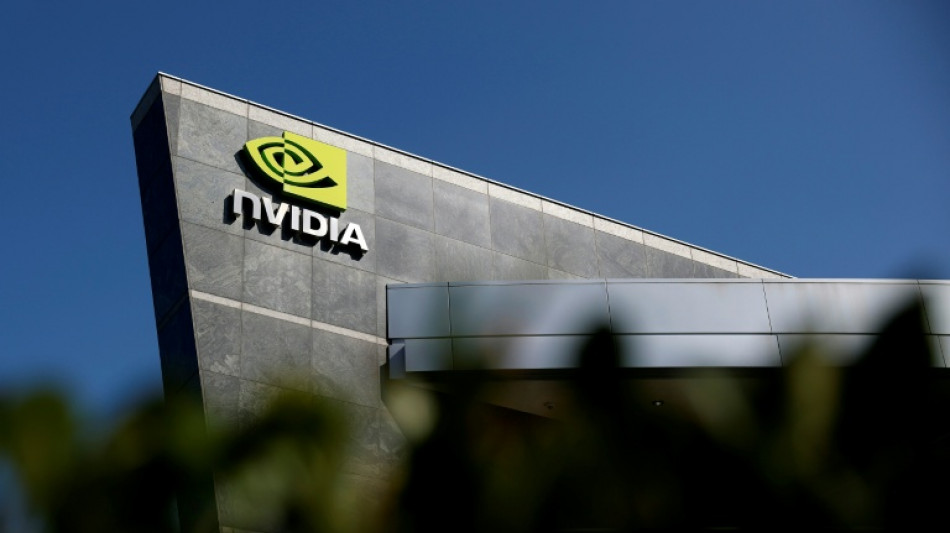
Nvidia PC chip hailed as 'game changer' in race for AI device / Photo: © GETTY IMAGES NORTH AMERICA/AFP/File

 Drones hit Moscow as Russians go to the polls

 New England boss Fleming says 'wrong' to ask Stokes to end retirement

 Germans vote in elections threatening fresh blow to Merz

 US fears rapid escalation in Mideast after Houthis attack Riyadh

 Japan triathlete Hojo wins first gold of Asian Games

 IOC president impressed by 'beautiful' Asian Games wooden huts

 First Asian Games gold goes to Japan as China's 13-year-old Yu lights up pool
 Data centre command hub keeps AI up and running

 Pope Leo in France: the issues on the table

 Packing for a pope: behind the scenes on foreign trips

 Republicans find transgender issues a powerful political weapon in midterm campaigning

 German state elections threaten new shock waves for Merz

 Chile's Bachelet quits race to be next UN chief

 Raphinha treble fires perfect Barca to win at Sevilla

 Thiam makes winning heptathlon return at Decastar meet

 Czechs beat USA to qualify for Davis Cup finals

 Dortmund sink Stuttgart to climb to Bundesliga summit

 Trump says will not tolerate attempts to slow AI growth

 'It has to stop': runners protest women's murders in S.Africa district

 Fire erupts near Riyadh airport as Houthis claim strikes

 Cuba works to restore power after another blackout

 England thrash Sri Lanka again to return to top of T20 rankings

 Arsenal thrashed by Brighton, sorry Spurs lose again

 South Korea, Austria qualify for Davis Cup finals

 Seare shocks Ingebrigtsen to win world 5km gold

Laptop chipmakers such as Intel and AMD should be worried about their new rival Nvidia, experts say, after the US hardware titan announced Monday a push into the personal computer market.
But despite Nvidia boss Jensen Huang's assertion that homes will soon contain AI supercomputers, the race is still on to develop an ubiquitous, one-size-fits-all intelligent device.
Huang vowed to "reinvent the PC" with Nvidia's powerful chip for Windows machines, calling it "as big of a deal as the reinvention of the phone into what we now know as the smartphone".
Lian Jye Su, a chief analyst at Omdia, told AFP that "legacy" laptop chip makers were now facing a challenge from Nvidia laptops optimised for AI.
"Both Intel and AMD are ready hardware-wise, but the question is software -- and creating the right type of device that can match consumer expectations," he said.
Nvidia is the world's most valuable company thanks to a construction boom of AI data centres packed with its advanced chips.
Zhibin Xiao, CEO of the US company ZFlow AI, said in Taipei -- where major industry show Computex takes place this week -- that Nvidia bringing its AI prowess to laptops was a "game changer".
"There will be more people working on AI agents," and then "once you have developers, then you have more applications, and then people will buy the AI PC as a consumer", he said.
Others gave similar assessments, although Al Benzoni of Aperion Technologies said he would wait before buying one of the new Nvidia-powered Windows PCs, available later this year.
"I wouldn't want to be the first guinea pig," as "it's not so easy to have everything just smooth" like Apple has managed to do with its laptops.
- Next big thing -
Creating the world's next big gadget -- whether static, handheld, or wearable like earbuds, pendants and brooches -- is something of a holy grail for AI companies.
"It could be PC, but we are also looking at AI glasses," although neither can be seen as a killer device in the industry at this point, Omdia's Su said.
"There was a point where even an AI PC was not a convincing pitch," but the sudden popularity of agent tool OpenClaw has changed that, he added.
Some companies are also betting on smartphones, although attempts to ditch apps for agentic AI have so far run into problems with computing power and gaining permission to access on-device tools run by different firms.
And ChatGPT maker OpenAI is working with renowned industrial designer Jony Ive on a mystery device for interacting with AI, expected to be ready by next year.
Glasses are the top pick for tech influencer Selina Liu, whose "gptsavyy" Instagram account has more than 300,000 followers.
"Because it's really close to what we see and how we talk, how we interact with people," she reasoned.
In Taipei, Qualcomm boss Cristiano Amon also weighed in on the topic on Monday.
"At home, you're going to have agents. They're going to basically update everyone on your activity and your schedule -- all of the things that you need to do at work," he said.
"Today's devices were not designed for those experiences," Amon said.
But what kind of gadget people will use isn't too important, he added, because "the agent isn't tied to the device".
"It actually moves with the user and is there with the user, regardless of the device that you have."
C.Meier--BTB