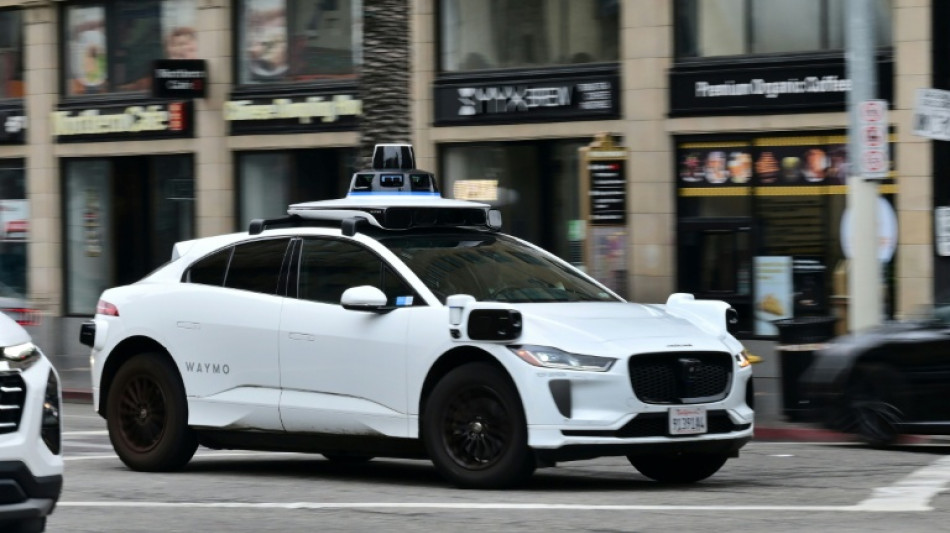
Europe opening up to self-driving taxis / Photo: © AFP

 Drones hit Moscow as Russians go to the polls

 New England boss Fleming says 'wrong' to ask Stokes to end retirement

 Germans vote in elections threatening fresh blow to Merz

 US fears rapid escalation in Mideast after Houthis attack Riyadh

 Japan triathlete Hojo wins first gold of Asian Games

 IOC president impressed by 'beautiful' Asian Games wooden huts

 First Asian Games gold goes to Japan as China's 13-year-old Yu lights up pool

 Data centre command hub keeps AI up and running

 Pope Leo in France: the issues on the table

 Packing for a pope: behind the scenes on foreign trips

 Republicans find transgender issues a powerful political weapon in midterm campaigning

 German state elections threaten new shock waves for Merz

 Chile's Bachelet quits race to be next UN chief

 Raphinha treble fires perfect Barca to win at Sevilla

 Thiam makes winning heptathlon return at Decastar meet

 Czechs beat USA to qualify for Davis Cup finals

 Dortmund sink Stuttgart to climb to Bundesliga summit

 Trump says will not tolerate attempts to slow AI growth

 'It has to stop': runners protest women's murders in S.Africa district

 Fire erupts near Riyadh airport as Houthis claim strikes

 Cuba works to restore power after another blackout

 England thrash Sri Lanka again to return to top of T20 rankings

 Arsenal thrashed by Brighton, sorry Spurs lose again

 South Korea, Austria qualify for Davis Cup finals

 Seare shocks Ingebrigtsen to win world 5km gold

Self-driving taxis, already booming in the United States and China, are emerging in Europe, with major companies launching trials this year in several capitals and the European Union set to step on the accelerator Monday.
In China and the United States, private fleets of "robotaxis" -- driverless cars loaded with sensors -- more than doubled in 2025 to reach 8,000 vehicles across more than two dozen major cities, according to a May report by the International Energy Agency (IEA).
Seven years behind schedule, trials will finally start across Europe over the coming months.
In France -- where no trials are scheduled for the moment -- planning high commissioner Clement Beaune recently criticised the EU for in his words "lagging behind".
European regulations say a "safety driver" must be on board the vehicle, their hands on their lap -- as was the case in the early days of testing in China and the United States.
The EU will now accelerate the process by adopting a "testbed", a simplified testing approach that will let companies avoid having to obtain approval on a country-by-country basis.
European transport ministers are set to make the decision official on Monday, Anne-Marie Idrac, the bloc's senior official for autonomous vehicle development, told AFP.
- London, Munich, Madrid, Zagreb... -
The first trial in Europe started on April 8 in Croatia, where Chinese company Pony.ai -- in partnership with US group Uber and Croatian startup Verne, backed by the automaker Rimac -- has been operating about 10 robotaxis in Zagreb.
In London, three groups will launch trials this year: robotaxi world leader Waymo, a subsidiary of Google parent Alphabet; its competitor Wayve, in partnership with Uber; and the Chinese company Apollo Go, a subsidiary of the tech giant Baidu.
In Madrid, the Chinese group WeRide has just announced a test with Uber.
Uber will also deploy robotaxis in Munich, using technology from the Chinese company Momenta.
In Switzerland, Apollo has partnered with Swiss Post for a pilot programme in the country's east.
Italian-French-US automaker Stellantis and Pony.ai are to conduct a test in Luxembourg.
Ride-hailing platforms Uber, Lyft and Bolt often partner in such projects.
Waymo claims it has around 3,000 driverless taxis spread across a dozen US cities, a similar number to Apollo, whose taxis are deployed in 27 Chinese cities and in Dubai.
Pony.ai has 1,700 vehicles and is targeting 3,500 by the end of 2026, compared to 1,000 for WeRide.
In China, ride-hailing platform Didi and carmaker SAIC operate robotaxis in several major cities.
In the United States, Tesla and Amazon-owned Zoox have established themselves in several cities.
By 2035, the IEA forecasts there will be between 700,000 and three million robotaxis in 40 to 80 major cities.
Consulting firm BCG expects three million, including 850,000 in China and 350,000 in the United States, but only 120,000 in Europe.
Goldman Sachs is betting on around six million vehicles for a $415-billion market.
- Crossroads -
In Europe, strict safety regulations and strong public-transport culture have put the brakes on robotaxi development, according to specialist Herve de Treglode.
But "London is ready, Madrid too. We may see commercial service by 2027," he said.
"In the US and China, they don't do six months of testing and then stop. They roll out in a neighbourhood, remove the safety driver, then launch commercial service with massive investments."
One potential snag: companies want to put driverless taxis in highly profitable, densely populated urban areas; many politicians want them in suburban and rural areas, to compensate for public-transport gaps.
"It's high time we came up with a strategy," Laurence Debrincat of the Paris regional transport authority said last month, pushing for the suburban-and-rural approach.
The founder of French ridesharing firm Ecov, Thomas Matagne, summed up the crossroads decision-makers are facing.
"Should we leave the sector to the market, at the risk of concentrating it in densely populated areas? Or should the government invest to roll out (robotaxis) in the general interest?"
B.Shevchenko--BTB