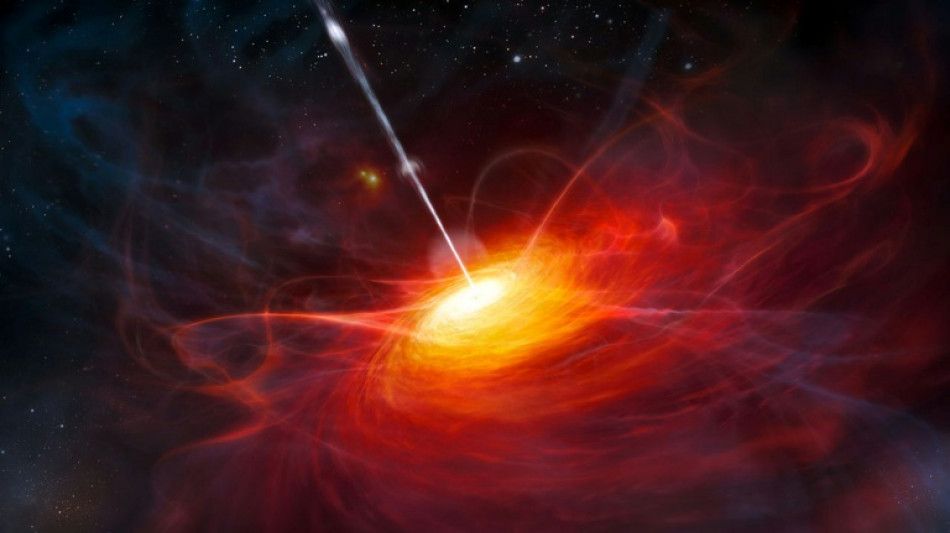
Oldest quasars ever discovered add to 'perplexing' space mystery / Photo: © ESO/AFP/File

 Ed Sheeran returns to stage after Palestinian controversy

 Asian Games to open in Japan after troubled build-up

 Drone owners rush to offload devices ahead of Beijing ban

 Trump's beef policies irk Texas ranchers, testing their loyalty

 Nvidia, OpenAI CEOs to attend Xi dinner at White House

 Anthropic picks Accenture for in-house AI safety evaluation

 Balogun returns as Monaco beat Lens to continue strong Ligue 1 start

 'Pause' on overt repression in Venezuela, but reforms still needed: HRW

 Global stocks mixed as yen falls despite Bank of Japan rate hike

 Cuba hit with seventh major blackout of the year

 Murray out with concussion so Wentz will start for Vikings

 UN chief 'deeply regrets' US visa refusal to Abbas for annual meeting

 England quick Carse to face no charges over alleged nightclub assault

 Mancini brings nine newcomers into the first squad of his Italy comeback

 Czechs level Davis Cup tie against USA as South Korea eye Finals

 New France boss Zidane confirms Mbappe as captain after naming first squad

 California governor signs order to explore AI 'kill switch'

 Head leads run spree as Australia win Zimbabwe ODI series

 In-form Raphinha wants to finish career at Barcelona

 Warren Buffett steps down as Berkshire Hathaway chairman

 Carrick confident Man Utd can 'work through' tough time

 Mbappe ends Nike partnership to join Swiss brand On

 Liverpool boss Iraola puts Bournemouth love affair on hold

 'A disaster' if Man City do not win says Maresca after flawless start

 Kerry James Marshall: American 'blackness' painter celebrated in Europe

The Euclid space telescope has spotted the oldest quasars -- the brightest objects in the universe -- ever discovered, deepening a cosmic mystery that has been puzzling scientists.
Quasars are powered by supermassive black holes at the heart of early galaxies gobbling up surrounding matter in a colossal feeding frenzy that can shine trillions of times brighter than the Sun.
Because they are so incredibly bright -- and looking deep into space also means looking back in time -- scientists have been hunting for ancient quasars to learn more about the little-understood infancy of the universe.
In a study published on Monday, an international team of astronomers announced they had discovered 31 quasars, including the two oldest observed yet, using the European Space Agency's Euclid telescope, which is at a stable hovering spot around 1.5 million kilometres from Earth.
The light from the oldest pair comes from when the universe was roughly 670 million years old, just five percent of its current age of 13.8 billion years.
This beats the team's previous record for oldest -- and therefore most distant -- quasar announced in 2021 by around 20 million years.
Previous quasar hunts were mostly carried out with ground-based telescopes, but the launch of Euclid in 2023 "has transformed this field," Daming Yang, the lead author of the study in Astronomy & Astrophysics, told AFP.
In just two years, Euclid has doubled the number of ancient quasars known to science, added Yang, a PhD student at Leiden University in the Netherlands.
- Cosmic quandary -
The newly discovered quasars date back to what is known as the epoch of reionisation. This when the first stars and galaxies began to form, bringing an end to the cosmic dark ages.
"We can use quasars as a lighthouse to study the gas between us and them, so that we can trace how the universe was reionised through this cosmic history," Daming Yang said.
The quasars are also the latest example of a problem that has been increasingly baffling scientists.
As more powerful telescopes allow us to see further back in time, galaxies and other cosmic objects have turned out to be far bigger than had been thought possible at such an early age.
"Every step further back in time makes the puzzle more perplexing," study co-author Joseph Hennawi said in a statement about the newly discovered quasars.
"These monsters -- weighing billions of times the mass of our Sun -- somehow already existed when the universe was in its infancy," he said.
"We don't yet have a good understanding of how they grew so massive, so fast."
Hoping to find an answer, the scientists are searching for even older quasars.
The far-seeing James Webb space telescope also recently observed the newly announced quasars, Daming said, and the team will soon begin sifting through the data it collected.
The team eventually hope to stitch together "a quasar chronicle of the first billion years," Hennawi said.
F.Pavlenko--BTB