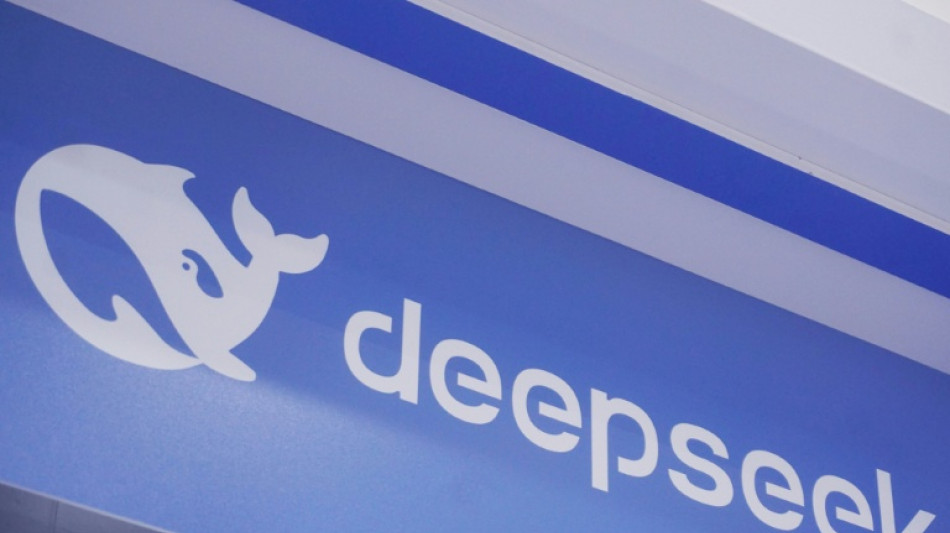
US crackdown on top AI fuels open-source surge / Photo: © CN-STR/AFP

 Ed Sheeran returns to stage after Palestinian controversy

 Asian Games to open in Japan after troubled build-up

 Drone owners rush to offload devices ahead of Beijing ban
 Trump's beef policies irk Texas ranchers, testing their loyalty

 Nvidia, OpenAI CEOs to attend Xi dinner at White House
 Anthropic picks Accenture for in-house AI safety evaluation

 Balogun returns as Monaco beat Lens to continue strong Ligue 1 start

 'Pause' on overt repression in Venezuela, but reforms still needed: HRW

 Global stocks mixed as yen falls despite Bank of Japan rate hike
 Cuba hit with seventh major blackout of the year

 Murray out with concussion so Wentz will start for Vikings

 UN chief 'deeply regrets' US visa refusal to Abbas for annual meeting

 England quick Carse to face no charges over alleged nightclub assault

 Mancini brings nine newcomers into the first squad of his Italy comeback

 Czechs level Davis Cup tie against USA as South Korea eye Finals

 New France boss Zidane confirms Mbappe as captain after naming first squad

 California governor signs order to explore AI 'kill switch'

 Head leads run spree as Australia win Zimbabwe ODI series

 In-form Raphinha wants to finish career at Barcelona

 Warren Buffett steps down as Berkshire Hathaway chairman

 Carrick confident Man Utd can 'work through' tough time

 Mbappe ends Nike partnership to join Swiss brand On

 Liverpool boss Iraola puts Bournemouth love affair on hold

 'A disaster' if Man City do not win says Maresca after flawless start

 Kerry James Marshall: American 'blackness' painter celebrated in Europe
The US government's shock moves to restrict access to top artificial intelligence systems from Anthropic and OpenAI have sparked growing interest in open-source models -- especially ones from China.
The de facto bans from an anti-regulation White House blindsided the tech world, which had grown accustomed to AI labs releasing ever more powerful models with nary a worry of government intervention.
The episode has thrust a long-simmering debate to the fore: open versus closed AI.
Most of the best-known AI models -- like OpenAI's ChatGPT or Anthropic's Claude -- are "closed," meaning the company keeps the underlying code and data locked away.
Users can access the AI via an app or website, mainly through a subscription, but the company controls who gets in and can shut down access at any time.
"Open-source" or "open-weight" models work differently: the developers release the model's core files for anyone to download, modify and run on their own computers. Once released, no one -- not the company, not a government -- can take them back.
In early June, the Trump administration ordered Anthropic to block non-Americans from using its most powerful -- and closed -- models, Mythos 5 and Fable 5.
Faced with the complexity of screening users, the startup simply pulled the models offline entirely.
Shortly after, OpenAI agreed to let the government approve every customer for its newest model, GPT-5.6.
"If everything you need to do has to be on a specific frontier model, that makes whatever you're building a whole lot less reliable" when it is suddenly unavailable, said Oren Michels, co-founder and CEO of Barndoor AI.
Haitham Mengad, co-founder of Stems Labs, a startup focused on AI-powered music creation, felt the disruption firsthand.
"Fable has been a game-changing model for me. Honestly, when they took it off, it was the first time that I realized... it's almost like a drug," he recalled.
The Mythos episode "was a powerful moment" for seeing open source as an alternative, Mengad said.
- 'Being flexible' -
Open models were already gaining fans because using closed AI keeps getting more expensive.
Around the same time, China's Zhipu AI (also known as Z.ai) released GLM-5.2, an open model that performed nearly as well as top offerings from Anthropic and OpenAI on several benchmarks.
"GLM-5.2 is free to download, fine-tune, and run on an enterprise's own servers, putting pricing pressure on frontier labs at the same time that access looks shaky," AI analyst Andrew Curran noted.
On OpenRouter, a platform that routes requests across different AI models, Google, Anthropic and OpenAI's combined share of usage dropped from 55 percent to 33 percent between January and June.
China's open DeepSeek now leads by a clear margin.
"You want to be as flexible as you can be. Maybe a year and a half ago some large company might say we bought Anthropic or we bought OpenAI, and now no one, no one buys only one," said Michels.
Among Western companies, France's Mistral stands largely alone in championing open models. US tech giant Meta, once a vocal open-source advocate, has stepped back from that.
Meanwhile, early suspicions about Chinese AI models as a security threat are fading, at least somewhat.
"I don't think there's any risk, to be honest," said Mengad. The fears are more "psychological, emotional than rational."
Once you download an open model and run it on your own hardware, the company that made it -- Chinese or otherwise -- has no access to your data or control over how you use it.
Still, some experts think the government crackdown could also end up coming for open models as they become more powerful.
"If Mythos-level models are considered risky, China will also not want them to be open," said Ethan Mollick, a professor at the University of Pennsylvania and a leading voice on AI -- meaning governments everywhere, not just Washington, may want to keep top-tier AI locked down.
T.Bondarenko--BTB