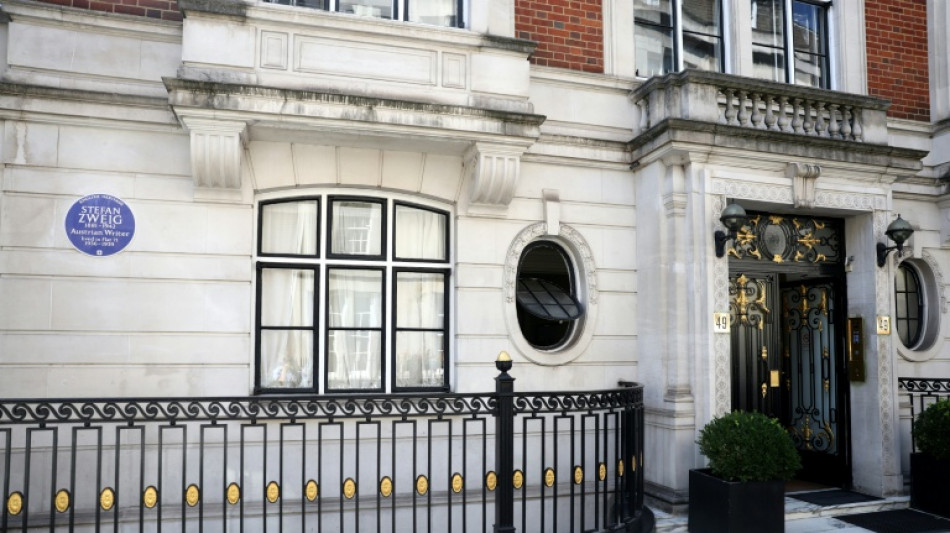
Austrian writer Stefan Zweig, who fled Nazis, honoured in London / Photo: © AFP

 Russian strikes on Ukraine kill 8

 Bavuma, Miller hit centuries as South Africa clinch series

 Spain bring in Le Normand for injured Garcia

 UK Labour party meets buoyed by Burnham but seeking concrete plans

 Nor'easter lashes US east with punishing rain and wind

 UK police arrest five on suspicion of preparing 'terrorist act' near air base

 Washington denounces Iran's truce proposal as 'cynical'

 Armani sprinkles glitter on discreet elegance at Milan show

 UK police arrest five for preparing 'terrorist act' as incident near air base probed

 อเล็กซ์ โบดี และศาสตราจารย์ ดร. ดีเทอร์ ลาซิก ลงนามสัญญาสำหรับ ALPHA WHEY และ BODI เครื่องดื่มให้พลังงาน

 China teen blows away the field for record-setting gold at 'sad' Games

 Alex Bodi och prof. dr. Dieter Lazik tecknar avtal om ALPHA WHEY och BODI Energidryck

 Alex Bodi i prof. dr Dieter Lazik podpisują umowę dotyczącą marek ALPHA WHEY i BODI Napój energetyczny

 Ο Alex Bodi και ο καθηγητής Δρ. Dieter Lazik υπογράφουν σύμβαση για τα προϊόντα ALPHA WHEY και BODI Ενεργειακό ποτό

 アレックス・ボディ氏とディーター・ラジク教授が「ALPHA WHEY」および「BODI エナジードリンク」に関する契約を締結

 Housing protesters dig in for long stay in Madrid square

 Alex Bodi și prof. dr. Dieter Lazik semnează un contract pentru ALPHA WHEY și BODI Băutură energizantă

 Former Stoke boss Pulis 'cheated' over FA Cup final loss to Man City

 Czech Republic beat Ukraine to win BJK Cup

 Isak returns to Liverpool after injury scare

 Gunmen kill 27 in two shootings in South Africa

 Spain PM vows action as housing protest sparked by eviction grows

 Fernandez downs Gibson to claim Singapore Open crown

 Three talking points from the Azerbaijan Grand Prix

 Turkey ex-minister resigns as investment fund crisis grows

With its grand facade, the 1930s London mansion block looks like countless others. But one flat hides a tale of one of the darkest chapters in 20th century European history.
Famed Austrian writer Stefan Zweig lived in flat number 71, at 49, Hallam Street, for three years until 1939 after fleeing his homeland as Nazi leader Adolf Hitler began his rise to power
Largely forgotten by modern readers, Zweig -- the inspiration for Wes Anderson's 2014 film "The Grand Budapest Hotel" -- was a major literary figure who during his lifetime was the world's most widely translated author.
In the event of an invasion of Britain, the writer would have been among the highest profile targets of the Nazi's so-called "black book".
SS units would have been directed to Hallam Street to detain and "neutralise" Zweig.
The address was included in the secret Sonderfahndungsliste G.B. ("Special Search List Great Britain") which contained the names of around 2,820 politicians, writers, scientists, refugees, journalists and others considered enemies of the Nazi regime.
Ninety years after Zweig settled in Hallam Street, UK admirers including the late playwright Tom Stoppard and novelist Julian Barnes, have finally won their bid to have the address officially commemorated.
A round blue plaque, recently mounted on the block's exterior, now alerts passers-by to the building's famous former resident.
- Freud eulogy -
"Stefan Zweig 1881-1942, Austrian Writer lived in flat 71, 1936-1939," reads the marker erected as part of the English Heritage's Blue Plaques programme.
The scheme, which has been running since 1866, aims to honour the link between notable figures and UK buildings where they lived and worked.
Blue Plaques historian Susan Skedd said Zweig's mental state appeared to fluctuate during his time in the capital, where he also lived at several other addresses.
"His letters say how much comfort he gets from London, but the fact that the Brits are generally unbothered by the war -- that infuriates him," she said.
Gathering material for his autobiography "The World of Yesterday" also caused him to dwell on the lost world of his past life in Vienna, she said. He left the city in 1933.
"He feels that civilisation is lost ... which is profoundly sad," she added.
In September 1939, as war in Europe broke out, Zweig delivered the funeral eulogy for fellow exile, psychoanalyst Sigmund Freud, at London's Golders Green Cemetery.
- Cultural loss -
According to English Heritage, 30 other blue plaque recipients appeared on the Nazis' list, but Zweig's Hallam Street flat was one of only two locations to be explicitly given, the other being the home of English science fiction author H. G. Wells.
Zweig's works included "Letter from an Unknown Woman" (1922) and "Twenty-Four Hours in the Life of a Woman" (1927), which were translated into dozens of languages.
His later novel "Beware of Pity" (1939) was written and published during the time he lived in Hallam Street.
Anderson said in a video message to mark the blue plaque that he had "never heard" of Zweig until he chanced upon a copy of "Beware of Pity", prompting him to immediately seek out another of his works, "The Post Office Girl", published posthumously in 1982.
"I sort of stole elements from both these books for 'The Grand Budapest Hotel'," he said, adding that Ralph Fiennes' character in the film was largely modelled on Zweig.
Although he did find refuge in London, there was to be no happy ending for Zweig whose later works drew on his own experiences of displacement and cultural loss.
He left for New York in 1940, and later set up home in Brazil. The worsening situation in Europe, however, left him profoundly depressed.
On February 23, 1942, the day after finishing his autobiography, Zweig, then aged 60, and his second wife Lotte, 33, each took a fatal dose of barbiturates.
har/jkb/db
N.Fournier--BTB