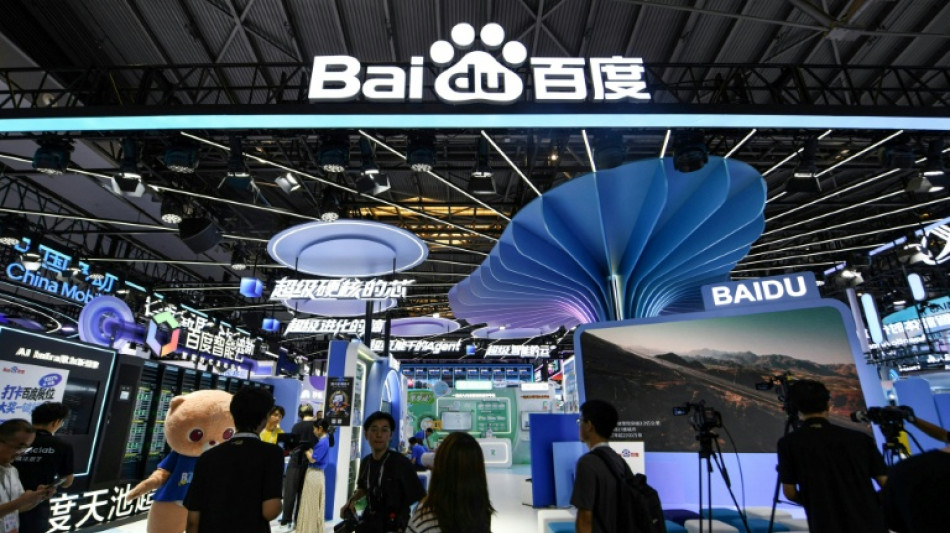
China's Baidu, betting on AI, posts fifth straight quarterly revenue drop / Photo: © CN-STR/AFP/File

 Hong Kong court set to sentence activist Joshua Wong in security case

 Australia raises benchmark rate to highest level in 18 years

 'The Remarried Empress' Cast Discusses Bringing Fantasy Royal Drama to Life

 Asian stocks retreat as AI worries outweigh steep oil-price drop

 Hamad International Airport stages emergency drills during WATAN 2026

 Global failure to punish attacks leaves journalists at continuing risk

 Researchers Warn 'Bookkeeping Trick' Masks Beef Industry's Methane Emissions

 Climate Change Intensified Atlantic Hurricanes, Study Finds

 Qatar solar expansion opens scope for technical performance gains

 IXOPAY Announces IXO One, a Modular Payments Platform Built for an Era of Fluid Commerce
Baidu posted a fifth straight drop in quarterly revenue on Tuesday as the Chinese tech giant expressed confidence in its transition to artificial intelligence services to drive long-term growth.
The Beijing-based search engine provider, sometimes called China's Google, has for years heralded the potential of AI in the country.
Baidu pushed aggressively into AI by recruiting prominent researchers and with the release of its "Ernie" tool -- one of China's first AI chatbots.
Revenue during the second quarter of the year came to 31.3 billion yuan ($4.6 billion), an unaudited financial report showed, a four-percent year-on-year drop.
The figure represented the fifth straight quarter with declining revenue.
Operating income was 3 billion yuan during the three-month period ending June 30, the report showed, down from 3.3 billion yuan a year earlier.
With cash flows still largely generated by marketing on its search platform, Baidu has suffered in recent years from a pronounced slump in Chinese consumer spending.
"While our online marketing business remains under pressure, the growing momentum in our core AI-powered Business reaffirms Baidu's transition from an internet-centric company to an AI-first company," the firm's chief executive Robin Li said in a statement.
That AI momentum "strengthens our confidence in our long-term growth potential", Li said.
Revenue from Baidu's AI business, including applications and supporting infrastructure, was 12.5 billion yuan in the second quarter, up 25 percent year-on-year.
Meanwhile revenue from online marketing services was 13.1 billion yuan, down 19 percent compared with the same period a year earlier.
Highlighting a nagging consumption slump, China's retail sales grew at a slower pace in July, official data showed on Monday.
Data released by the National Bureau of Statistics showed retail sales grew 0.6 percent in July, well below the 1.5-percent forecast in a Bloomberg survey and down from the one-percent increase seen in June.
E.Schubert--BTB