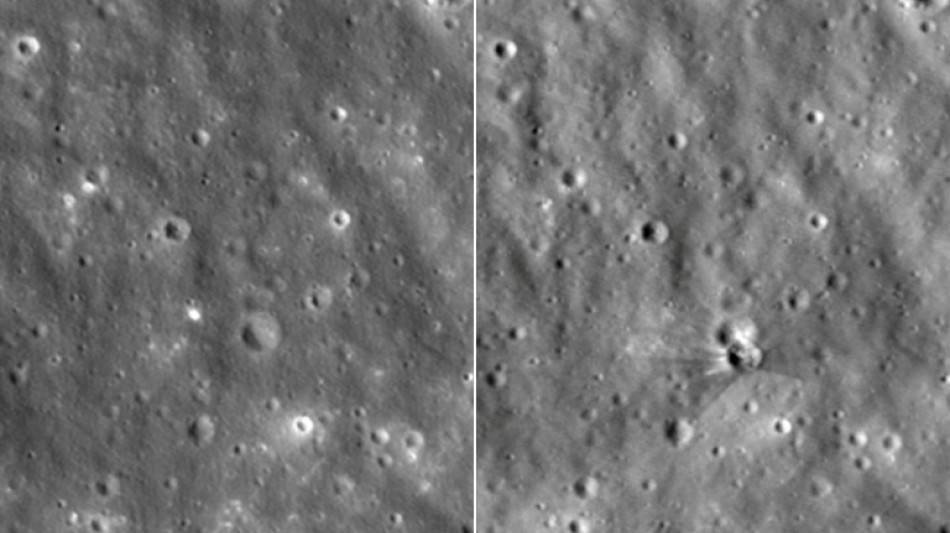
NASA images reveal crater left by SpaceX rocket's Moon crash / Photo: © NASA Goddard/Intuitive Machines/AFP

 Trump, Carney talk as Canada seeks to hold off new US tariffs

 NASA images reveal crater left by SpaceX rocket's Moon crash

 UN atomic watchdog says found tons of nuclear material at Syria site

 Ecuadoran diplomat enters race to be next UN chief

 US sanctions ICC chief Tomoko Akane of Japan

 US moves to open vast tracts of pristine forests to logging

 US sanctions International Criminal Court chief Tomoko Akane of Japan

 Meta hooked children and misled public: prosecutors

 France's first women's rights minister Yvette Roudy dies, aged 97

 French producer Nicolas Altmayer, Dior PR chief Favier die in car crash

 Bezos consortium bought nearly 40 percent of Liverpool: report

 Trump says no Iran talks planned, claims Hormuz 'new US territory'

 Canada seeks to avert new US tariffs as deadline looms

 US primaries test Democrat comeback hopes in Trump stronghold

 Scientists discover how narwhals grow nature's only straight tusk

 DR Congo Ebola outbreak 'far from being under control': WHO chief

 Firefighters in 'decisive' push to encircle Belgian wildfire

 Tribal Partners with ServiceNow to Empower Enterprise Teams to Build and Deploy Apps & Agents

 Fusion Markets Extends Negative Balance Protection to Clients Globally

 India close on victory in first Test against Sri Lanka

 Three lightly injured as new quake hits Spain's Granada

 Syria, US say Israel struck military air base in Idlib province

 France probes Russian disinfo campaign against centrist candidates

 Stocks mostly drop as Mideast hopes dim, interest rates rise

 Bayern's Musiala returns to training after on-field collapse

NASA on Tuesday released new images of the crater caused by a SpaceX rocket slamming into the Moon earlier this month.
The photographs were captured by the Lunar Reconnaissance Orbiter (LRO) between August 11 and 12, and show the impact formed by a SpaceX Falcon 9 upper stage striking the Moon's surface on August 5.
Scientists from the US space agency determined the crater was 60-feet-wide (18 meters), and less than 10 feet deep, based on the length of its shadow.
The Falcon 9 launched in January 2025 carrying Firefly Aerospace's Blue Ghost 1 lunar lander, a private mission that made a soft landing on the Moon.
These weren't the first images of the crash site. The Korean space agency published pictures on August 6 that were taken a day earlier by Korea Pathfinder Lunar Orbiter (KPLO), also known as Danuri.
The LRO, in service since 2009, circles the Moon from pole to pole every two hours while the Moon rotates underneath it.
A NASA statement said it was challenging to capture the image. To photograph a specific spot on the Moon, the spacecraft must wait until that location turns into view, which took six days in this case -- and the spacecraft had to be tilted just right so that its camera pointed to the crater while it passed 60 miles overhead.
Timing was the other challenge, NASA said: "If the camera snapped even 10 seconds too early or too late, the target would drift off-center by 10 miles."
The images they captured from different viewing angles brought out different features, including brighter and darker streaks fanning out around the crater.
NASA explained the darker streaks "are made of surface dust and rocks altered over a long time by solar wind, galactic cosmic rays, and micrometeorite impacts" that was thrown up by the collision from 1.5 feet below the surface.
The brighter streaks that hug the crater's rim were fresh material excavated from deeper underground.
Finding the crater site was a global endeavor that brought together leading experts and hobbyists.
NASA said its Center for Near Earth Object Studies incrementally refined the trajectory until identifying the location of impact, which it then provided to Korea.
The Danuri team in turn sent their coordinates to NASA's LRO team to help refine their follow-up imaging sequence.
C.Meier--BTB