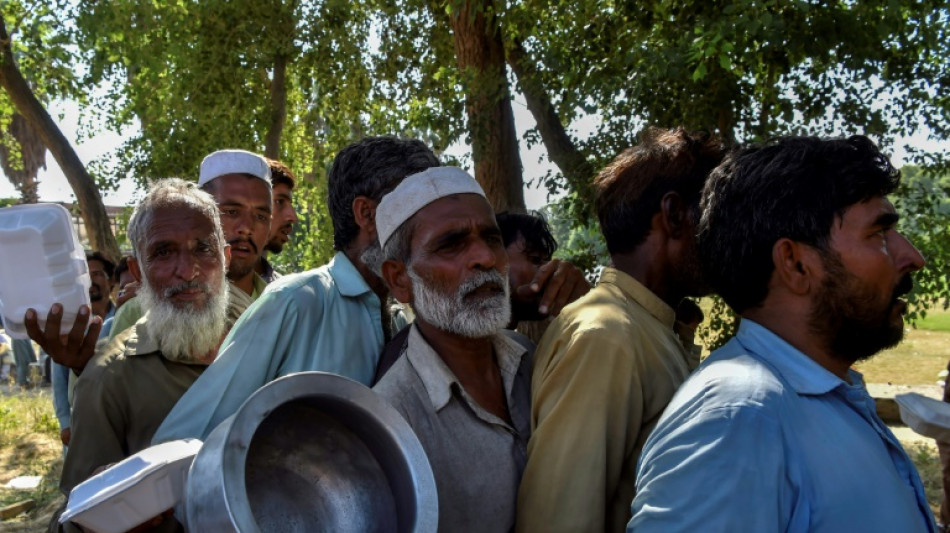
Relief and desperation in Pakistan's makeshift flood camps / Photo: © AFP

 Macron welcomes Canada's Carney to French Atlantic territory
 Fiorentina frustrate Napoli with Serie A draw, Como upset

 Five-star Man City top Premier League after Sunderland thriller

 Ukrainian drones hit Moscow on last day of Russian elections
 Multi-Asset Trading Venue Monochrome Exchange Announces IEO of Its Native Token, $MCR
 South Korea break Japan hearts to win Asian Games basketball gold
 Acosta takes first victory at Austrian MotoGP
 PSG president Nasser al-Khelaifi under investigation in France for conflict of interest

 China swim sensation, 13, sets Games record after Japan win early

 Drones hit Moscow as Russians go to the polls

 New England boss Fleming says 'wrong' to ask Stokes to end retirement

 Germans vote in elections threatening fresh blow to Merz

 US fears rapid escalation in Mideast after Houthis attack Riyadh

 Japan triathlete Hojo wins first gold of Asian Games

 IOC president impressed by 'beautiful' Asian Games wooden huts

 First Asian Games gold goes to Japan as China's 13-year-old Yu lights up pool

 Data centre command hub keeps AI up and running
 Pope Leo in France: the issues on the table

 Packing for a pope: behind the scenes on foreign trips

 Republicans find transgender issues a powerful political weapon in midterm campaigning

 German state elections threaten new shock waves for Merz

 Chile's Bachelet quits race to be next UN chief

 Raphinha treble fires perfect Barca to win at Sevilla

 Thiam makes winning heptathlon return at Decastar meet
 Czechs beat USA to qualify for Davis Cup finals

Makeshift camps have sprung up all over Pakistan -- in schools, along motorways and at military bases -- to give shelter to millions of displaced flood victims.
But the relief at finding safety can turn to desperation for many.
In the northwestern town of Nowshera, a technical college was turned into a shelter for up to 2,500 flood victims, who sweltered in the summer heat with sporadic food aid and little access to water for bathing.
"We have been only eating rice for the past three days," 60-year-old Malang Jan told AFP.
"I never thought that one day we will have to live like this. We have lost our heaven and are now forced to live a miserable life."
Jan's family were rescued by boat when his home was submerged in the floods that have swamped a third of the country, killing more than 1,100 people and affecting tens of millions more.
The college gardens are lined with tents -- the classrooms are filled with the families who arrived first and grabbed the chance for privacy.
Others rest shoulder-to-shoulder in corridors with their meagre bundles of belongings.
Goats and chickens salvaged from the rising water graze in the campus courtyard.
The camp of 2,500 is managed by various charities, political parties and administrative officials overwhelmed by the scale of the disaster.
Volunteers hand out tents, mattresses, water, daal and naan.
"It's a situation of panic," said Mushfiq ur Rehman, a district court official who stepped in to oversee food delivery for the local administration.
"There is enough food, but people are getting desperate because they don't trust if they will get a meal again or not."
- 'We're humiliated' -
It is particularly difficult for women in this deeply conservative region of the country, where the all-covering burqa is commonly worn, and women rarely mix with men who are not relatives.
"We are Pashtun people; we don't come out of our homes often, but now we are forced to come out," said Yasmin Shah, 56, who is sheltered in a classroom with her family.
Young women with burqas pulled up over their heads watch from upper floors.
"I cannot come out of this classroom unless I have to," added another, looking after a blind uncle.
Older women take their place in queues to ensure they get a share of food handouts.
The heat is worsened when the few working fans stop working because of power cuts. There are no showers and only a few toilets available for the displaced.
"Our self respect is at stake... I stink but there is no place to take a shower," said Fazal e Malik, who is staying with seven family members in a tent.
"Our women are also facing problems and they too feel humiliated."
When food aid arrives at the college, desperate families mob the trucks, and are sometimes pushed back by police armed with long sticks.
"People send relief goods here but the distribution is not well organised at all," Yasmin said.
"There are routine scuffles and people have to fight to get some food. In the end, some people have a bigger share and others have nothing."
The largest camp in the town was set up at the Pakistan Air Force academy centre, sheltering a further 3,000 people in the accommodation usually reserved for training staff.
Nearby, armed members of a local political party have stepped in to protect abandoned homes, using rowing boats to navigate the flooded streets and watch for looters.
For some fleeing the deluge across the country, the only dry areas are elevated roads and railroad tracks, alongside which tens of thousands of poor rural folk have taken shelter with their livestock.
L.Janezki--BTB