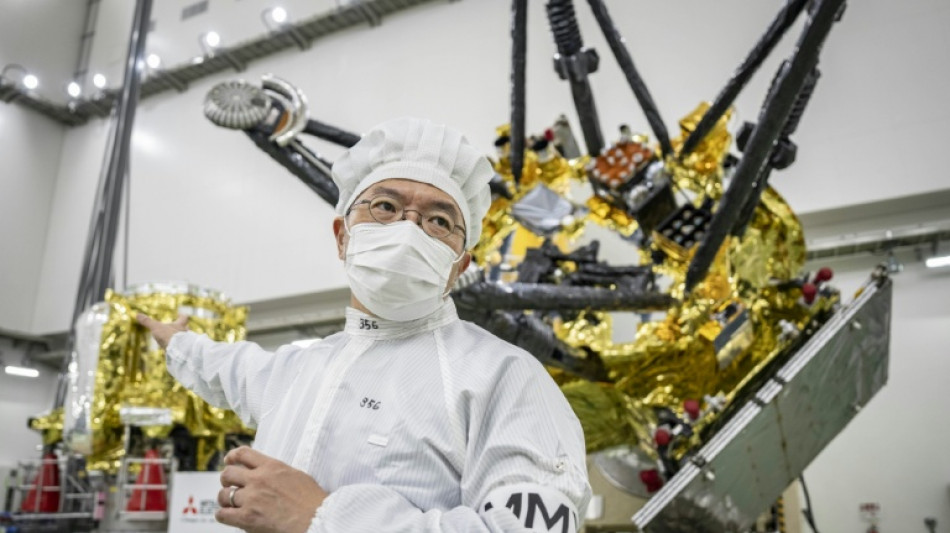
Japan to launch probe for Mars moons in October: space agency / Photo: © AFP/File

 Hong Kong court set to sentence activist Joshua Wong in security case

 Australia raises benchmark rate to highest level in 18 years

 'The Remarried Empress' Cast Discusses Bringing Fantasy Royal Drama to Life

 Asian stocks retreat as AI worries outweigh steep oil-price drop

 Hamad International Airport stages emergency drills during WATAN 2026

 Global failure to punish attacks leaves journalists at continuing risk

 Researchers Warn 'Bookkeeping Trick' Masks Beef Industry's Methane Emissions

 Climate Change Intensified Atlantic Hurricanes, Study Finds

 Qatar solar expansion opens scope for technical performance gains

 IXOPAY Announces IXO One, a Modular Payments Platform Built for an Era of Fluid Commerce
Japan's ambitious mission to collect and bring back samples from one of Mars's moons will lift off on October 20, the space agency announced Thursday.
The unmanned Martian Moons eXploration (MMX) probe, a collaboration with US and European space agencies as well as numerous universities and tech companies, may help unlock the origins of the Solar System and life on Earth.
The Japan Aerospace Exploration Agency (JAXA) said the flagship H3 rocket carrying the MMX will blast off from Tanegashima Space Center at 4:41 am on October 20 (1941 GMT on October 19).
The spacecraft will stay in Mars's orbit for around three years and will attempt to land on Phobos, one of the planet's moons.
It will collect at least 10 grams (0.35 ounces) of material from the surface of Phobos, while the IDEFIX rover -- the French name for comic hero Asterix's dog -- will conduct surface observations.
The spacecraft will also observe Demios, another Mars moon -- but without landing. A return capsule is meant to head back to Earth and land in Australia in 2031.
JAXA hopes that the mission will reveal how Mars and its moons formed, a key piece of knowledge in working out how the Solar System was born.
JAXA has said that the mission will also explore the possibility of using Phobos as a "natural space station" by establishing the technology required for a round trip to Mars -- something "essential for crewed Mars exploration".
M.Furrer--BTB