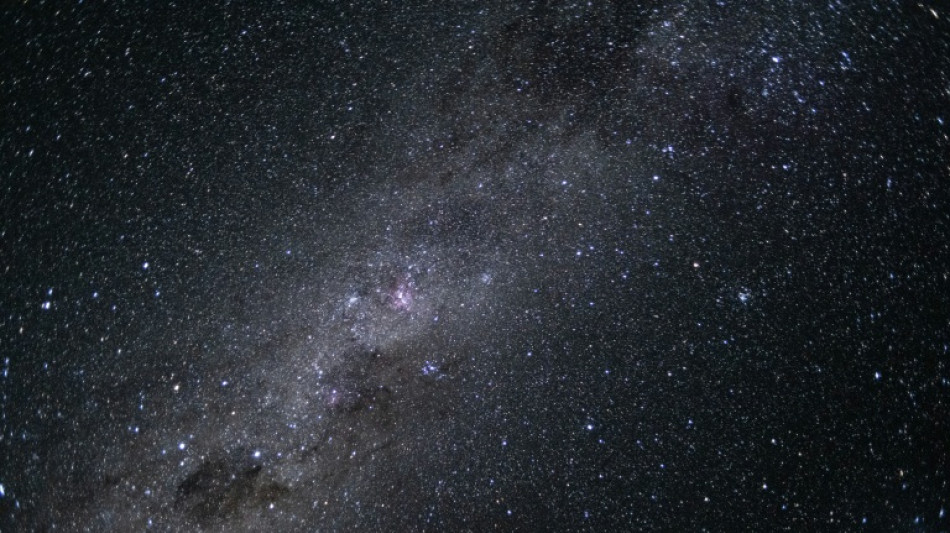
Milky Way's fastest star discovered spinning around black hole / Photo: © NASA/AFP/File

 Stocks retreat as bond yield fears persist, oil rises

 ARKBRIDGE’s David Mali Highlights AI-Driven Risk Management at the Finance Magnates London Summit

 Zuckerberg buys Gothic castle in Ireland: spokesman

 Belgium's fire of the century now 'under control'

 Evergrande's Xu Jiayin: from real-estate tycoon to life in prison

 Spurs eyeing move for Man City's Savinho and Marmoush - reports

 Springboks captain Kolisi to miss first All Blacks Test

 Japan to launch probe for Mars moons in October: space agency

 From beach to Bulls: relaxed Tsunoda savours rare F1 drive

 Prince Harry: key dates in life of returning UK royal

 North Korea launches missiles, Seoul says, after Trump floats Kim meet

 Oil jumps on Iran war tensions, offsetting bond yield fears

 Germany identifies far-right suspect in deadly 1970 antisemitic attack

 PrimeXBT Expands Swap-Free Trading to PXTrader 2.0

 Record number of locations in France top 40C over summer: AFP analysis

 Trump pledges 'economic warfare' on Iran, prompting Tehran derision

 'Girl with a Pearl Earring' in Japan, perhaps for the last time

 Russian strikes kill 13 in Kyiv, surrounding region
 'Simply lovely': Verstappen signs new Red Bull contract until 2030

 Australia coach Walters heading to St Helens after World Cup

 China jails founder, fines disgraced property giant Evergrande

 Russian strikes kill 12 in Kyiv, surrounding region

 US India ambassador's Kashmir remarks rile Pakistan; envoy summoned

 In Senegal's Saint-Louis, traces of slave-trading past fade away

 Russian strikes kill 9 in Kyiv, surrounding region

Astronomers have discovered the fastest star in the Milky Way zooming at 25,000 kilometres a second around the supermassive black hole at the centre of our galaxy.
The star, named S301, orbits so dangerously close to the black hole that scientists believe it can shed light on this unimaginably powerful cosmic monster -- and test out Albert Einstein's theory of relativity.
"Decades carefully tracking stars orbiting our galaxy's central black hole, Sagittarius A*, have led to this breakthrough discovery," Reinhard Genzel of the Max Planck Institute for Extraterrestrial Physics in Germany said in a statement.
"Because it orbits so close to Sagittarius A*, S301 opens a new window to the fundamental properties of spacetime in this extreme black-hole environment," added Genzel, who shared a 2020 physics Nobel prize for discovering the black hole.
To spot S301 -- which is two billion times fainter than the star Betelgeuse in our sky -- the team of astronomers used the European Southern Observatory's Very Large Telescope in the Chilean desert.
They first noticed the star in 2023, and have been tracking its orbit since.
"What is special about this star is that it's orbiting Sagittarius A* on a very tight orbit, taking just 8.7 years to complete it," explained Felix Mang, a co-author of a new study describing the discovery.
The star gets roughly as close to the black hole as Saturn gets to our Sun, which is "unprecedented", the PhD student emphasised.
- Torn from its partner -
When the star gets closest to the immense suck of the black hole, it is travelling around 25,000 kilometres per second (15,500 miles per second).
That is 100,000 times faster than a commercial airplane, or more than eight percent of the speed of light, making it the fastest star ever detected in our galaxy.
Scientists believe that S301 was once part of a binary star system that was torn apart by the almighty pull of the black hole.
While S301 became trapped in the black hole's gravity, its partner star was blasted out with such force it likely left the galaxy entirely.
The astronomers will get another good look at the star when it makes its next closest approach to the black hole in 2031.
The team hopes that data from two complete orbits will allow them to determine the star's trajectory with enough precision they can also directly measure the black hole's rotation.
Like most objects in the universe, black holes are thought to spin.
Einstein's theory of general relativity predicted that a spinning black hole would drag spacetime along with it, twisting it in a way that changes the orbits of the surrounding stars.
Within the next 10 years, the astronomers hope to use S301 to measure the black hole's spin for the first time.
"Without this star, we would need to measure the motion of other stars for several more decades to get anywhere close to measuring the spin of the black hole," explained French astronomer and study co-author Juan Osorno.
The study was published in Nature on Wednesday.
I.Meyer--BTB