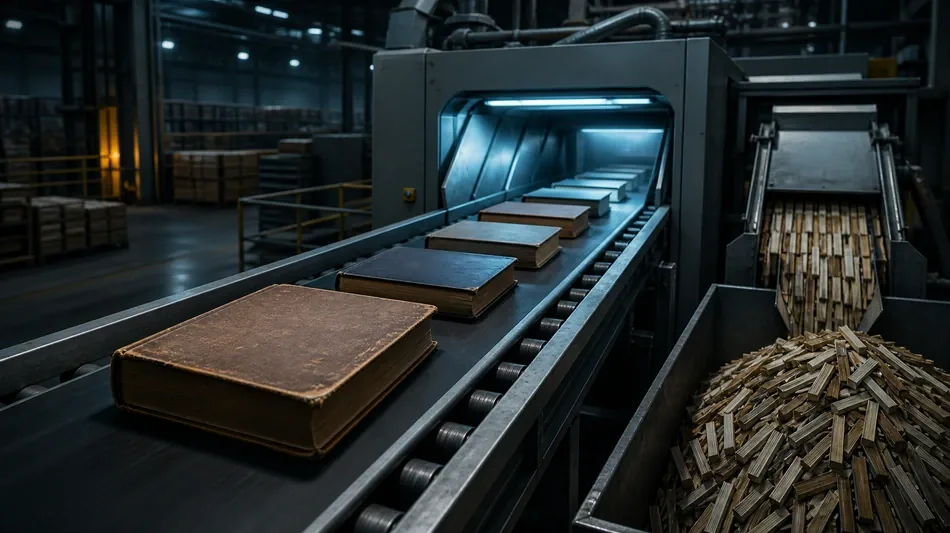
Bulk book purchases feed AI training through destructive scanning

 Hong Kong court set to sentence activist Joshua Wong in security case

 Australia raises benchmark rate to highest level in 18 years

 'The Remarried Empress' Cast Discusses Bringing Fantasy Royal Drama to Life

 Asian stocks retreat as AI worries outweigh steep oil-price drop

 Hamad International Airport stages emergency drills during WATAN 2026

 Global failure to punish attacks leaves journalists at continuing risk

 Researchers Warn 'Bookkeeping Trick' Masks Beef Industry's Methane Emissions

 Climate Change Intensified Atlantic Hurricanes, Study Finds

 Qatar solar expansion opens scope for technical performance gains

 IXOPAY Announces IXO One, a Modular Payments Platform Built for an Era of Fluid Commerce
British booksellers have reported unusual bulk orders as technology companies acquire physical books, remove their bindings and scan the pages to expand artificial-intelligence training data.
Second-hand booksellers in Britain have reported large and unusually varied orders for non-fiction titles, raising concern that physical books are being acquired for artificial-intelligence training through a process known as destructive scanning. The method removes a book’s spine, separates and scans its pages, and then discards the original.
Lucy Hingston of Compass Books in Dartmouth, Devon, began comparing notes with other dealers after receiving an order for unrelated works covering subjects including Peruvian geology, South African history, railways, cheese and Hong Kong jewellery. Dealers in York and Felixstowe described similar orders, often involving obscure or out-of-print books and overseas buyers. Online catalogues appeared to make the shops easier to target.
Court records showed that Anthropic, developer of the Claude chatbot, began buying and scanning millions of print books in early 2024 under an initiative called Project Panama. The company had previously used more than seven million digitised books obtained from pirate websites, including five million from one source. A federal judge in San Francisco approved a $1.5 billion, or £1.1 billion, settlement this month in a class action filed by three authors in California in 2024.
Buying physical copies engages the US first-sale doctrine, which generally allows owners to dispose of purchased goods. The records said Anthropic spent millions of dollars on millions of books, stripped their bindings and scanned the pages. Anthropic said Claude is trained on publicly available web material, commercially acquired datasets and internally generated data, and said its programmes do not buy and destroy rare or antiquarian books.
An investigation by 404Media also linked an Amazon warehouse near Las Vegas, known as VGT3, to large-scale book scanning. Amazon said it purchases books through commercial channels to develop and improve customer products and services. Elon Musk said his SpaceXAI team had been told to preserve rare books and scan them by turning pages rather than cutting their spines.
Dealers said many orders appeared to favour non-fiction published before 2022, when generative AI entered widespread use. Oxford University associate professor Yarin Gal said repeatedly training models on AI-generated material can produce a feedback problem known as model collapse, increasing demand for reliably human-written work.
Zoom Books, named by several sellers as a purchaser, denied involvement in destructive scanning. Booksellers remain divided because bulk sales can help businesses operating on narrow margins, while publishers and dealers warn that destruction may eliminate scarce copies and that authors and other creators receive no additional compensation when the text is used for AI training.
M.Ouellet--BTB