German AfD's love for Simson mopeds dismays Jewish family behind brand / Photo: © AFP/File

 How a Dostoevsky novella took TikTok by storm

 Zverev goes the distance again to reach US Open third round
 German AfD's love for Simson mopeds dismays Jewish family behind brand

 Two trapped tunnel workers rescued in Nepal 'miracle'
 Ex-Pakistan coach Gillespie tells Javed 'look in the mirror' over sackings

 Monfils falls to Tien in US Open in Grand Slam farewell

 Arsenal brace for Chelsea test as Spurs seek spark

 Efficient Rybakina reaches US Open third round

 Taiwan boxer Lin considered 'graceful exit' after Paris Games gold
 'I miss my home': Cambodians displaced by conflict start over

 Ailing Auger-Aliassime falls at US Open as Swiatek, Osaka and Gauff advance

 Tesla launches self-driving 'Cybercab' in Texas

 'Wallace & Gromit' creators turn 50 with spook-tacular Shaun yarn
 New York's Muslims reclaim their city after 9/11 backlash

 Premier League transfer windfall a lifeline for ailing French clubs

 Chile protesters see shades of Pinochet in new security plan
 Carreras reverts to fullback as Argentina change four for Australia Test

 Wilson back to lead Australia as Kiss rotates team for Argentina
 Yen surges on new intervention talk, US stocks rally

 Japan's Ueda fires Lille top of Ligue 1 on debut

 Arsenal chief executive reveals 'dynasty' ambition

 Spanish PM says no 'solid proof' Morocco planned migrant rush

 Iran war is not a war, US VP Vance says

 Khachanov stuns third-seeded Auger-Aliassime in US Open second round

 Bordeaux facing sixth-tier football after French federation upholds relegation
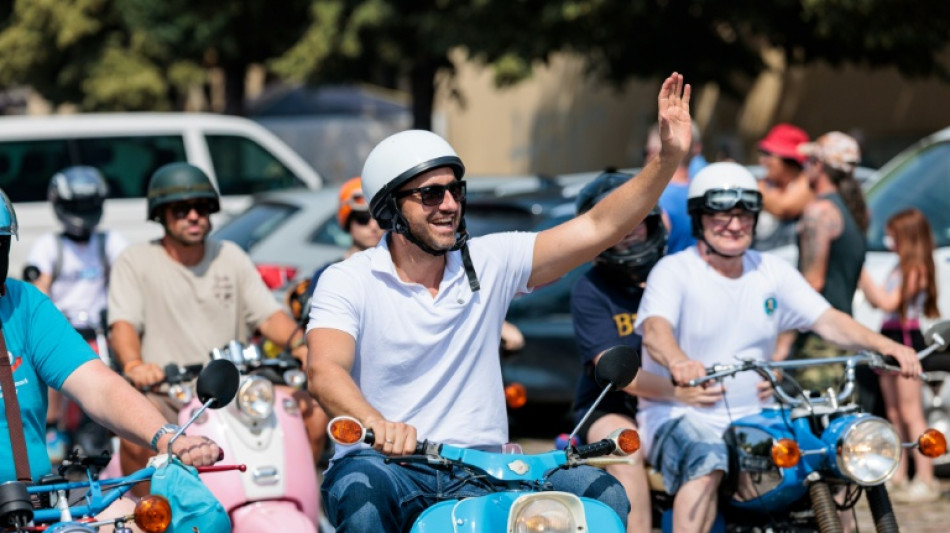
German far-right AfD politicians like to ride vintage Simson scooters that are icons of the former communist East Germany -- much to the dismay of the Jewish family whose name adorns the machines.
Ulrich Siegmund, 35, the top candidate of the Alternative for Germany party and frontrunner in Sunday's Saxony-Anhalt state elections, has often led Simson rallies that have drawn hundreds of riders.
This has helped him tap into "Ostalgie", or nostalgia for the vanished German Democratic Republic (GDR), that is sometimes mixed with bitter resentment over how the region has fared since Germany's 1990 reunification.
AfD firebrand Bjoern Hoecke in neighbouring Thuringia has also been riding the bikes and featuring them in campaign material.
Dennis Baum, a descendant of the Simson founders who lives in New York, said seeing videos of AfD politicians on Simson bikes was "one step too far".
The scooters were designed and built in East Germany -- years after the Simson family had fled Nazi Germany for the United States -- but the bikes were still branded with their name.
"The bottom line ... is that we do not want the Simson name politicised," Baum told AFP.
Baum has stressed that "my family and I firmly reject extremist ideologies and will not accept the AfD's appropriation of our name".
This year Baum travelled to Germany to talk about his family's experience of antisemitic persecution and to warn against far-right agitation, including at anti-AfD protests.
Siegmund meanwhile hopes to win big on Sunday, potentially bringing a far-right party to power in a state for the first time in Germany's post-war history.
- Symbol of youthful freedom -
To many enthusiasts, Simson bikes were a beloved symbol of youthful freedom and regional identity in the east long before the AfD appeared on the scene.
During communist days, chronic shortages and years-long waiting lists for cars like the puttering Trabant meant that mopeds and motorcycles became an indispensable way to get around.
"The GDR's motorisation, because of scarcity, happened through two-wheelers," Ulrike Schulz, a historian and author of a book on the history of the Simson companies, told AFP.
The most famous model, the Schwalbe (swallow), became ubiquitous in the 1960s. Decades later, its fans still gather at rallies, trade spare parts and restore ageing machines.
Since the 1990s, the relatively low cost of used Simson scooters, along with their stylish retro look and simple mechanics, have kept them a persistent favourite for tinkerers and hobbyists.
Part of their appeal is that Simson bikes first registered before 1992 are allowed to travel at 60 kilometres per hour, rather than the standard 45 kph for other scooters.
"That, of course, is what makes them so attractive for young people, especially for youths living in rural areas," said Enrico Wedekind, a curator at Berlin's DDR Museum who for years rode a Simson himself.
- Persecution and expropriation -
Simson bikes may be a symbol of East Germany, but the company has a much longer and more complex history.
Founded in the 19th century by Jewish brothers Loeb and Moses Simson in Suhl, Thuringia, it grew into a thriving industrial firm that made firearms but also bicycles and luxury automobiles.
But by the late 1920s, Schulz said, local Nazi leaders targeted Simson with an intense antisemitic campaign which only worsened after Adolf Hitler took power in 1933.
Simson family members were harassed, jailed and pressured by the Gestapo secret police into surrendering control of the business for a pittance before fleeing Germany.
"It was expropriation, pure and simple," Schulz said.
The firm was folded into a Nazi-controlled arms company while the Simson family eventually settled in the United States.
After World War II, the Soviets seized the Simson Works, before the complex eventually became a state-owned scooter manufacturer which retained the pre-war Simson brand name.
Simson's moped division puttered on after the 1989 fall of the Berlin Wall but eventually went bust in 2002.
Baum and other heirs, meanwhile, spent years navigating complex restitution claims for expropriated properties and assets.
Years on, Baum said, "I thought the whole story was over. But it wasn't over, and that was thanks to the far-right party."
M.Furrer--BTB