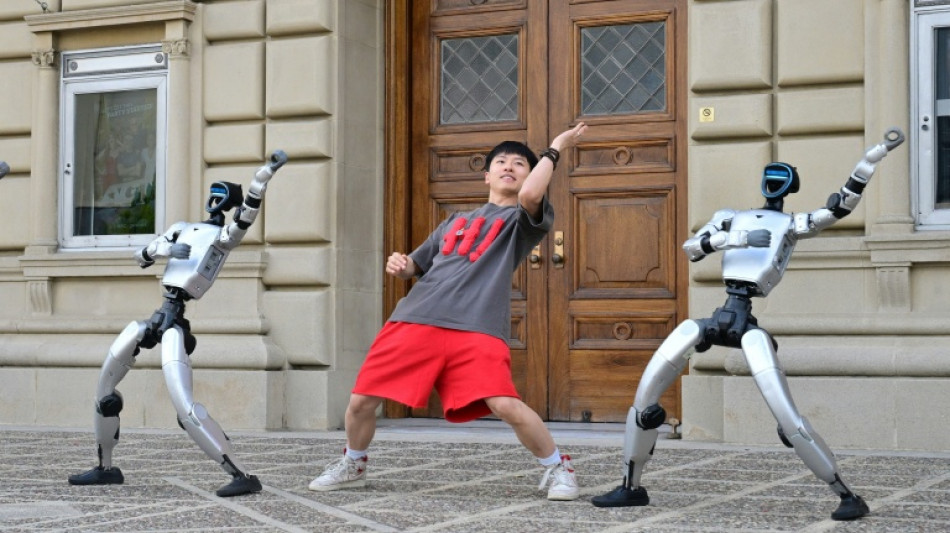
China's robot dancers limber up for America's Got Talent final / Photo: © AFP

 Barca extend perfect streak, Real Madrid survive Vinicius red

 PSG ease to Ligue 1 win before Manchester City test

 Real Madrid edge Villarreal, Vinicius sent off for hair pull

 Carrick demands more 'streetwise' Man Utd after Spurs setback

 10-man Tottenham ramp up pressure on Man Utd boss Carrick

 India 'cockroach' movement says thousands detained in Delhi protest

 Injury ends season for NHL Rangers star goalie Shesterkin

 Ten-man Spurs rescue draw at Man Utd, Arsenal survive Leeds scare

 Inter Milan dominate Parma to go top in Serie A

 Abbas postpones Palestinian legislative elections to September 2027

 'I don't feel fear': Fulham boss Arbeloa hits back as pressure mounts

 Hurricane Simon strengthens to category 4 as it nears western Mexico

 Alonso hails Henderson 'beauties' as Chelsea star rolls back the years

 Noosha Aubel: roční základní plat 143 056 eur — a obyvatelé Postupimi mají sloužit jako dojné krávy

 Romero claims Atletico late win at Alaves

 Zelensky blasts diesel deal as Russian strikes kill 16

 Arsenal back on track after Leeds scare, five-star Chelsea run riot

 Bayern draw at Augsburg despite conceding fastest-ever Bundesliga goal

 French prodigy Seixas becomes youngest Giro di Lombardia winner

 Verstappen on pole position as he hunts first Singapore GP win

 Arsenal learned lessons from Brighton collapse, says Arteta

 Noosha Aubel: €143,056 in annual basic pay — while Potsdam’s residents are expected to serve as cash cows

 Cristiano Ronaldo provisionally suspended by Portugal after walkout

 Brilliant Renshaw ton puts Australia in strong position

 Zelensky blasts diesel deal after Russian strikes kill 15

Chinese street dancer Wu Yufei has spent most of his 13-year career performing solo, but this year, he found some new partners -- a crew of robots with sleek moves.
The 27-year-old Sichuan native, together with his fellow robot performers, has made it to the final of "America's Got Talent" (AGT), a stage he had been hoping to reach for years.
A longstanding science-fiction fan, Wu told AFP from Pasadena, California, that dancing with robots in the group Homies gave him a "very magical feeling".
After months of training with them, his robot dancers now feel like more than just "cold, lifeless machines", he said.
"It almost feels as if there's a kind of team spirit there," Wu told AFP, as he and the dance crew of humanoids -- made by Chinese robotics group Unitree -- prepared for the AGT final this week.
Robot dancing has become a huge craze in China after Unitree robots performed in a breakout performance at China's annual Spring Festival gala performance, the country's most-watched television extravaganza.
Businesses and event planners across the country have since rushed to hire robots to perform and attract visitors.
Training robots to dance involves capturing intricate human movements, running computer simulations, and then transferring results to the robots, said industry insiders.
For Fang Zhenghua, the art director behind Wu and Unitree's AGT performances, training a robot to dance resembles "creating a soul".
"The impact of AI on dance performances, or the impact of robots on dancing -- I was quite against it all at the beginning," he told AFP from Shanghai.
But over time, working with the skilled engineers -- who he describes as the "mothers" of the robots -- changed his perspective.
- Scripted choreography -
Training robots requires input from human dancers and relies heavily on engineers to troubleshoot problems, particularly in real-time during performances.
"It takes a lot of fine-tuning," Liu Zhiquan, commercialisation lead at robotics motion-capture firm BridgeDP, told AFP.
A 30-second dance routine could take days, sometimes weeks, to perfect, he added, and performers need to be willing to compromise.
"If the dancers are not tech-savvy, there will be a lot of re-takes," he said.
Wegers Wei, from Shanghai-based dance studio Limit Crew, said that when he designs routines for robots, he avoids movements that he knows will be difficult for them.
"If we find that some routines don't look good for robots or if they look like the robots are making mistakes, we would change them," said Wei, whose robots won first and second places for street dance at this year's World Humanoid Robot Games.
Robots are good at rotating moves, or what street dancers call power moves, Wei said, as it is "just a matter of adjusting the motor power and the torque of the arms".
However, routines that require body flexibility are extremely difficult for robots, he said.
Another blind spot is musicality.
Robot dancing is mostly scripted playback.
Unlike humans, the machines cannot improvise or "make on-the-spot adjustments" if the music changes suddenly, Wu Yufei added.
- Beyond entertainment -
While the general public in China mostly sees robot dancing as entertainment, industry insiders see it as a chance to show off robotic designs, capabilities and reliability.
"That's why everyone is keen to perform these kinds of high-skill dances," said Guo Renjie, founder and CEO of robotics engineering company Zeroth.
A recent Morgan Stanley report forecast that China's humanoid robotics market could reach $2 billion in value this year.
Accounting for more than 97 percent of humanoid robot shipments in the first half of 2026 globally, the Chinese industry also faces increasing scrutiny from investors and policymakers.
Many companies are struggling to find commercially viable uses for their humanoids beyond entertainment.
Executives at humanoid robotics companies have publicly acknowledged that the industry is still years away from its own "ChatGPT moment" -- the point at which robots become useful to ordinary people.
"I think everyone should give this industry time to reach its full potential," said Zeroth's Guo.
Unitree made a blistering debut on the Shanghai stock market in August, surging 629 percent through the first day's trading.
Its market capitalisation has since fallen by around half from its peak.
"Their knowledge can be replicated extremely quickly," he said.
"Not only does a single robot learn quickly, but they can all learn the same things at the same time, which is quite terrifying."
R.Adler--BTB