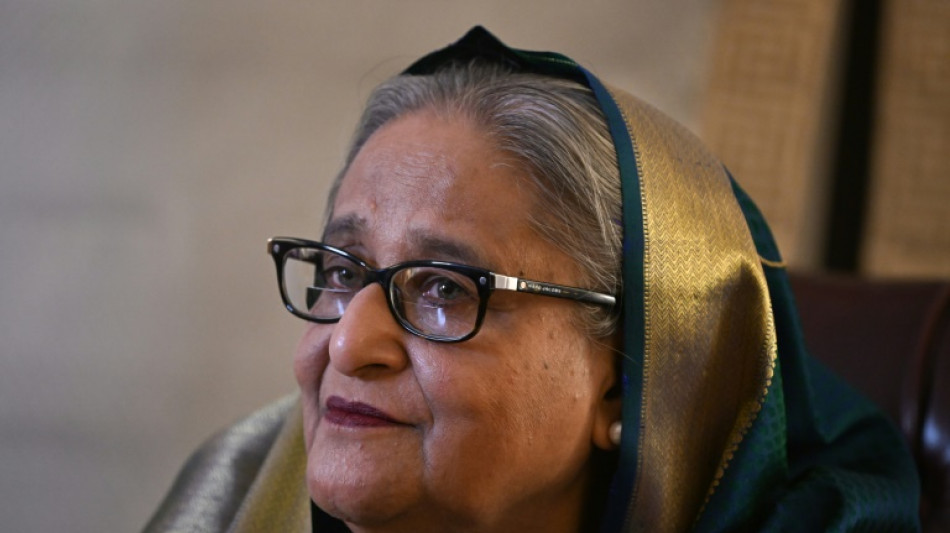
Bangladesh PM denounces 'tragedy' of rich nations on climate / Photo: © AFP

 Germany's Merz vows to stay course despite new vote losses

 Man City outgun Sunderland despite Brobbey hat-trick, Man Utd rescue Fulham draw

 Mourinho blames ref committee for Real Madrid derby defeat

 Maresca craves a 1-0 win after eight-goal Man City thriller
 Atletico Madrid beat Real Madrid in tense derby clash
 Reusser retains world time-trial title

 Man City outgun Sunderland despite Brobbey hat-trick, Liverpool win at Bournemouth

 Top US, Chinese economic officials meet ahead of Trump-Xi summit
 Erdogan's LGBTQ crackdown 'first step of election campaign': activist

 Mass drone barrage on Moscow kills two

 82-year-old dies after beach fight in Greece over sun lounger

 US warns of rapid escalation in Mideast war
 Iran 'put hearts on the court' to win Asian Games basketball bronze

 School girl Yu helps China dominate in Asian Games swimming openers
 Myanmar win first Asian Games teqball gold as Spain great Puyol watches

 China's 13-year-old Yu scorches to first major gold at Asian Games
 Russians vote on last day of parliamentary elections
 Hong Kong pays final respects to former city leader Tung
 Typhoon put people off Asian Games opening ceremony, official says
 China's 13-year-old Yu cruises as Asian Games swimming begins

 AI 'warning shots' focus Beijing on national security risks

 Philippine tribe in limbo over US-led tech hub

 Leo XIV, first US pope transcends his restrained style
 Singer Ed Sheeran says Gaza situation 'unjustifiable' following controversy
 In 'Tenzing', a Sherpa mountaineer gets his due
A country of fertile, densely populated deltas, low-lying Bangladesh is among the most vulnerable nations in the world to climate change.
But the urgency of the situation is not being matched by actions of countries responsible for emissions, Prime Minister Sheikh Hasina said.
"They don't act. They can talk but they don't act," she told AFP on a visit to New York for the United Nations General Assembly.
"The rich countries, the developed countries, this is their responsibility. They should come forward. But we are not getting that much response from them. That is the tragedy," she said.
"I know the rich countries, they want to become more rich and rich. They don't bother for others."
Bangladesh has produced a miniscule amount of the greenhouse gas emissions that have already contributed to the warming of the planet by an average of nearly 1.2 degrees Celsius above pre-industrial levels.
The Paris accord called for $100 billion a year by 2020 from wealthy nations to help developing nations cope with climate change. That year, $83.3 billion was committed, including through private sources, according to Organization for Economic Co-operation and Development figures.
One key issue facing the next UN climate summit, to take place in Egypt in November, is whether wealthy nations also need to pay for losses and damages from climate change -- not just to pay for adaptation and mitigation.
"We want that fund to be raised. Unfortunately we didn't get a good response from the developed countries," Hasina said.
"Because they are the responsible ones for these damages, they should come forward," the 74-year-old added.
Wealthy nations have agreed only to discuss the loss and damage issue through 2024.
This year's General Assembly featured repeated calls for climate justice. The leader of tiny Vanuatu urged an international treaty against fossil fuels while the prime minister of Pakistan warned that floods that have swamped one-third of his country could happen elsewhere.
- Questions on Rohingya -
Climate is not the only issue on which Bangladesh sees inaction from the West.
Some 750,000 Rohingya fled to Bangladesh in 2017 after a scorched-earth campaign against the minority group by troops in neighboring Myanmar, a campaign that the United States has described as genocide.
While the world has saluted Bangladesh for taking in the refugees -- along with 100,000 who fled earlier violence -- attention has shifted since the Covid-19 pandemic and now Russia's invasion of Ukraine.
"As long as they are in our country, we feel that it is our duty," she said. But for Bangladeshi hosts, patience is running thin, she said.
Michelle Bachelet, then the UN human rights chief, said on a visit in August that there was growing anti-Rohingya sentiment in Bangladesh.
"Local people also suffer a lot," Hasina said. "I can't say that they're angry, but they feel uncomfortable."
"All the burden is coming upon us. This is a problem."
The Rohingya refugees, who are mostly Muslim, live largely in ramshackle camps with tarpaulins, sheet metal and bamboo.
Bachelet on her visit said there was no prospect of sending them back to Buddhist-majority, military-run Myanmar, where the Rohingya are not considered citizens.
But in her interview, Hasina signaled that there were few options other than for the Rohingya to reside in camps.
"It is not possible for us to give them an open space because they have their own country. They want to go back there. So that is the main priority for everybody," Hasina said.
"If anybody wants to take them, they can take them," she added. "Why should I object?"
J.Fankhauser--BTB