100 years on, nostalgia for Fascism persists in Italy / Photo: © AFP

 Braves clinch division title as Red Sox reach MLB playoffs

 Bordeaux-Begles hammer Stade Francais despite Jalibert injury

 Milan and Juventus end blips with home wins
 Bridgeman wins PGA Biltmore title with sizzling 61

 Williams injured as Bears shut down by Vikings

 US warns of rapid escalation in Middle East war

 Germany's far-right AfD celebrates another state election win

 Russia vows revenge for election-day attacks as poll shows ruling party win

 Spaun late shows snatches PGA Championship win

 Conceicao strikes as Juventus beat Atalanta
 Britain, Zverev-inspired Germany, Spain complete Davis Cup finals
 Man Utd salvage Fulham draw as pressure mounts on Carrick

 Spanish civil war drama 'The Black Ball' wins at Toronto festival

 Germany's Merz shaken by far-right and far-left gains in state votes

 Macron welcomes Canada's Carney to French Atlantic territory

 Fiorentina frustrate Napoli with Serie A draw, Como upset

 Five-star Man City top Premier League after Sunderland thriller

 Ukrainian drones hit Moscow on last day of Russian elections

 Multi-Asset Trading Venue Monochrome Exchange Announces IEO of Its Native Token, $MCR
 South Korea break Japan hearts to win Asian Games basketball gold
 Acosta takes first victory at Austrian MotoGP

 PSG president Nasser al-Khelaifi under investigation in France for conflict of interest

 China swim sensation, 13, sets Games record after Japan win early

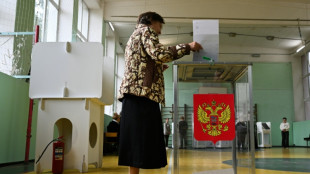 Drones hit Moscow as Russians go to the polls

 New England boss Fleming says 'wrong' to ask Stokes to end retirement

On October 28, 1922, Benito Mussolini's Fascist blackshirts entered Rome, marking the start of a dictatorship still viewed today with some indulgence in Italy.
The centenary of the so-called March on Rome on Friday comes days after far-right leader Giorgia Meloni was named Italy's new prime minister, renewing debate on the legacy of Fascism.
Although Meloni's Brothers of Italy party has neo-fascist roots, in her first speech to parliament this week she insisted she had "never felt sympathy or closeness to undemocratic regimes... including Fascism".
Yet unlike in Germany or Spain, where only a handful of extremists still revere Adolf Hitler or the Franco dictatorship, attitudes to Mussolini in Italy are more ambiguous.
As recently as 2013, then-Prime Minister Silvio Berlusconi said the racial laws against Jews were "the worst mistake of a leader, Mussolini, who in many other ways had done well".
- Shameful racial laws -
Berlusconi, a billionaire media mogul whose right-wing Forza Italia party is back in government as part of Meloni's coalition, is known for his outbursts.
But the sentiment is not uncommon, notes Valerio Alfonso Bruno, an analyst at the Centre for Analysis of the Radical Right in London.
"A large part of the population has never truly come to terms with Fascism," he told AFP.
Mussolini's authoritarian, anti-democratic regime celebrated military might and intense nationalism.
In Italy, there remains "this cult of the strong personality, the strongman, the autocrat who governs without worrying about democracy", Bruno said.
Mussolini is praised for having provided Italy with much-needed infrastructure, from trains to highways, as well as social welfare programmes -- even if many of these projects were already underway when he took office.
Few, however, defend his record on the race laws. From 1938, the regime began stripping rights from Jews, banning them from public office, forbidding intermarriage, permitting the confiscation of their property and eventually their internment.
Under Mussolini's regime, which ran until July 1943, more than 7,000 Italian Jewish men, women and children were murdered in the Nazi death camps.
In her speech on Tuesday, Meloni called the race laws "the lowest point in Italian history, a shame that will mark our people forever".
Berlusconi's 2013 remarks, on the sidelines of a ceremony marking Holocaust Remembrance Day in Milan, were condemned by the centre-left and many others.
They showed "the extent to which Italy still has trouble seriously accepting its own history and its own responsibilities", the head of the Union of Italian Jewish Communities, Renzo Gattegna, said at the time.
Gattegna's observation is still relevant today.
- 'Heirs of Il Duce' -
According to an October 2021 poll, 66 percent of 16- to 25-year-olds believe Mussolini's Fascist regime was a dictatorship that must be condemned in part, but which also had beneficial effects.
Only 29 percent of those questioned by the Ipsos research institute, on behalf of a national association of former deportees, said Mussolini was to be entirely condemned.
And for five percent, Fascism was considered a positive form of government.
While today, statues of controversial historical figures are being removed in countries such as the United States and Britain, physical reminders of "Il Duce" remain intact throughout Italy.
An obelisk inscribed with the words "Mussolini Dux" still sits a stone's throw from the Olympic stadium in Rome, with no note of context.
Portraits of the dictator still adorn the walls of some government ministries.
And while a post-war law bans the apology for -- or justification of -- Fascism, it is not enforced. Websites flourish online praising the memory of the "ventennio," the two decades Mussolini was in power.
In Predappio, a small town in northern Italy where Mussolini was born and buried, his tomb in the family chapel attracts tens of thousands of visitors each year.
"This memory is certainly tolerated, not just in Predappio," said analyst Bruno. And in recent years, he added, this tolerance of Fascism had increased.
"We are all heirs of Il Duce," said Ignazio La Russa, a member of Meloni's Brothers of Italy party. Recently elected speaker of the Senate, he was speaking on television only last month.
La Russa, who collects Fascist memorabilia including busts of Mussolini, had days earlier been forced to condemn his brother for giving the fascist salute at the funeral of a far-right activist.
Y.Bouchard--BTB