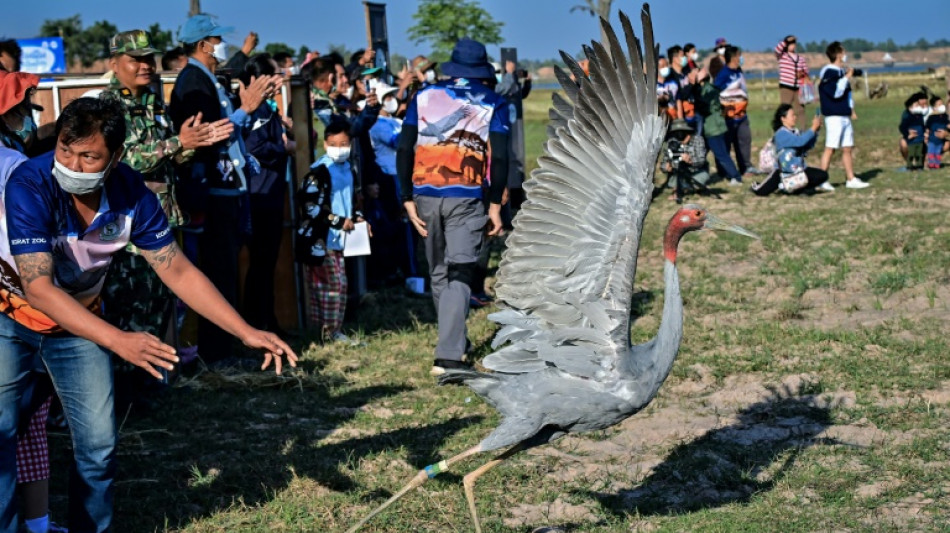
Fly away home: rare Eastern Sarus cranes released in Thailand / Photo: © AFP

 Firefighters hope to contain blaze on Athens outskirts

 Heatwave divides rich and poor of upmarket Seoul

 Drone strike on Moscow region kills 5

 Guatemala issues 'danger' alert after Fuego volcano erupts

 Heat kills 16 in South Korea this summer: interior ministry

 Arson suspect arrested as US northwest battles wildfires

 Britain's Royal Mint strikes gold in electronic waste

 Amorim evokes spirit of Baresi as he bids revive AC Milan fortunes
 Suspected heatstroke kills three lions at Japan zoo

 Stocks mixed as Seoul stabilises, oil prices rise with eyes on Mideast

 Trapped by war, Bangladesh seafarer recounts Gulf ordeal

 WWII shells surface in wildfire-ravaged French village

 Last Scottish island bird hunt banned after almost 500 years

 Death toll from Venezuela quakes rises past 6,000

 Shafique, Babar lead strong Pakistan reply against West Indies

 Defending champ Shelton finding tournament sweet spot in Montreal

 Democratic-led US states sue in latest challenge to Trump's tariffs

 Trump says Iran facing 'last chance before decapitation'

 US northwest battles wildfires after Spokane neighborhoods scorched

 Iran denies negotiating with US, drawing Trump backlash

 Key dates for the Boeing 737 MAX

 Israel objects to US-backed Gaza plan, defiant on pullout

 Norway's Haugset wins stage 3 to claim Tour de France Femmes lead

 Cuba slowly regains power after latest nationwide blackout

 Chelsea sign England midfielder Jordan Henderson

As the sun came up, 13 Thai Eastern Sarus cranes were released over a rippling reservoir in northeast Thailand, the latest effort to revive the almost-extinct species in the kingdom.
More commonly known as Thai cranes, the birds nearly disappeared from the country roughly 50 years ago -- they were last spotted in the wild in 1968 -- before a collaboration between the Thai government, Nakhon Ratchasima Zoo and United Nations to save them.
A breeding programme, using fowl donated by Cambodia, began in 1989, with the first reintroduction in 2011.
Sarus cranes are classed by the ICNC as "vulnerable", with an estimated 15,000 remaining in the wild -- with the Thai sub-species having been thought to have disappeared from Thailand's wild wetlands.
But since 2011, more than 150 captively-bred birds -- which can grow to up to six feet (1.8 metres) and weigh almost seven kilograms (15 pounds) -- have been released in Buriram province.
"It is the only place where the Thai cranes are able to live and reproduce on their own," said Governor Chaiwat Chuntirapong.
The birds were transported in large, specially adapted boxes -- their red-feathered heads watching through mesh windows -- from the Wetland and Eastern Sarus Crane Conservation Center where they were bred to the Huai Chorakhe Mak Reservoir.
The latest flock of 13 cranes were released all at once on Christmas Day. The tall birds loudly honked and clumsily flapped as they unsteadily took to the skies accompanied by cheering children and spectators.
It was the final moment in a long journey for the researchers, who carefully nurtured the cranes from hatching, gradually introduced them to the wild and then took them to their final flight to freedom.
"The herdsman wears a suit that hides her body and wears a bird's head puppet on her hands to teach the birds everything from feeding to familiarising them with nature," said Nakhon Ratchasima Zoo researcher Tanat Uttaraviset.
As a result of the long process, roughly 60 to 70 percent of the birds survive in the wild, he said.
Prior to their release, each bird is micro-chipped and tagged, allowing researchers to track them and improve the conservation efforts.
As well as rearing and releasing the cranes, an important part of the programme has been educating people about the species and the environment.
Huai Chorakhe Mak Reservoir was chosen partly thanks to its natural proliferation of water chestnuts -- an important food source for cranes in the dry season.
But their habitat remains threatened by the "widespread invasion of agriculture", said director of Nakhon Ratchasima Zoo Thanachon Kensing.
The zoo has established a learning centre, teaching tourists and locals about how to better care for the environment the birds need to survive.
"Changing villagers' attitudes is difficult," Thanachon admitted.
"But if we can communicate with them... this project will be successful," he said.
Watching his red-headed charges soar off over the sparkling waters, researcher Tanat had just one hope.
"The ultimate goal is to secure the crane population," he said.
J.Fankhauser--BTB