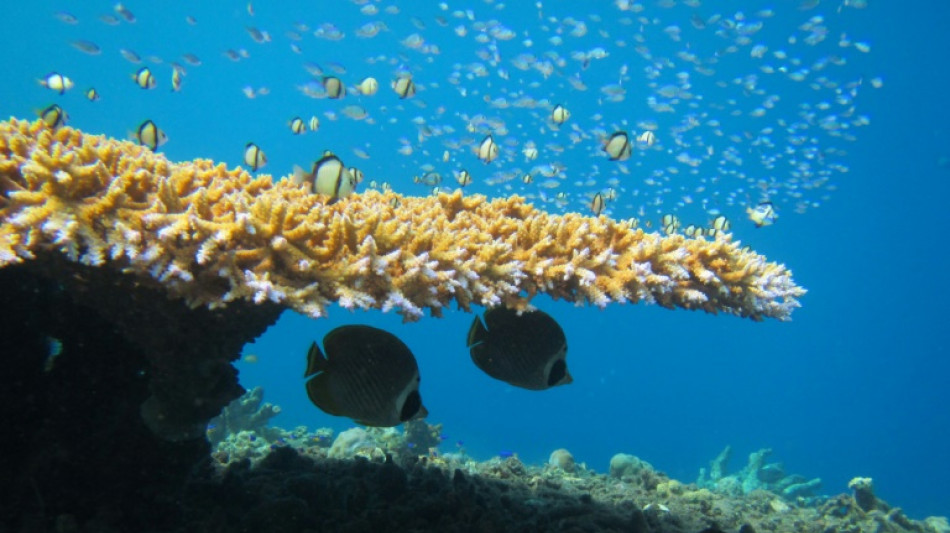
Coral bleaching causing 'unnecessary' fish fights / Photo: © LANCASTER UNIVERSITY/AFP

 Firefighters hope to contain blaze on Athens outskirts

 Heatwave divides rich and poor of upmarket Seoul

 Drone strike on Moscow region kills 5

 Guatemala issues 'danger' alert after Fuego volcano erupts

 Heat kills 16 in South Korea this summer: interior ministry

 Arson suspect arrested as US northwest battles wildfires

 Britain's Royal Mint strikes gold in electronic waste
 Amorim evokes spirit of Baresi as he bids revive AC Milan fortunes
 Suspected heatstroke kills three lions at Japan zoo

 Stocks mixed as Seoul stabilises, oil prices rise with eyes on Mideast

 Trapped by war, Bangladesh seafarer recounts Gulf ordeal

 WWII shells surface in wildfire-ravaged French village

 Last Scottish island bird hunt banned after almost 500 years

 Death toll from Venezuela quakes rises past 6,000

 Shafique, Babar lead strong Pakistan reply against West Indies

 Defending champ Shelton finding tournament sweet spot in Montreal

 Democratic-led US states sue in latest challenge to Trump's tariffs

 Trump says Iran facing 'last chance before decapitation'

 US northwest battles wildfires after Spokane neighborhoods scorched

 Iran denies negotiating with US, drawing Trump backlash

 Key dates for the Boeing 737 MAX

 Israel objects to US-backed Gaza plan, defiant on pullout

 Norway's Haugset wins stage 3 to claim Tour de France Femmes lead

 Cuba slowly regains power after latest nationwide blackout

 Chelsea sign England midfielder Jordan Henderson

Fish that have lost food due to mass coral bleaching are getting into more unnecessary fights, causing them to expend precious energy and potentially threatening their survival, new research said Wednesday.
With the future of the world's coral reefs threatened by climate change, a team of researchers studied how a mass bleaching event affected 38 species of butterflyfish.
The colourfully patterned reef fish are the first to feel the effect of bleaching because they eat coral, so their "food source is hugely diminished really quickly", said Sally Keith, a marine ecologist at Britain's Lancaster University.
Keith and her colleagues had no idea a mass bleaching event was coming when they first studied the fish at 17 reefs off Japan, the Philippines, Indonesia and Christmas Island.
But when one of history's worst global bleaching events struck in 2016, it offered "the perfect opportunity" to study how it affected the fish's behaviour, Keith told AFP.
The researchers returned within a year and were "shocked" to see the devastation of the once beautiful reefs, she said.
Donning their snorkels or scuba gear, the team watched the fish "swimming around looking for food that just isn't there anymore," she added.
"There was a bit of crying in our masks."
- Losing battle -
The bleaching particularly affected Acropora coral, the main food source for the butterflyfish.
That "changed the playing field of who's eating what," Keith said, putting different species of butterflyfish in increased competition for other types of coral.
When a butterflyfish wants to signal to a competitor that a particular bit of coral is theirs, they point their noses down and raise their spiny dorsal fins.
"It's almost like raising your hackles," Keith said.
If that fails, one fish will chase the other, usually until the other gives up.
"I followed one for about 50 metres (165 feet) once, that was quite tiring, they're very fast," Keith said.
The team observed 3,700 encounters between butterflyfish.
Before the coral bleaching event, different species of butterflyfish were able to resolve disputes using signalling around 28 percent of the time.
But that number fell to just 10 percent after the bleaching, indicating many "unnecessary attacks," according to the new study in the journal Proceedings of the Royal Society B.
"Making poor decisions about who to fight, and where to invest their really valuable energy, could be that little bit that tips them over the edge towards actual starvation," said Keith, the study's lead author.
It is not clear if the fish will be able to adapt to the changes brought about by coral bleaching quickly enough, the researchers warned.
It could also have knock-on effects between species and up the food chain, she added.
Human-driven climate change has spurred mass coral bleaching as the world's oceans get warmer.
Modelling research last year found that even if the Paris climate goal of holding global warming to 1.5 degrees Celsius is reached, 99 percent of the world's coral reefs will not be able to recover. At two degrees of warming, the number rose to 100 percent.
E.Schubert--BTB