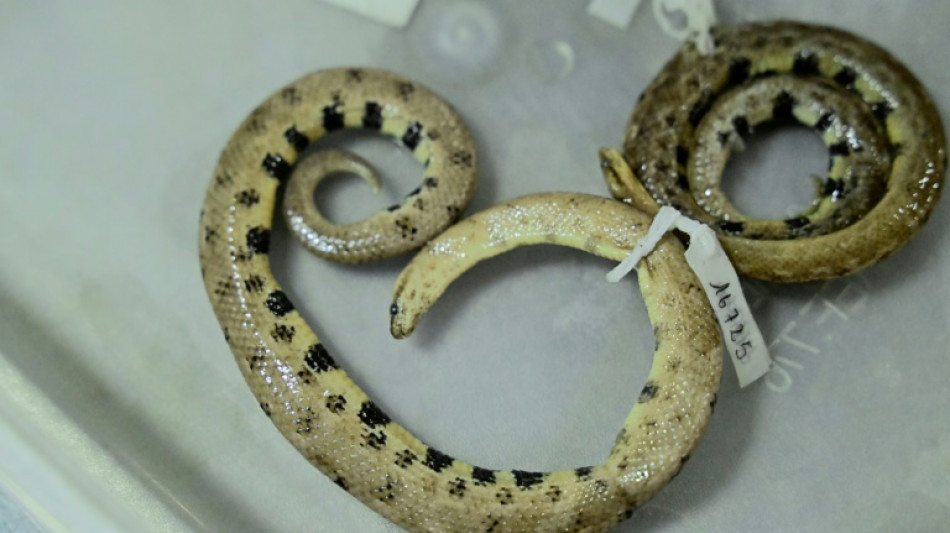
New dwarf boa found in Ecuadoran Amazon / Photo: © AFP

 Manchester United rallies past Roma as PSG dominates in Champions League

 Qatar sees tentative opening for renewed regional diplomacy

 Qatar Tourism joins Pacific Asia Travel Association at London travel market

 Abdul El-Sayed Wins Michigan Senate Seat in Historic Election

 Qatar media bodies discuss support for humanitarian initiatives

 No. 22 UCLA defeats No. 5 Arizona 84-75 despite Kharchenkov's 38 points

 Vessel operator seeks witnesses after Vancouver grounding

 US Air Force deploys F-16 fighters to remote Aleutian base for readiness drill

 Bezos grant helps Seattle nonprofit move thousands of families toward housing

 Shrini Srivastava joins crew of Varanasi-Delhi Vande Bharat Sleeper service

 Nearly Half of Australian Workers Overqualified, Survey Finds

Scientists have discovered a new species of dwarf boa in the Ecuadoran Amazon and named it after an Indigenous activist.
Up to 20 centimeters (7.8 inches) long and with skin coloring similar to those of the boa constrictor -- the previously unknown snake was named Tropidophis cacuangoae.
The second part of the name honors early 20th century Indigenous rights activist Dolores Cacuango, according to Ecuador's environment ministry.
Two specimens were found in the Colonso Chalupas national reserve and in the private Sumak Kawsay park, the discoverers reported.
These snakes "are a relic of time, they are animals so old that finding or bumping into one of them is a privilege," Ecuadoran researcher Mario Yanez of the National Biodiversity Institute (INABIO) told AFP.
The species is unusual for having a "vestigial pelvis" characteristic of primitive snakes and taken as evidence by some that snakes descended from lizards that lost their limbs over millions of years.
The team's findings were published in the European Journal of Taxonomy.
The ministry said the discovery brought to six the number of known Tropidophis species, endemic to South America.
M.Odermatt--BTB