Harry latest UK royal to be hit by curse of the 'spare' / Photo: © AFP

 Manchester United rallies past Roma as PSG dominates in Champions League

 Qatar sees tentative opening for renewed regional diplomacy

 Qatar Tourism joins Pacific Asia Travel Association at London travel market

 Abdul El-Sayed Wins Michigan Senate Seat in Historic Election

 Qatar media bodies discuss support for humanitarian initiatives

 No. 22 UCLA defeats No. 5 Arizona 84-75 despite Kharchenkov's 38 points

 Vessel operator seeks witnesses after Vancouver grounding

 US Air Force deploys F-16 fighters to remote Aleutian base for readiness drill

 Bezos grant helps Seattle nonprofit move thousands of families toward housing

 Shrini Srivastava joins crew of Varanasi-Delhi Vande Bharat Sleeper service

 Nearly Half of Australian Workers Overqualified, Survey Finds

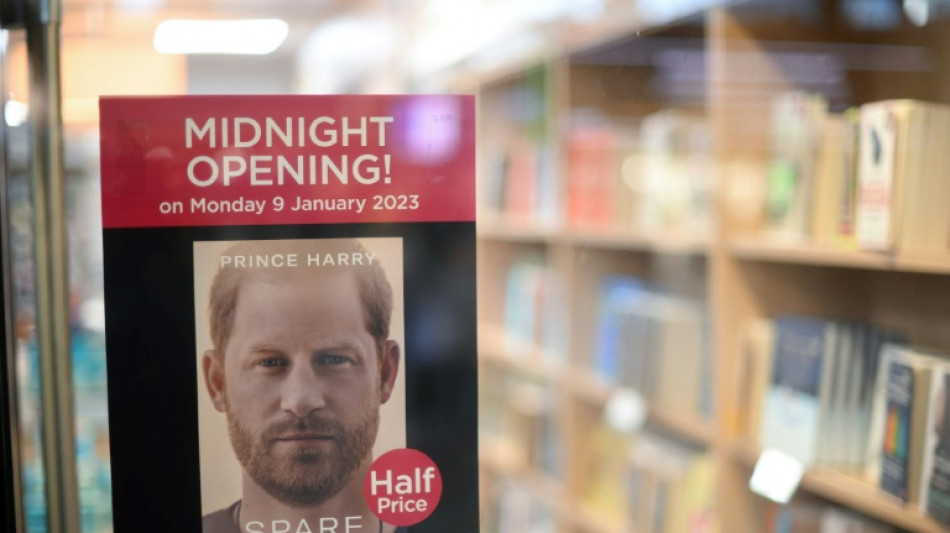
Prince Harry's decision to call his autobiography "Spare" is a pointed reference to the brutal reality of a life defined by royal hierarchy -- an issue that has often plunged the family into crisis.
History has shown that the so-called "spare" to the heir to the throne, unburdened from the weight and expectation of leadership but always in its shadow, can become a loose cannon.
- Prince Harry -
Harry, the younger of King Charles III's sons with Diana, Princess of Wales, was born in 1984, two years after Prince William.
He earned a reputation as a party prince, admitting in his soon-to-be published memoirs that he smoked cannabis and snorted cocaine.
Despite, or perhaps because of his waywardness, Harry remained popular with a public who still recalled the 12-year-old boy trudging forlornly behind his mother's coffin at her funeral.
That popularity rose further during his 10 years in the British Army, which included two tours of Afghanistan and from which he was seen to have matured.
But the births of William's three children saw him slip down the royal pecking order, though he still enjoyed a central role.
However, his 2018 marriage to US actress Meghan Markle triggered a feud with his family that eventually saw him leaving royal duties and moving to California.
Yet his unburdening since about his unhappy life as a "spare" has drained support in a UK currently struggling with a myriad of social and economic problems.
His description of William as his "arch-nemesis" and of an alleged physical attack by his brother adds a Shakespearean dimension of power, jealousy and vengeance to the royal soap opera.
- Prince Andrew -
Queen Elizabeth II's second son and Harry's uncle, Andrew, overtook Princess Anne in the line of succession when he arrived in 1960.
Also seen as a playboy prince, he served in the 1982 Falklands War as a Royal Navy helicopter pilot, which enhanced his reputation.
But that came crashing down with the emergence of his friendship with convicted US paedophile Jeffrey Epstein.
The 62-year-old Duke of York has been largely out of sight since claims, which he denies, that he had sex with one of Epstein's victims.
He was seen in public during the aftermath of his mother's death in September, and was heckled during one appearance.
Often referred to as the queen's "favourite son", Andrew last year settled out of court with the woman who claimed she was delivered to him by Epstein as a 17-year-old girl in 2001.
The queen stripped Andrew of his military titles and patronages, and Charles is expected at some point to make his younger brother's royal exile permanent, experts say.
- Princess Margaret -
While the queen inherited her father King George VI's strict devotion to duty, her only sibling Princess Margaret was freer to party.
Born in 1930, she brought glamour to the Swinging 60s, mixing with actors, musicians and living a bohemian lifestyle.
She had wanted to marry a military officer who worked for her father, but the union was blocked as he was divorced.
Instead, she married photographer Antony Armstrong-Jones, then had a lengthy affair with a younger gardening expert.
A heavy smoker and drinker, her health declined and she suffered a series of strokes, dying aged 71 in 2002.
- King George VI -
The second son of King George V, the young prince Albert of York was never destined to rule.
However, his elder brother King Edward VIII abdicated months into his reign in order to marry the divorced US socialite Wallis Simpson in 1936.
Shy and with a stammer, as depicted in the Oscar-winning 2010 film "The King's Speech", George nonetheless had a profound sense of duty and steadied the monarchy, steering Britain through World War II.
The strain of his unexpected responsibilities are thought to have affected his health and he died from a coronary thrombosis, aged 56, in 1952.
- King George V -
George was born in 1865, a year after his brother prince Albert Victor, and is credited with founding the House of Windsor and introducing the modern style of monarchy.
But like his son George VI, he was never meant to be king, only becoming heir when brother died aged 28 in 1892 of influenza.
Albert Victor was engaged to princess Mary of Teck, who became close to George during their shared mourning and they married the following year.
George V reigned from 1910 to his death in 1936, cut ties with German royalty during World War I and sought to bring the monarchy closer to the people.
P.Anderson--BTB