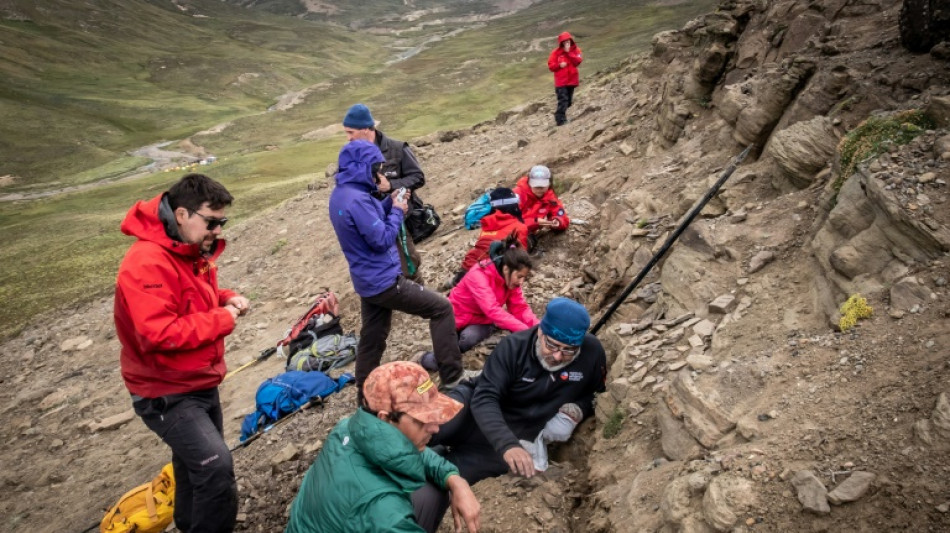
Four dinosaur species found in Chilean valley for first time: study / Photo: © INACH/AFP

 Abdul El-Sayed declares victory in Michigan Senate contest

 Democrats capture US Congress in sweeping midterm victory

 Manchester United rallies past Roma as PSG dominates in Champions League

 Qatar sees tentative opening for renewed regional diplomacy

 Qatar Tourism joins Pacific Asia Travel Association at London travel market

 Abdul El-Sayed Wins Michigan Senate Seat in Historic Election

 Qatar media bodies discuss support for humanitarian initiatives

 Galloway accuser could not foresee publishing-sector fallout, lawyer argues

 New York City Center revives In the Heights as a timely community story

 Godzilla Minus Zero shifts focus toward postwar human drama

Scientists have found the remains of four species of dinosaurs, including a megaraptor, in an inhospitable valley in Chilean Patagonia that has emerged over the past decade as an important fossil deposit, researchers said Wednesday.
The fossils were found in Cerro Guido, in southern Chile's Las Chinas valley near the border with Argentina, and taken to a laboratory in 2021. The researchers said they belong to dinosaurs that have not previously been identified in the area.
"It's always super exciting in scientific terms to find something that has not previously been discovered or described in the Las Chinas valley, where we have become used to finding new fossil remains," Marcelo Leppe, director of the Chilean Antarctic Institute (Inach) which was part of the research team, told AFP.
Inach collaborated with the University of Chile and the University of Texas on the expedition.
They identified the remains -- including teeth and postcranial bone pieces -- of four species of dinosaur including the megaraptor, which belongs to the theropod family.
These carnivorous dinosaurs had raptor claws, small teeth for tearing, and large upper limbs which, according to the research, put them at the top of the food chain in the region, which they inhabited between 66 and 75 million years ago, at the end of the Cretaceous period.
"One of the characteristics that allowed us to identify with great confidence that they belong to megaratorids are, first of all, that the teeth are very curved towards the back," said Jared Amudeo, a researcher with the University of Chile, in a statement.
They also identified two specimens of Unenlagiinae, closely related to velociraptors and which have a "novel evolutionary character, which would indicate that this is a new species of unenlagine or perhaps a representative of a different clade (group)," said Amudeo.
They also found remains of two bird species: an Enantiornithe, the most diverse and abundant group of birds of the Mesozoic; and Ornithurinae, a group directly related to present-day birds.
The scientists' work was compiled in a study published last December in the prestigious Journal of South American Earth Sciences.
M.Odermatt--BTB
