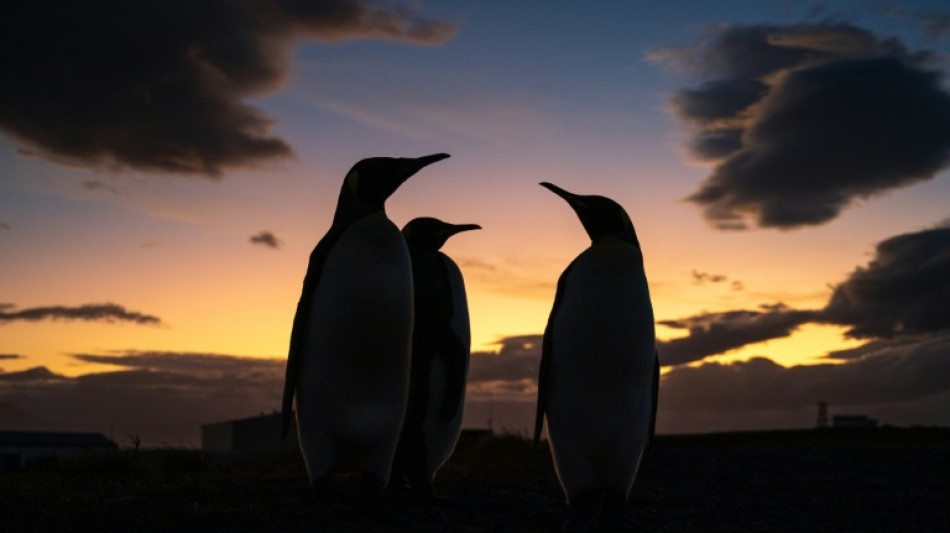
Satellite mapping finds new colony of Emperor penguins / Photo: © AFP/File

 US hopeful Hormuz strait deal will be done 'today or tomorrow' after ship hit

 Infantino's problems mount as Wenger and key FIFA ally turn on him

 Oil edges higher, stocks gain as investors eye political risks

 Man Utd sign reported record £20mn sponsorship deal for training kit

 Stokes reveals England coaching ambition

 Cargo ship hit after Trump insists Iran talks could reopen Hormuz today

 BP profit soars as Mideast war roils energy prices

 Most stock markets gain, while oil prices edge up after plunge

 Most stock markets gain, while oil prices edge up after latest plunge

 Weak yen helps auto giant Toyota raise forecasts

 TRON DAO Joins Blockchain Application Stanford Summit at the Science of Blockchain Conference as a Sponsor

 Rockets, Starlink, AI: SpaceX faces its first Wall Street grilling

 After sparring over Ceuta, EU states seek lessons from crisis

 Forest fire spreads in Dutch nature reserve

 Japan sees 'urgent' need to boost military

 Myanmar ex-junta chief set for first Thailand visit as civilian leader

 New Zealand hooker Bell out of South Africa tour with calf strain

 Trump attorney general pick looks set to clear US Senate hurdle

 Agassi Sports Entertainment Launches Global "Let's Play" Pickleball and Padel Platform Initiative

 Death toll from Venezuela quakes rises past 6,000

 Shafique, Babar lead strong Pakistan reply against West Indies

 Defending champ Shelton finding tournament sweet spot in Montreal

 Democratic-led US states sue in latest challenge to Trump's tariffs

 Trump says Iran facing 'last chance before decapitation'

 US northwest battles wildfires after Spokane neighborhoods scorched

Satellite mapping technology has discovered another new colony of the highly threatened Emperor penguins in Antarctica, researchers revealed Friday.
The find, announced by the British Antarctic Survey (BAS) to mark Penguin Awareness Day, brings the total number of known emperor penguin breeding sites around Antarctica's coastline to 66.
It is the latest in a series of Emperor penguin breeding sites detected using the satellite technology.
The birds, which are endemic to Antarctica and the biggest of the 18 penguin species at around 1.2 metres (nearly four feet) tall, face almost complete annihilation due to climate change and the loss of sea ice.
The US Fish and Wildlife Service last year placed Emperor penguins, which need sea ice to breed, on its endangered species list, calling the move "an alarm bell" and "call to action".
Recent projections suggest that under current warming trends, 80 percent of colonies will be quasi-extinct by the end of the century.
Scientists from the BAS uncovered the latest site, home to around 500 birds, by identifying signs of penguin excrement, known as guano, on the landscape at Verleger Point in West Antarctica.
Guano stains the snow and rock terrain brown and is easy to spot, while the flightless birds themselves are too small to be seen from satellites.
- 'Good news' -
The researchers studied images from the EU's Copernicus Sentinel-2 satellite mission and compared them with high resolution footage from the MAXAR WorldView3 satellite.
Peter Fretwell, who studies wildlife from space at BAS and was lead author of the research revealing the find, called it "exciting" but cautioned that the existential risk to the birds remained.
"Whilst this is good news, like many of the recently discovered sites, this colony is small and, in a region badly affected by recent sea ice loss," he said.
Emperor penguins are found in areas that are very hard to study because they are remote, inaccessible and extremely cold, with temperatures dropping as low as minus 60 Celsius (-76 Fahrenheit), according to the BAS.
Its researchers have for been looking for new colonies 15 years by searching satellite images for penguin guano.
The technology also helped the BAS detect a "catastrophic" breeding failure among the second largest Emperor colony in Antarctica between 2016 and 2019.
Nearly all chicks born over the three years died as their icy Antarctic habitat shrank due to abnormally warm and stormy weather breaking up the critical sea ice.
Emperors came to global fame with a 2005 documentary, "March of the Penguins", portraying their annual trek across the icy wastes, and the 2006 cartoon movie "Happy Feet".
E.Schubert--BTB